THE THREE FUNDAMENTAL STATES OF IMAAN - Introduction
Go to Homepage
بِسۡمِ اللهِ الرَّحۡمٰنِ الرَّحِيۡمِ
In the Name of Allâh, the Most Gracious, the Most Merciful.ⓘ
All praise belongs to Allah alone, and may He exalt our Last Prophet Muhammad ﷺ, bless him and his family, Companions, and all who follow him rightly until the Last Hour.
An introduction to the three fundamental states of Īmān: what makes a person a Muslim, what takes a person out of Islām, and what leads to salvation. A clear explanation based on the Qur’ān and authentic Sunnah to help every Muslim understand the reality of true faith.
Published: March 25, 2026
Last Update: March 31, 2026
Category: muhammadur-rasulullah
بِسۡمِ اللهِ الرَّحۡمٰنِ الرَّحِيۡمِ
In the Name of Allâh, the Most Gracious, the Most Merciful.
All praise belongs to Allah alone, and may He exalt our Last Prophet Muhammad ﷺ, bless him and his family, Companions, and all who follow him rightly until the Last Hour.
You are reading link-31 online.
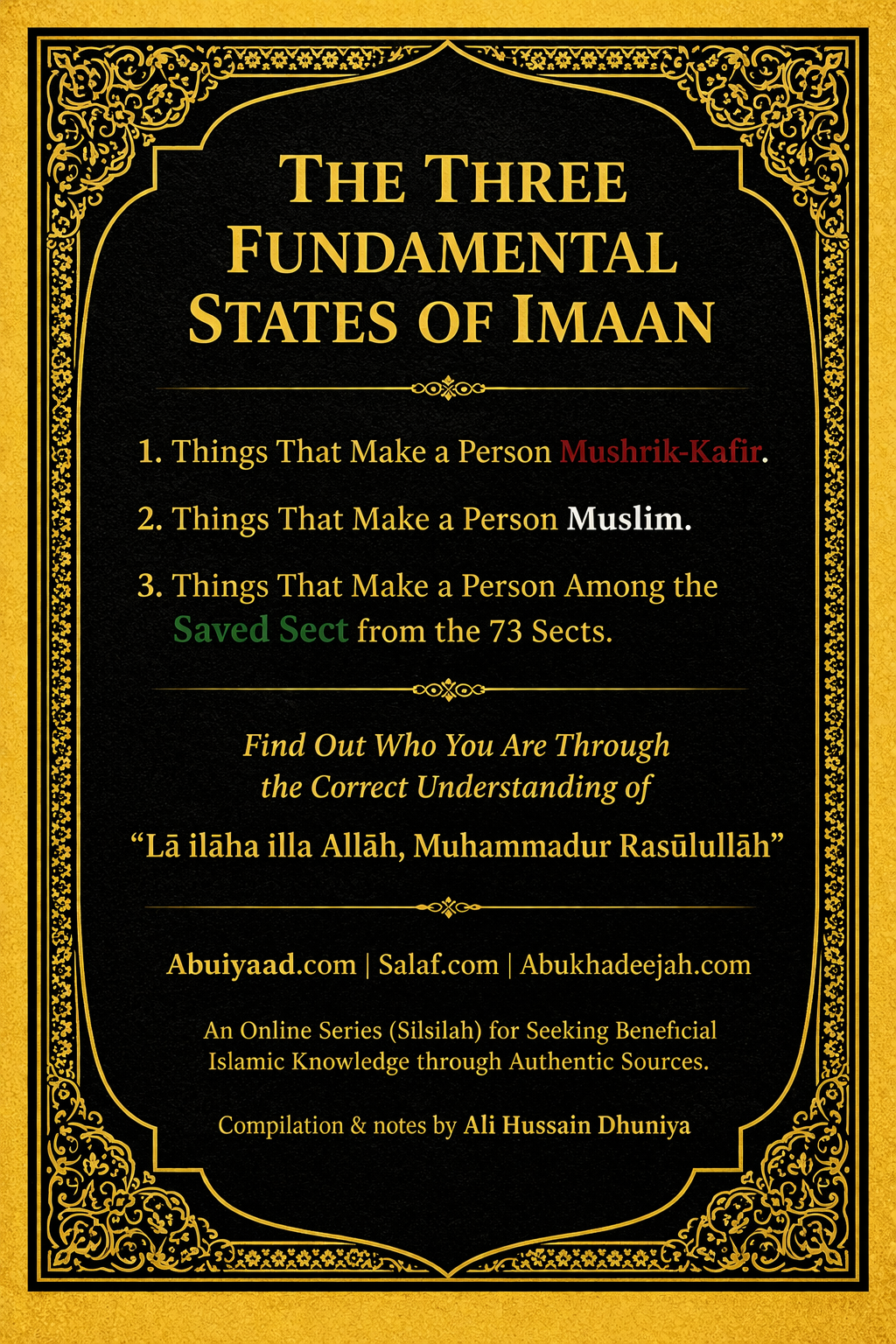
THE THREE FUNDAMENTAL STATES OF IMAAN
- Things That Make a Person Mushrik-Kafir.
- Things That Make a Person Muslim.
- Things That Make a Person Among the Saved Sect from the 73 Sects.
Detailed Explanation of the Actions of the Heart, the Actions of the Tongue, and the Actions of the Limbs that Completely Nullify a Person’s Shahādatayn and Lead to Eternal Hellfire After Death.
An Explanation of the Shahada (Lā ilāha illā Allāh) According to the Last Prophet Muhammad ﷺ
Detailed Explanation of the Actions of the Heart, the Actions of the Tongue, and the Actions of the Limbs that Establish a Person’s Shahādatayn and Lead to Salvation and Eternal Paradise After Death.
An Explanation of the Shahada (Lā ilāha illā Allāh) According to the Last Prophet Muhammad ﷺ
“Yes, the Salaf is the Sect of Allah (Hizbullah – Quran 58:22)” — Al-ʿAllāmah Shaykh Ṣāliḥ al-Fawzān.
An Explanation of the Shahada (Lā ilāha illā Allāh) According to the Last Prophet Muhammad ﷺ
Find Out Who You Are Through the Correct Understanding of
“Lā ilāha illa Allāh, Muhammadur Rasūlullāh”
── ✦ ──
Abuiyaad.com | Salaf.com | Abukhadeejah.com
An Online Series (Silsilah) for Seeking Beneficial Islamic Knowledge through Authentic Sources.
Compilation & notes by Ali Hussain Dhuniya
── ✦ ──
Disclaimer:
This article-link is not purely generated by AI tools such as ChatGPT, Gemini, or others. AI tools have only been used to correct grammar, improve sentences, and organise the content properly.
However, the intention, content structure, layout, references, as well as the checking and verification of this article-link have been carried out by the compiler himself, Ali Hussain Dhuniya.
This article-link does not contain any affiliate links.
Introduction
بِسۡمِ اللهِ الرَّحۡمٰنِ الرَّحِيۡم
In the Name of Allâh, the Most Gracious, the Most Merciful.
All praise belongs to Allah alone, and may He exalt our Last Prophet Muhammad ﷺ, bless him and his family, Companions, and all who follow him rightly until the Last Hour.
I bear witness that none has the right to be worshipped in truth (Laa ilaaha) except Allah alone, without any partner( illAllah); and I bear witness that Muhammad sallallaahu 'alayhiwa sallam is His Slave and Last Messenger(Muhammadan Rasoolullaah).
Know—may Allāh have mercy upon you—that it is obligatory (wājib) upon every male and female Muslim, and also upon non-Muslims, to learn, accept and walk upon the highest branch of īmāan, which is the Shahādah (Kalimah), according to the teaching of the Last Prophet Muhammad Rasūlullāh (صلى الله عليه وسلم) .
Allāh said in the Qur'an:
“So know (O Muhammad صلى الله
عليه وسلم) that Lā
ilāha illallāh (none has the right to be worshipped but Allāh), and
ask forgiveness for your sin, and also for (the sin of) believing men and believing women. And Allāh
knows well your moving about, and your place of rest (in your homes).”
— Surah Muhammad (47:19), Muhsin Khan Translation
And Allāh also said:
“And verily, We have sent among every Ummah (community, nation) a Messenger
(proclaiming): "Worship Allâh (Alone), and avoid (or keep away from) Tâghût (all
false deities i.e. do not worship Tâghût besides Allâh)." Then of them were some whom
Allâh guided and of them were some upon whom the straying was justified. So travel through the land
and see what was the end of those who denied (the truth).”
— Surah An-Naḥl (16:36), Muhsin Khan Translation
This verse and many others prove that every Prophet and Messenger was sent with the same core message: Lā ilāha illAllāh (Tawḥīd).
In this article-link introduction, we will look at the clear pattern that Īmān is directly connected to the life of this world. This worldly life is a place of test and choice, and those choices are directly linked to our eternal fate, either Hell or Paradise forever in the Hereafter.
Along with this, we will also see the importance of learning the Shahādatayn and dying upon Tawḥīd (the Shahādah). Every Muslim needs to understand the different levels of sins and misguidance, and the results of those actions both in this world and in the Hereafter.
Shahādah Is Īmāan and Īmāan Is Shahādah
The Last Prophet Muhammad ﷺ clearly explained that the foundation of faith(Imaan) is the statement of Tawḥeed(singling out Allah alone sincerely in worship without associating anything with him).
The Last Messenger of Allah ﷺ said:
“Īmān has over seventy — or over sixty — branches. The most excellent of them is the statement: Lā ilāha illAllāh…”
— Sahih Muslim (35), Sahih al-Bukhari (9)
This hadith proves something very clear:
The Shahādah is not just part of
Īmāan — it is the highest branch of Īmāan and its foundation.
The statement Lā ilāha illAllāh (Shahada) is the divider between Kufr & Islam.
After the Shahādah come the other branches of faith(beliefs), such as:
- Prayer(Salah)
- Fasting
- Zakāh & Sadqah
- Hajj & Umrah
- Good character(Manners)
- Modesty(Haya)
- All other acts of worship
So all of Islām stands upon this one foundation: Lā ilāha illAllāh, Muḥammadur Rasūlullāh.
The Hadith of Muʿādh ibn Jabal
Narrated by Ibn Abbas:
When the Prophet ﷺ sent Mu'adh ibn Jabal to Yemen, he said:
“You will come to the People of the Scripture. Invite them first to testify that none has the right to be worshipped except Allah and that Muḥammad is His Messenger…”
— Sahih al-Bukhari (4347)
If they accepted the Shahādah, then the Prophet ﷺ ordered him to teach them:
- the five daily prayers
- then Zakāh
- then the rest of the obligations
Lessons from This Hadith
This narration makes the methodology of Islam very clear:
- The Shahādatayn is the foundation of Islām.
- All acts of worship are built upon it.
- Daʿwah begins with ʿAqīdah (Īmāan) before anything else.
- Without Shahādah, no action is accepted.
Sources: The Importance of ‘Aqeedah (Creed), by Shaykh Ibn Baaz | Bakkah.net | All of the Prophets began with correction of matters of ‘Aqeedah, and by waging war upon Shirk and its manifestations – Shaykh Rabee’ ibn Haadee – AbdurRahman.Org | The Great Importance Given to the ’Aqeedah in the Madinan Period – Shaykh Rabee | Dawud Burbank – AbdurRahman.Org
The Meaning Is One Even If the Names Differ
The terms:
- Īmāan
- ʿAqīdah
- Tawḥeed
- Sunnah
- Millah
- Ḥanīfiyyah
- Shahādah
all point to one single reality: ” To worship Allah alone sincerely without associating anything with Him.”
Just like different words can describe the same reality, the meanings remain the same even when the terms differ.
For example:
“Mount Everest is the highest mountain in the world.”
“Mount
Everest is the tallest mountain in the world.”
The wording changes, but the reality remains the same.
In the same way, whether it is called Īmān, Tawḥeed, ʿAqīdah, or Shahādah, the meaning is one, even though the names differ[1]: “ to worship Allah alone sincerely without associating anything with Him.”
The Meaning of the Shahādah
The meaning of Lā-ilāha illā-Allāh Muḥammadur-Rasūlullāh is:
“There is no one worthy of worship in truth except Allāh, and
Muḥammad is the Messenger of Allāh.”
(Lā
maʿbūda bi’l-ḥaqqi illā Allāh)
Is the Shahādah Alone Enough to Save a Person?
By saying the Shahādah (Kalimah), a person enters Islām and becomes a Muslim.
But an important question arises:
Is the Shahādah alone enough to save a person from eternal Hellfire on the Day of Judgement?
The short answer is: Yes — but only when nothing contradicts it or nullifies it completely.
Proof from the Hadiths
Hadith 1:
Narrated by Abdullah ibn Amr ibn al-As that the Messenger of Allah ﷺ said:
Allah will bring a man from my Ummah before all of creation on the Day of Judgement. Ninety-nine scrolls of sins will be brought for him, each scroll stretching as far as the eye can see.
Allah will ask him:
“Do you deny anything from this? Have the recording angels wronged you?”
He will say: “No, O my Lord.”
Then Allah will say: “You have a good deed with Us. Today you will not be wronged.”
Then a card will be brought, and on it will be written:
“Lā ilāha illAllāh, Muḥammadur Rasūlullāh.”
The scrolls will be placed on one side of the scale and the card on the other side. The scrolls will become light and the card will become heavy.
Nothing is heavier than the Name of Allah.
— Jami' at-Tirmidhi (2639) Sahih(Authentic)
What This Hadith Proves
This hadith does not mean that the Shahādah is only words. Instead, it proves something deeper:
- The person truly believed in the Shahādah
- He did not nullify it with both major and minor shirk or anything that invalidates shahada completely
- He still had the foundation of Tawḥeed
- That is why the card became heavier than ninety-nine scrolls of sins
Hadith 2:
It is narrated on the authority of Abu Malik that the Last Messenger of Allah ﷺ said:
“He who professed that none has the right to be worshipped except Allah( لاَ إِلَهَ إِلاَّ اللَّهُ) and rejected everything that is worshipped besides Allah, his wealth and blood become inviolable, and his affair is with Allah.”
— Sahih Muslim (23a)
This hadith-2 makes the matter very clear. Salvation is not connected only to pronouncing the words, but also to rejecting every false deity that people worship besides or along with Allah.
What This Means
The Shahādah is not:
- only words spoken by the tongue,
- and not only belief in the heart without action.
Rather, a person must also reject all forms of shirk and all false objects of worship.
So whenever we read in the hadith where the Prophet ﷺ said:
“Whoever says Lā ilāha illAllāh will enter Jannah,”
it must be understood correctly. If it meant only saying the words, then it would have been very easy for everyone.
But the Shahādah has:
- pillars,
- conditions,
- and requirements.
Al-Allamah Shaykh Muḥammad bin 'Abdul-Wahhab was asked about the meaning of Lā ilāha illAllāh (there is none worthy of worship in truth but Allah), and he replied by saying: Know, may Allah the Most High have mercy on you, that this statement(Lā ilāha illAllāh) is the divider between disbelief and Islam."
And Al-Allamah Al-Mufti of Islam, Shaykh Salih Al-Fawzan, commented on this statement in his explanation of the book called “The Meaning of The Statement of Tawhid La ilaha illAllah written by Imam Mujaddidh Muhammad Abdul bin Wahab”:
“As for what follows: The statement Lā ilāha illAllāh is a tremendous statement, light upon the tongue and heavy on the scales (of good deeds) because in reality, it incorporates Islām.
However this statement is not merely an utterance, rather it has a meaning and a requirement; it has pillars and conditions that are essential in understanding it; and had the intent been merely pronouncing it, then all those who say it would become Muslim because it is easy to say Lā ilāha illAllāh and become a Muslim without doing anything from actions.
Therefore this statement is tremendous, however it has a meaning, a requirement, pillars and conditions which are essential in realising it, and due to this, indeed it will not benefit except with the presence of the aforementioned things.” End of Speech, read the book here online: The-Meaning-of-the-Statement-of-Tawhid-La-ilaha-illAllah-Exp.-by-Sh.-al-Fawzan.pdf
The Correct Understanding
The meaning of the Shahādah is:
- To affirm that only Allah alone deserves all kinds of worship without ascribing any partners to him.
- To reject everything that is worshipped besides Him.
- To accept it with the tongue, the heart, and the actions.
So the Shahādah is the key to Paradise — but like every key, it must have the correct teeth to open the door.
The lesson is clear: The Shahādah is the greatest deed a person can have — and nothing is heavier than the Name of Allah.
The Two Pillars (Arkān) of the Shahādah
The Shahādah consists of two pillars:
1. Negation (Nafy)
“Lā ilāha”
This means: There is nothing worthy of worship in truth.
This negates all false gods, idols, saints, awliyāʾ (friends of Allāh), and anything else worshipped besides or along with Allāh.
2. Affirmation (Ithbāt)
“illā Allāh”
This means: Except Allāh.
This affirms that only Allāh alone is truly worthy of worship, with no partners.
The Methodology of All Prophets
This structure—negating all false deities and affirming worship solely for Allāh without partners—is the methodology (manhaj) of all the Prophets and Messengers.
The same message was repeated by our beloved, noble, final Messenger and Prophet: Muhammad ﷺ.
The Qur’ān clearly establishes the principle of negation (rejection) before affirmation (belief) — especially regarding Tawḥīd and the shahādah(Iman/Aqidah). This structure is found in many verses. Here are some key examples:
1.Surah Baqrah (2:256)
Whoever disbelieves in Tâghût[2] and believes in Allâh, then he has grasped the most trustworthy handhold that will never break.
🔹 Negation first: “disbelieves in Ṭāghūt”
🔹 Affirmation next: “and believes in Allah”
2.Sūrah Al-Zukhruf (43:26–27)
(remember) when Ibrâhîm (Abraham) said to his father and his people: "Verily, I am innocent of what you worship, "Except Him (i.e. I worship none but Allâh Alone) Who did create me; and verily He will guide me."
- 🔴 Negation: “I am free from
what you worship”
- 🟢 Affirmation: “Except the
One who created me”
Prophet Ibrāhīm (peace be upon him) expressed barā’ah(disassociation) from shirk before affirming Tawḥīd.
3. Sūrah Maryam (19:48)
"And I shall turn away from you and from those whom you invoke besides Allâh. And I shall call upon my Lord and I hope that I shall not be unblest in my invocation to my Lord."
— Al-Hilali & Khan
Breakdown:
🔴 Negation (Nafī):
“I shall turn away from you and from those whom you invoke besides
Allâh.”
This part is a clear
rejection of:
- The people involved in shirk,
- And the false
deities or beings they call upon besides Allah (idols, prophets,
saints, etc.).
It represents disassociation (barā’ah) from shirk and its people.
🟢 Affirmation (Ithbāt):
“And I shall call upon my Lord, and I hope that I shall not be
unblessed in my invocation to my Lord.”
This part affirms exclusive worship of Allah alone — turning
to Him in duʿā’, trust, and hope
— which is an act of pure Tawḥīd.
4. Sūrah Al-Mumtahanah (60:4)
Indeed there has been an excellent example for you in Ibrâhîm (Abraham) and those with him, when they said to their people: "Verily, we are free from you and whatever you worship besides Allâh: we have rejected you, and there has started between us and you hostility and hatred for ever until you believe in Allâh Alone" - except the saying of Ibrâhîm (Abraham) to his father: "Verily, I will ask forgiveness (from Allâh) for you, but I have no power to do anything for you before Allâh.[3]" Our Lord! In You (Alone) we put our trust, and to You (Alone) we turn in repentance, and to You (Alone) is (our) final Return.
🔹 Clear barā’ah (disavowal) comes first
🔹 Then comes loyalty to Allah and His worship
5. Sūrah Al-Kāfirūn (109:1–6)
109:1 - Say: (O Muhammad صلى الله عليه وسلم to these Mushrikûn and Kâfirûn): "O Al-Kafirûn (disbelievers in Allâh, in His Oneness, in His Angels, in His Books, in His Messengers, in the Day of Resurrection, and in Al-Qadar)!
— Al-Hilali & Khan
109:2 - "I worship not that which you worship,
109:3 - "Nor will you worship that which I worship.
109:4 - "And I shall not worship that which you are worshipping.
109:5 - "Nor will you worship that which I worship.
109:6 - "To you be your religion, and to me my religion (Islâmic Monotheism)."
- 🔴 Negation: “I do not
worship what you worship”
- 🟢 Affirmation: Implied in “To you your religion, and to me mine” — that the Prophet worships Allah alone
This entire sūrah is a declaration of barā’ah from shirk & its people.
6. Surah Al-Anbiyaa (21:25)
And We did not send any Messenger before you (O Muhammad صلى الله عليه وسلم) but We revealed to him (saying): Lâ ilâha illa Ana [none has the right to be worshipped but I (Allâh)], so worship Me (Alone and none else)."
— Al-Hilali & Khan
🔹 Negation: "There is no deity or anything worthy of worship."
🔹 Affirmation: "except Allah alone "
7. Surah Al-‘Ankabūt (29:17)
"You worship besides Allâh only idols, and you only invent falsehood. Verily, those whom you worship besides Allâh have no power to give you provision: so seek your provision from Allâh (Alone), and worship Him (Alone), and be grateful to Him. To Him (Alone) you will be brought back.
— Al-Hilali & Khan
🔹 Negation: "What you worship besides Allah are false"
🔹 Affirmation: "Worship Him and seek provision from Him"
8. Surah Al-Isra (17:22-23)
لَا
تَجْعَلْ مَعَ
ٱللَّهِ
إِلَـٰهًا
ءَاخَرَ
فَتَقْعُدَ
مَذْمُومًۭا
مَّخْذُولًۭا •
وَقَضَىٰ رَبُّكَ
أَلَّا
تَعْبُدُوٓا۟
إِلَّآ
إِيَّاهُ...
"Do not set up with Allah another god, lest you be
disgraced and forsaken. And your Lord has decreed that you worship none but Him..."
🔹 Negation:
"Do not set up another god with Allah"
🔹 Affirmation:
"Worship none but Him"
Similarly there are many Authentic hadiths on Shahada, let me mention one:
9. Lā ilāha illallāh wallāhu Akbar, lā ilāha illallāhu waḥdah, lā ilāha illallāh waḥdahu lā sharīka lah, lā ilāha illallāh lahu ‘l-mulku wa lahu ‘l-ḥamd, lā ilāha illallāh wa lā ḥawla wa lā quwwata illā billāh.
There is none worthy of worship but Allah, Allah is the Most Great. None has the right to be worshipped but Allah alone. None has the right to be worshipped but Allah alone, Who has no partner. There is none worthy of worship but Allah, His is the dominion and His is the praise. There is none worthy of worship but Allah, there is no power and no might but by Allah.
Reference: At-Tirmidhi and Ibn Majah. See also Al-Albani, Sahih At-Tirmidhi 3/152 and Sahih Ibn Majah 2/317.(Hisn al-Muslim 152)
10. It Is narrated on the authority of Abu Malik: I heard the Messenger of Allah (ﷺ) say: He who professed that there is no-one worthy of worship in truth except Allah and made a denial of everything which the people worship beside Allah, his property and blood became inviolable, an their affairs rest with Allah.-Sahih Muslim 23a
11. It has been narrated on the authority of Abdullah b. 'Umar that the Messenger of Allah said:
I have been commanded to fight against people till they testify that there is nothing that deserve to be worshipped but Allah, that Muhammad is the messenger of Allah, and they establish prayer, and pay Zakat and if they do it, their blood and property are guaranteed protection on my behalf except when justified by law, and their affairs rest with Allah. - sahih Muslim 22
Statement of Shaykh ‘Abdul ‘Azīz al‑Rājihī 🔹
Clarifying the meaning of the phrase:
There can be no Tawheed (Belief in One God) except with two things: (1) Believing in Allaah, and (2) Disbelieving in the Taaghoot (false deities/religions).
So whoever doesn’t hold the polytheists and the Jews and the Christians to be disbelievers, he hasn’t rejected the false deities/religions (i.e. Taaghoot).
So his Tawheed is not valid and he has no Eemaan.
Therefore two things are required for Tawheed: (1) Rejection of the Taaghoot and (2) Belief in Allaah. This is found in the Statement of Tawheed: Laa ilaaha illaaAllaah (There is no deity worthy of worship in truth except Allaah). Laa ilaaha (There is no deity worthy of worship): This is a Rejection of the Taaghoot. illaaAllaah {Except Allaah}: This is Belief in Allaah.
This is since Laa ilaaha illaaAllaah negates all of the different forms of worship done for other than Allaah Disbelieving in the Taaghoot means rejecting and negating worship that is performed to other than Allaah, absolving oneself from it and from its people and showing enmity to them. This is what Disbelieving in the Taaghoot means.
So enmity towards the polytheists and hatred for them for the sake of Allaah is required.
Allaah says about Ibraaheem: “You indeed have a good example in Ibraaheem and those with him, when they said to their people: ‘Verily we are free from you and whatever you worship besides Allaah. We have rejected you and there has appeared hostility and hatred between us and you forever until you believe in Allaah alone.’” [Surah Al Mumtahanah: 4]
This is the Haneefiyyah (upright religion), the religion of Ibraaheem – that you worship Allaah sincerely making the religion solely for Him and that you absolve yourself from worshipping anything besides Allaah, rejecting it and hating it, whilst loathing and having enmity for its people. End of speech[4]
✅ Summary
These Quranic Verses & Authentic hadiths reinforce the core structure of Lā ilāha illallāh:
- Negation (nafī): Deny
and reject all worship of false deities or anything that is worshipped besides or along with
Allah.
- Affirmation (ithbāt): Confess and affirm that all worship and exclusivity are for Allāh alone.
The Foundation of Islam
The statement:
“Lā ilāha illAllāh, Muḥammadur Rasūlullāh”
is the foundation of Islām.
It is called the Shahādatayen (the two testimonies of faith) and is the entry point into Islām. Everything in Islām is built upon it.
1. Lā ilāha illAllāh
This means:
“There is no one worthy of worship in truth except Allāh.”
Lā ilāha
(There is no one worthy of worship in truth)
This part negates all false gods, idols, saints, graves, trees, stones, buried righteous Muslims, awliyāʾ of Allāh, the sun, moon, stars, or anything else people may worship.
Among the 73 sects that ascribe themselves to Islām, they do not openly use the word “worship.” They do not say, “We worship the graves of righteous Muslims (the awliyāʾ of Allāh),” yet their actions, beliefs in the heart, and statements on the tongue related to major shirk-kufr prove that it is indeed worship.
Allamah Imam Al-Shafi‘i from the A’immah Arbaʿa (Four Imams) said:
“That a person meets Allāh with every sin except shirk is better than
meeting Him upon any one of the innovated beliefs.”
— Reported by al-Bayhaqī in
al-Iʿtiqād (p.158)
Imam Al-Shafi’i’s statement matches with the Hadees Qudsi where the Last Prophet Muhammad ﷺ said that Allāh said: “O son of Ādam, if you were to come to Me with sins nearly as great as the earth, then you meet Me not associating anything with Me, I would come to you with forgiveness nearly as great as it.”
Full Hadith:
Anas bin Malik narrated that the Messenger of Allah (ﷺ) said:
“Allah, Blessed is He and Most High, said: ‘O son of Adam! Verily as long as you called upon Me and hoped in Me, I forgave you, despite whatever may have occurred from you, and I did not mind. O son of Adam! Were your sins to reach the clouds of the sky, then you sought forgiveness from Me, I would forgive you, and I would not mind. So son of Adam! If you came to me with sins nearly as great as the earth, and then you met Me not associating anything with Me, I would come to you with forgiveness nearly as great as it.’” - Jami` at-Tirmidhi 3540 - Hsan Hadith.
This ḥadīth shows two very important points:
- No matter how big the sins are, Allāh’s forgiveness is greater.
- The condition is dying upon Tawḥīd (not committing shirk).
So even if a person’s sins were like mountains, as long as he repents and meets Allāh without shirk, forgiveness is still possible.
illAllāh
(Except Allāh)
This affirms that only Allāh has the right to be worshipped, loved, obeyed absolutely, and called upon.
This is Tawḥīd (pure monotheism): worshipping Allāh alone in truth without associating any partners (shirk) with Him.
🔹 This was the core message of all Prophets, from:
- Noah
- Abraham
- Moses
- Jesus
to the final Prophet:
- Muhammad ﷺ
2. Muḥammadur Rasūlullāh
“Muḥammad is the Messenger of Allāh.”
This means believing that Muḥammad ﷺ was sent by Allāh with the final revelation—the Qur’an—and that he must be obeyed in everything he commanded, believed, and taught.
Following the Prophet ﷺ is part of completing Tawḥīd and is necessary for accepting Lā ilāha illAllāh.
Allāh says:
“Muḥammad is the Messenger of Allāh.”
—
Surah Al-Fatḥ (48:29)
And Allāh says:
“Muḥammad is not the father of any man among you, but he is the
Messenger of Allāh and the last of the Prophets.”
— Surah Al-Aḥzāb (33:40)
All the Prophets Preached the Same Message
Every Prophet called their people to Tawḥīd, meaning Lā ilāha illAllāh in meaning.
For example:
- In the time of Moses
Lā ilāha illAllāh, Mūsā Rasūlullāh - In the time of Jesus
Lā ilāha illAllāh, ʿĪsā Rasūlullāh - In our time with the final Prophet
Lā ilāha illAllāh, Muḥammadur Rasūlullāh
The first part of the Shahādah remains unchanged across all nations and times.
The second part identifies the Messenger of that era.
True belief in the Shahādah requires both parts.
If one is missing, the person is not a Muslim.
The Hadith of Muʿādh ibn Jabal
Narrated by Ibn Abbas:
When the Prophet ﷺ sent Muadh ibn Jabal to Yemen, he said:
“You will come to the people of the Scripture. Invite them to testify that
none has the right to be worshipped except Allāh and that Muḥammad is His
Messenger (لاَ إِلَهَ
إِلاَّ اللَّهُ،
وَأَنَّ
مُحَمَّدًا
رَسُولُ
اللَّهِ)...”
— Sahih
al-Bukhari (4347)
So whoever says the Shahādah but does not believe in the last Prophet Muhammad ﷺ and does not accept him as the final Prophet, then such a person is a mushrik-kafir even if he says the Shahādah endless times. If a person rejects the finality of the Prophethood of Muhammad ﷺ, then he has rejected the meaning of the Shahādah itself.
There are such people and groups that exist in the name of Islam like Ahmadiya-Qadiyani, the followers of Dajjal “Ahmad Ghulam Mustafa Qadiyaani”. These people say the Shahādatayn “Lā ilāha illAllāh, Muḥammadur Rasūlullāh”, but they reject the Prophet Muhammad ﷺ as the Last of all Prophets by saying: The Shahādatayn does not say ‘Last Prophet’. So be aware of such major-kufr-shirk understanding.
Did you see how these people are justifying major kufr using the best words (Kalimah) “Lā ilāha illAllāh Muḥammadur Rasūlullāh”? Source: Moosaa Richardson أبو العباس موسى الطويل on X: "@islam_et_media Unaware of the disaster called the "Ahmadiyyah" cult? Read: https://t.co/K8cSYVFDFj" / X
Similarly, we have other extreme Ahlul-Bidʿah from the 73 sects like extreme Sufis such as Barelvi-Sufis, Chishti-Sufis, Tijani-Sufis, Naqshbandi-Sufis, and extreme Shia such as Rafidah Shias where they believe it is okay and not major shirk-kufr to call upon Prophets, Messengers, and Awliyāʾ in the grave (Barzakh life) for help, assistance, miracles, duʿāʾ, intercession, healing, and protection by claiming that Allah has given them abilities even if they are in the grave living their comfortable Barzakh life.
By claiming, Allah is the ultimate Helper and Owner of all harms and benefits and everything happens by the will of Allah and we are taking them as means (Wasilah), they are the most pious and closer to Allah, and they use Qurʾānic and hadith proofs which are related to this world, not in the Barzakh, just to mislead people by saying the life of the Prophets, Messengers, and Awliyāʾ of Allah in the grave is the same as worldly life, which is actually an unseen Barzakh life not the same like worldly life.
So when we look at all their proofs and gather them, we find that these(extreme sufis and shias) people do not differentiate between the worldly life of the Prophets, Messengers, and Awliyāʾ of Allah (Sahabah, the four Imams, famous saints like Shaykh Abdul Qadir Jilani, Moinuddin Chishti, Ahmad al-Badawi, Nizamuddin Awliya and so on) and their grave life, which is the unseen Barzakh life.
Meaning: When the Prophets, Messengers, and Awliyāʾ of Allah were both physically and spiritually alive in this world, the people at their time used to seek help, assistance, duʿāʾ, intercession, miracles, healing, and protection, and the Prophets, Messengers, and Awliyāʾ of Allah also used to seek help and assistance from their people when they were both physically and spiritually alive in this world. Remember: alive in this world, not in the Barzakh. In this scenario, we all Muslims agree it was permissible and correct.
But after the worldly death of the same Prophets, Messengers, and Awliyāʾ of Allah, meaning they are buried in the grave living their unseen Barzakh life which we cannot perceive from this worldly life, these people still believe that Allah allows them to perform duʿāʾ on behalf of others when worldly people invoke them in front of their graves or far from their graves, help them, perform miracles, cure illnesses and diseases, and intercede with Allah for worldly people when worldly people invoke them. So this is how they justify major shirk-kufr with Allah.
So one should not be confused when such people use the Shahādatayn or the Qurʾān and Sunnah to justify major shirk-kufr. Do not get deceived by their numbers, religious appearance like beard, kurta-payijamah-topi(dress), manners, and Qurʾān recitation.
Yes, not all 72 sects out of 73 will remain in the Hellfire forever as our major scholars clarified, but there will be individuals and groups that will remain in the Hellfire forever just like mushrik-kafir because of their extreme bidʿah in Islam and hypocrisy in belief (al-iʿtiqād). That is why the first state of Īmāan, we will learn is related to things that make any person mushrik-kafir.
Later in this compilation guide-book online series, I will compile a separate series about extreme Sufis and Shias. There are two levels among Shias and Sufis: one group has reached the level of major shirk-kufr and bidʿah mukaffirah (bidʿah which is major shirk-kufr), and the other has not reached the level of major shirk-kufr and bidʿah mukaffirah but remains Ahlul-Bidʿah. So you will find individuals inside groups and also in organised group forms.
The Danger of Shirk
Allāh says:
“Indeed, Allāh does not forgive that partners should be set up with Him
in worship, but He forgives anything else to whom He wills.”
— Surah An-Nisāʾ (4:48)
Major shirk-kufr removes a person from Islām and leads to eternal punishment if a person dies upon it without valid repentance.
Other than major shirk, there are other things that remove a person from the fold of Islām completely, such as:
- major kufr,
- bidʿah mukaffirah (meaning a bidʿah which becomes major shirk-kufr),
- apostasy (riddah),
- making jokes and fun about Islām,
- declaring something ḥalāl which is clearly established as ḥarām in Islām, such as fornication, adultery, rape, murder, stealing, disobedience to parents, and so on,
- asking for help, assistance, duʿāʾ, intercession, healing, protection, and miracles from those who are in the grave, whether they are Prophets, Messengers, Awliyāʾ of Allah, normal Muslims, or non-Muslims, or even those who have not yet died in this worldly life like ʿĪsā (ʿalayhis-salām), while claiming: I am a Muslim with correct Īmān.
Correct Īmān here means they say: we believe Allah alone is worthy of worship, we do not worship idols, we take them only as wasīlah (means) between Allah and ourselves, everything happens by the will and permission of Allah, only Allah is the Owner of all harms and benefits, we do not consider them as gods appointed by Allah, they are Muslims, and so on.
All of these beliefs are correct when you approach someone who is alive in this worldly life, physically and spiritually, accessible, able, and having the ability to help. But using this “correct Īmān” to justify calling upon anyone who is in the grave is still major shirk-kufr because it mirrors the beliefs of the mushrik-kafir at the time of the last Prophet Muhammad ﷺ and also the beliefs of the mushrik-kafir at the time of the first Messenger Nūḥ (ʿalayhis-salām), when five righteous Muslims died and from there shirk appeared as something new in mankind’s religion (Islām).
As I said above, I will compile a separate series on this subject.
To summarize all of this, I have named it as State-1 Īmān, which is:
“Things That Make a Person Mushrik-Kafir.”
The Door of Repentance[5]
Despite the severity of shirk and kufr, the door of repentance remains open until:
- The soul reaches the throat at death.
- The sun rises from the west.
The Prophet ﷺ said:
“Allāh accepts the repentance of the servant until the soul reaches the
throat.”
— Sunan al-Tirmidhī (3537)
Narrated Abu Huraira: Allah's Messenger (ﷺ) said, "The Hour will not be established till the sun rises from the west, and when it rises (from the west) and the people see it, then all of them will believe (in Allah). But that will be the time when 'No good it will do to a soul to believe then. If it believed not before.."' (6.158) The Hour will be established (so suddenly) that two persons spreading a garment between them will not be able to finish their bargain, nor will they be able to fold it up. The Hour will be established while a man is carrying the milk of his she-camel, but cannot drink it; and the Hour will be established when someone is not able to prepare the tank to water his livestock from it; and the Hour will be established when some of you has raised his food to his mouth but cannot eat it." - Sahih al-Bukhari 6506
Dying Upon the Shahādah (Tawḥeed) Guarantees Paradise
Even if a person committed major sins (less than shirk and kufr)
The scholars of Ahl al-Sunnah agree on one fundamental principle:
“Whoever dies upon Tawḥeed will not remain in Hell forever, even if he committed major sins.”
Below are clear proofs from authentic hadith.
1. People of Tawḥeed Will Be Taken Out of the Fire
Narrated by Jabir ibn Abdullah that the Messenger of Allah ﷺ said:
“Some of the people of Tawḥeed(أَهْلِ التَّوْحِيدِ) will be punished in the Fire until they become like coal. Then the Mercy of Allah will reach them, they will be taken out and thrown at the gates of Paradise. Then the people of Paradise will pour water over them and they will grow just like plants grow after a flood. Then they will enter Paradise.”
— Jami' at-Tirmidhi (2597) – graded ṣaḥīḥ
This hadith proves clearly:
- They were punished in the Fire
- But they were still people of Tawḥeed
- And in the end they entered Paradise
2. Whoever Dies Without Shirk Will Enter Paradise
Narrated by Abu Dharr al-Ghifari:
The Prophet ﷺ said:
“Jibrīl came to me and gave me glad tidings that whoever dies without associating anything with Allah will enter Paradise.”
I said: Even if he committed theft? Even if he committed adultery?
He said:
“Yes, even if he committed theft and even if he committed adultery.”
— Sahih al-Bukhari (7487), Sahih Muslim (94)
This hadith clearly shows that major sins do not remove a person from Islām as long as he dies upon Tawḥeed, unlike the beliefs of Khawarij.
3. The Intercession of the Prophet ﷺ Is for Major Sinners
Narrated by Anas ibn Malik:
“My intercession will be for the people of major sins from my Ummah.”
— Jami' at-Tirmidhi (2435) - Sahih
Also reported in Sunan Abi Dawud
(4739) - Sahih (Imam Al-Albani)
This proves that those who committed major sins are still part of the Ummah and will eventually be saved through the intercession of the Prophet ﷺ.
The Conclusion
All these authentic hadith lead to one clear result:
- Whoever dies upon the Shahādah
- Without committing shirk
- Even if he committed major sins
He will not remain in Hell forever and will eventually enter Paradise.
This is the belief of Ahl al-Sunnah:
The people of Tawḥeed may be
punished, but they will never remain in Jahannam(hellfire) eternally.
Life is Directly Linked to Imaan
The state of any sane human being’s Imaan(Belief) is closely linked to his/her worldly life. This worldly life is directly connected to the Hereafter:
Life → Death → Grave (Barzakh) → Day of Judgement → Eternal Hell or Heaven.
Our Teacher(Ustad) Shamshi said “Our purpose in this life is not just to waste our time. We are here for a greater purpose. This life is only a test.
You would never build a house on a bridge. Why? Because the purpose of a bridge is only to cross from one side to the other.
In the same way, this life is like a bridge. It is not our final home. We are only passing through it. Our real destination is the Hereafter.” source: This Life is Like a Bridge | Shamsi #shorts - YouTube
Explanation: Life as a Bridge
- Life Has a Purpose
- Our existence is not random or meaningless.
- Allah created humans to test them in this temporary world.
- This life is a preparation stage for the eternal life in the Hereafter.
- Highlight: “This life is only a test.”
- Analogy of the Bridge
- A bridge is built only to cross from one side to another.
- You would not live on a bridge, because that is not its purpose.
- Similarly, this life is a temporary passage, not our final home.
- Highlight: “You would never build a house on a bridge… this life is like a bridge.”
- Our Real Destination
- The Hereafter is our eternal home.
- Success in this life is measured by preparation for the Hereafter.
- Highlight: “Our real destination is the Hereafter.”
- Key Takeaways
- Don’t get attached to worldly distractions.
- Use your life wisely: perform good deeds, seek knowledge, worship Allah, and prepare for the Hereafter.
- Remember: temporary world vs. eternal Hereafter.
What is Life?
Well, you may have read various articles on what life is. But this section is special, because I will explain something which is common and that everyone agrees on, regardless of what your background is.
Life is all about managing, dealing with, or controlling depression, anxiety, and stress (which I call DAS in short) with the most important things in life based on priorities.
Depression, Anxiety, and Stress are among the key tools Shaytan uses to hinder both Muslims and non-Muslims from seeking and acting upon beneficial knowledge until death.
- Depression stems from dwelling on past events that one wishes to forget but keeps recalling, resulting in sadness and confusion.
Depression often involves dwelling on past events and a sense of sadness or confusion, particularly when a person is unable to move on from those memories & in extreme cases, it can lead to suicide.
- Anxiety arises when a person is anxiously anticipating the completion of something, constantly worrying about when it will happen, when it will happen when it will happen….., or worrying about its outcome or timing, leading to inner turmoil and distress.
- Stress is the result of excessive worry about the future, overwhelming the mind with concerns about what lies ahead.
Stress is often caused by excessive worry about the future or upcoming events, which can overburden the mind and lead to physical and mental strain.
No one can completely escape from these three challenges—depression, anxiety, and stress—because Allah has created life with hardship. However, one can minimize and manage them. Anyone claiming to completely eliminate them is lying and deceiving others.
Everyone’s life continues like this, and whoever cannot handle it commit suicide and kill himself or herself.
And we live like this with the most important thing in our life, and we all know that making a lot of money is very important. But this can vary depending on where the person is in life. For example, if a person is preparing for a government exam, then passing the exam and getting the government job is their importance. A child focuses on passing school. Ministers must look after their people. So it varies.
But one thing is common: money and wealth, which everyone needs to survive.
We have many important tasks in our life, but what we actually do is prioritize them. For example, brushing teeth is a very small task that we do every day, but it is still our first priority to clean ourselves, and then the rest comes.
So we all have priorities, and they vary depending on where the person is in life.
For Muslims
For Muslims, depression, anxiety, and stress are part of our life. They are among the best tools for Shayṭān to misguide people, and they are also part of nature, meaning the way Allah created life.
Allah never said that He created pure good on this earth. Rather, He created a mixture of both evil and good.
The pure good is Jannah, and the pure evil is Jahannum.
All the good and evil and all creations are created by Allah alone. We are not like those who believe that for good there is one god and for evil there is another separate god.
No. In Islam, Allah created both evil and good. However, we do not attribute evil to Allah, as our last Prophet Muhammad ﷺ said in an authentic ḥadīth in Ṣaḥīḥ Muslim[11]:
“O Allah, evil is not attributed to You.”
Discussion on Depression and Anxiety
(Dawah Table – Ustad Shamshi with a Non-Muslim)
Lady says to Shamshi: Obviously, one of the biggest things that I have struggled with in the past two years is anxiety and depression, so I wanted to give a bit more insight into it.
Shamshi: It is interesting because yesterday I was reading a book called The Eight Steps to Happiness. From an Islamic perspective, anxiety and depression are not something that is recommended. We believe that Satan tries to push people toward anxiety and depression in order to misguide them. However, we also recognize that these feelings are part of human nature.
That is why the Prophet Muhammad ﷺ used to supplicate[12]:
“O Allah, I seek refuge in You from anxiety and depression.”
So as Muslims, we believe that one of the best ways to remove anxiety and depression is by returning back to your Creator, Allah.
Even though from a worldly perspective people may seem to have everything, life appears easier today. You have your phone, and if you want to order something, you can easily order it. Yet despite all of this, depression is very widespread.
Sometimes people say that the happiest countries in the world are places like Japan and Sweden. But it is strange because suicide rates in countries like Japan and Sweden are very high. So how can they truly be the happiest countries?
What they often mean by happiness is that people have high salaries, comfortable homes, and a good standard of living. But that is not the true meaning of happiness.
The true meaning of happiness is when you understand that you are a servant of your Creator, Allah, and that you have a purpose in this life. This life is a test.
When you understand this, many things become clear. For example, what is anxiety? Anxiety is when a person fears something that may happen in the future. But when you understand that nothing happens in the future except by the permission of Allah, then that fear begins to disappear.
One of Satan’s methods is to scare people about the future. But when you know that the future is in the hands of Allah, that anxiety begins to fade away.
Likewise with depression. Depression often comes from something that happened in the past. So the difference between anxiety and depression is that anxiety is fear of the near future, while depression is sadness about something that happened in the past.
But again, when you believe in your Creator and understand that whatever happened in the past cannot be changed, then you begin to deal with it properly.
That is why the Prophet Muhammad ﷺ taught us that when something happens, do not say: “If I had done this or that.” Because saying this opens the door for Satan to whisper to you and increase your sadness.[13]
So we believe that Islam provides solutions for these problems. This does not mean depression never exists, but it means there is guidance on how to deal with it.
When you understand that depression comes from dwelling on the past, you remind yourself that even the Prophets of Allah such as Moses, Jesus, Abraham, and Noah went through severe hardships.
When you realize that hardships are part of the test of this life, it helps you deal with them.
Allah created this life as a test, and the solution is to return back to your Creator and not allow Satan to fill your heart with whispers.
One simple example is that some people say that one way to reduce anxiety is to wash your face. In Islam, we already have something called wuḍūʾ (ablution) before prayer.
When you wake up, you wash your face, perform ablution, and then you pray.
But prayer must be done with focus. Some people pray while their mind is still thinking about problems from the past. Instead, when you pray, remind yourself that this life is a test and that you are here to worship Allah in the best way according to your ability.
When you remember this sincerely, the anxiety and sadness begin to decrease.
Another important thing is listening to the Qurʾān. This is something I often advise people to do.
Allah says in the Qurʾān:
“Whoever does righteous deeds, whether male or female, while being
a believer – We will surely give them a good life, and We will reward them according to the best of
what they used to do.”
(Qurʾān 16:97)
This “good life” mentioned in the verse (ḥayāh ṭayyibah) does not mean a life without hardship. That is impossible in this world.
Allah created this worldly life in such a way that it contains both ease and hardship.
The only place where there is no hardship at all is Paradise.
Allah created this life with both good and evil. He created Paradise as a place of pure good, and He created Hellfire as a place of pure evil.
When a person understands this reality, it helps them deal with anxiety and depression and return back to their Creator.
The Prophets Also Faced Hardship
Even the Prophets faced great trials.
Allah saved Jesus (ʿĪsā), and he was not killed.
Allah
saved Moses (Mūsā) and drowned Pharaoh.
Prophet Muhammad ﷺ also faced many hardships:
His father died before he was born.
His mother died when he was six.
His
beloved wife Khadījah died.
His uncle who protected him died.
Some of his children
died.
His own relatives opposed him and followed him in the streets,
calling him a liar.
Yet he remained patient and continued spreading goodness.
Link: https://www.youtube.com/watch?v=EUp85C61j5E timing: 0-5-11
End discussion, further discussion was on another topic.
From Another Angle: Life Is About Fulfilling Desires
Life is all about fulfilling desires, and desires can be good or bad.
A good desire can be fulfilled by a good path or by a wrong path. In the same way, a bad desire can also be fulfilled by a right path or a wrong path.
In Islam, having a good desire is achievable only through a good path.
Bad desires should not be fulfilled through either a good or a bad way in Islam.
Those Muslims who fulfill their good desires using the wrong path are not correct, and it can lead to major shirk or kufr, or something lesser than that, depending on the sins and the approach, because in Islam, not every sin, their ruling and judgement is the same.
With fulfilling desires comes a mixture of evil and good deeds.
Meaning: In this life, we have a mixture of both good and evil. Here, we do not have pure evil or pure good.
But there is a place of pure evil and a place of pure good.
Jannah(paradise) is pure good and
enjoyment.
Jahannum(hellfire) is pure evil and
torment.
If you want the place of all good which is everlasting, worship Allah alone without associating anything with Him.
If you want the place of all kinds of evil and torment where the skin is burned in fire, just as Allah said in the Qurʾān:
“Surely! Those who disbelieved in Our Ayât (proofs, evidence,
verses, lessons, signs, revelations, etc.), We shall burn them in Fire. As often as their skins are roasted
through, We shall change them for other skins that they may taste the punishment. Truly, Allâh is Ever
Most Powerful, All-Wise.”
— Al-Hilali & Khan (Surah An-Nisa)
Remember, in this world we have one skin. If it gets completely burned, no one can regenerate that person’s skin again.
But in Jahannum (Hellfire), Allah will burn the skin as much as He wants.
This follows up on the question of evil.
The Question of Evil
Those who are atheist, agnostic, or from ahlul-hawā (people of desires) often say:
“If God is just, merciful, and exists in reality, then why is there evil?”
As I explained above, the question and argument are incorrect in the first place.
Allah never said that He created this creation without evil. Rather, He created it with a mixture of evil and good.
Allah said in the Qurʾān:
لَقَدْ خَلَقْنَا الْإِنسَانَ فِي كَبَدٍ
“We have certainly created man into hardship.”
— Saheeh
International
“Verily, We have created man in toil.”
— Al-Hilali &
Khan
Brief Tafsīr
(Verily, We have created man in Kabad.)
Ibn Abi Najih and Jurayj reported from ʿAta, from Ibn ʿAbbas
concerning the phrase in Kabad:
“He was
created while in hardship.”
Mujahid said:
فِى كَبَدٍ
(in
Kabad) meaning: a drop of sperm, then a clot, then a lump of flesh, enduring in his creation.
He also said this is similar to Allah’s statement:
حَمَلَتْهُ
أُمُّهُ كُرْهاً
وَوَضَعَتْهُ
كُرْهاً
“His mother bears him with hardship and brings
him forth with hardship.” (46:15)
Saʿid bin Jubayr said:
“In hardship and seeking livelihood.”
ʿIkrimah said:
“In hardship and long-suffering.”
Qatadah said:
“In difficulty.”
Al-Hasan said:
“Enduring the hardships of the world in life and the severity of the Hereafter.”
Even Without God, Evil Cannot Be Removed
From a realistic worldly point of view that everyone who is sane can grasp:
For the sake of argument, let us remove God from the atheist, agnostic, or people-of-desire worldview.
Even then, you cannot remove both evil and good from this world.
For example, if any atheist or agnostic believes they have the capability to turn this worldly life into pure good, then they should do it.
But we all know they cannot.
Because Allah did not create this life as pure good.
The fact that we desire peace and tranquillity all the time proves that Paradise is real, which Allah promised for the believers.
And the fact that we instinctively demand justice for criminals shows that there is a place of punishment called Jahannum, which Allah prepared for the criminals (mujrimūn).
Another example:
Bombs are made using science and used to kill people.
Guns and weapons are
designed to kill humans and animals using scientific principles.
Drugs and alcohol are produced using
chemistry.
Even if someone removes God from their worldview, they still cannot remove evil.
This shows that for atheists or people of desires, their science or their desires become their god, even if they do not openly say it.
As Allah said in the Qurʾān:
“Have you seen the one who takes as his god his own desire? Then would
you be responsible for him?”
— Saheeh International
“Have you (O Muhammad ﷺ) seen him who has taken as his
ilâh (god) his own vain desire? Would you then be a Wakîl over him?”
— Al-Hilali
& Khan
(Qurʾān 25:43)
Another Objection: “No One Came Back From Heaven or Hell”
People of desires, atheists, or agnostics often say that no one comes back from Heaven or Hell to tell us that it is true.
The answer to this doubt is simple.
First, it does not have to be that way.
Second, this worldly life is a place of choice and decision making before you die.
For example, suppose you want to travel to a country. What would you do first?
Of course, you investigate where you are going. You check what currency they use, whether it is a safe country, and what is allowed or not.
For example, if you want to visit Syria, would you say: “Once I reach there, I will come to know”?
Of course not.
There might be a civil war going on, and you may die.
So what do you do first while you are still where you are?
You investigate whether the country is safe, what currency they use, and how to reach there.
You do not say: “Let me reach there first, then I will come to know.”
Because you may die.
Therefore, the conclusion is clear:
This worldly life is a place of choice and decision making before death.
Allah does not guide those who are insincere.
Watch the conversation below between our Teacher Shamshi and Non-Muslims
Shamsi & Visitor Discussing the Existence of God | Speakers Corner (par-1)
Proving Islam Is True Through The Quran | Shamsi at Speakers Corner(part-2)
American Visitor Returns to Accept Islam! | Shamsi at Speaker's Corner At the end, he accepted Islam, alhamdollilah (part-3)
https://www.youtube.com/shorts/3e53kmOK9gc (2 Types of People that Hate Islam? | Shamsi #shorts)
Just as we have hardships and evil in our life at the same time we have desires that we want to fulfill.
This follows the second equation
Life = Desires
In Islam:
“From the evil of the whisperer who withdraws.”
— Saheeh
International
“From the evil of the whisperer (devil who whispers evil in the hearts
of men) who withdraws.”
— Al-Hilali & Khan
(Qurʾān 114:4)
Narrated Abu Hurairah رضي الله عنه:
The Messenger of Allah ﷺ said:
“The (Hell) Fire is surrounded by all kinds of desires and passions,
while Paradise is surrounded by disliked undesirable things.”
(Saḥīḥ
al-Bukhārī, Vol. 8, Hadith No. 494)
Inordinate desires and animalistic passions lead to the Fire, while self-control, perseverance, chastity, and obedience to Allah and His Messenger ﷺ lead to Paradise.
What leads to Hell is easy to do, while what leads to Paradise is difficult to do.
Abu Huraira reported: The Messenger of Allah, peace and blessings be upon him, said, “When Allah created Paradise and Hellfire, He sent Gabriel to Paradise saying: Behold it and what I have prepared therein for its people. Gabriel came and looked at it and what Allah had prepared therein for its people, then he returned to Allah and he said: By Your might, no one will hear of it but that he will enter it. Allah ordered that it be surrounded by adversity and He said: Return to it and behold what I have prepared therein for its people. Gabriel returned and found that it was surrounded by hardship, then he returned to Allah and he said: By Your might, I fear that no one will enter it. Allah said: Go to the Hellfire and behold it and what I have prepared therein for its people. Gabriel found that it was in layers, one above another, then he returned to Allah and he said: By Your might, no one who hears of it will enter it. Allah ordered that it be surrounded by desires and He said: Return to it. Gabriel returned and he said: By Your might, I fear that no one will escape it.”
Source: Sunan al-Tirmidhī 2560 Grade: Sahih (authentic) according to Imam Al-Tirmidhi and Hasan(good) by Darrusalam.
Various types of desires
Humans have endless desires, but these desires are temporary and will die, which is our third equation.
Desires = Death
Our last Prophet Muhammad ﷺ said:
It was narrated that Abu Hurairah said:
“The Messenger of Allah ﷺ said: ‘Frequently remember the destroyer of pleasures,’ meaning death.”
حَدَّثَنَا
مَحْمُودُ بْنُ
غَيْلاَنَ،
حَدَّثَنَا
الْفَضْلُ بْنُ
مُوسَى، عَنْ
مُحَمَّدِ بْنِ
عَمْرٍو، عَنْ
أَبِي سَلَمَةَ،
عَنْ أَبِي
هُرَيْرَةَ،
قَالَ قَالَ
رَسُولُ اللَّهِ
صلى الله عليه
وسلم:
“أَكْثِرُوا
ذِكْرَ هَاذِمِ
اللَّذَّاتِ”
يَعْنِي
الْمَوْتَ.
Sunan Ibn Majah 4258 - Hasan(Good) hadith
In short:
Death is the destruction of desires.
Always remember, everything is pre-decreed by Allah before He created this creation, and everyone is pre-destined either for Hell or for Heaven for eternity. But the main question arises: yes, Allah knows our pre-destiny—whether in Paradise or Hell—but hold on: knowing Allah does not mean we know too. Of course not; only Allah knows, and we do not know what is prepared in the pre-decree. So, take an action to know the Qadar (pre-decree) of Allah, meaning we do not know whether we are destined for eternal Paradise or eternal Hell, but Allah knows.
To come to know about our fate in the Hereafter, we have to take action, just like in our daily life: Allah knows what we will do, but we do not know. So, what do we do? We take action using the asbāb (means) that Allah has placed in this worldly life. None knows what is pre-decreed for him or her until it actually passes. Similarly, keep doing righteous actions, and on the Day of Judgment, Allah will reveal your pre-decree destination.
Understanding Qadar (Divine Pre-Decree) and Human Action
- Everything is Pre-Decreed by Allah
- Allah knows everything before creating the universe.
- Every person’s final abode—Paradise or Hell—is known to Allah, part of His divine knowledge.
- Highlight: “Everything pre-decreed by Allah before creation.”
- Knowledge of Allah vs. Knowledge of Humans
- Just because Allah knows our destiny, it does not mean we know it.
- Humans cannot perceive their pre-decree in the Hereafter.
- Highlight: “Knowing Allah does not mean we know too.”
- Action is Required to Understand Qadar
- While Allah knows, humans must take action in this life to come closer to understanding their fate.
- This is similar to daily life: Allah knows what we will do, but we still act using causes and means (asbāb).
- Highlight: “To know about fate in the Hereafter, we must take action in this life.”
- Righteous Actions are Key
- We do not know our pre-decree, so we continue to perform righteous deeds.
- Only on the Day of Judgment will Allah reveal the final outcome of our destiny.
- Highlight: “Keep doing righteous actions; the pre-decree destination will be revealed on the Day of Judgment.”
- Practical Understanding
- Life is a balance between trusting Allah’s knowledge and actively taking action.
- We rely on asbāb (means, like studying, praying, and working) while leaving the results to Allah.
- This teaches humility, reliance on Allah, and consistent good deeds.
Dr. Saleh As-Saleh mentioned in his book “Al Qadaa wal Qadar (Fate in Islam)
“ that:
AI-Qadar is a secret unknown to any creature until it is manifested. The person's will precedes his action and it is not based upon a knowledge of AI-Qadar. · Claiming that Allah ordained upon him such and such, is false because it is a claim of knowing the unseen which is only known to Allah. Pdf-page 87.
Let us not forget that the matter of AI-Qadar is the "secret" of Allah in His creation. He did not reveal it to a close angel, nor to a ProphetMessenger."128 We believe in the great Wisdom of Allah in His creation and we do not question Him on anything: "He cannot be questioned as to what He does, while they will be questioned." (Qur'an 21: 23)
Certainly, if a matter is not clear to us, it does not mean that there is no wisdom behind its occurrence. Always there is a Wisdom behind everything that Allah creates or does not create. He is the All-Wise; His wisdom is not to make all of His Wisdom known to us. When It is considered foolishness that a person reveals everything he knows to others, then is it fitting to Allah the Exalted and Most Perfect to reveal everything? Pdf-page 116-117.
Side note: It is illogical and doesn't make sense to use our limited intellect to judge Allah's actions, who is perfect in His knowledge and wisdom. For example, if a person is cutting someone’s forearm and you see it, you might think how cruel this person is, but if the person explains, “I am a doctor; if I don’t cut his arm, his deadly disease will spread in his body and he may die,” then the action becomes understandable. This is just a smaller-scale example. Another example is a 5-year-old child who cries when a doctor injects her; the child judges the doctor’s action as evil with her limited intellect. It is illogical, irrational, and impossible to judge Allah’s actions and knowledge based upon the limited intellect that we have.
Everyone is inside Allah's Qadr – no one is outside of Allah's Qadr:
Certainly, when a person is about to do something, he proceeds based upon his own choice, without any knowledge that Allah had pre-ordained it and imposed it upon him. That is why some scholars said that the AI-Qadar is "a sealed secret." Not all of us know that Allah had decreed such and such until it is actually manifested; only then can we say that Allah had pre-ordained it as such and such. Of course, this does not mean blaming AI-Qadar for our deeds.
In this regard, a story about Umar ibn Al-Khattab relates that when he wanted to cut the hand of a thief, the thief said:
"Wait, O Commander of the Faithful! By Allah, I did not steal except by the AI-Qadar of Allah" (i.e., blaming his action on AI-Qadar).
Umar replied:
"And we will cut your hand only by the AI-Qadar of Allah."
Thus, Umar established evidence against the excuse of the thief. Of course, Umar could have established evidence by both the Judicial or Legislative Will (because he is commanded to cut the hand of the thief) and by AI-Qadar (Universal Will).
Therefore, no one has the right to take AI-Qadar as an excuse for committing sin.-Pdf-page 119.
AI-Qadar, is Allah's Secret. Therefore, our minds are not independently able to comprehend all of its details. Sufficent is what revealed to the Prophets about it. We are permitted to seek knowledge about A/- Qadar, and this is different from asking questions like: "Why did Allah guide "Ahmad" but not "Salem?", "Why rain falls on the "southern" part of the land but not on "eastern side?" etc. Certainly, The Wisdom of Allah in AI-Qadar cannot be questioned! - pdf page-154.
End of Speech source: Fate in Islam (1995) by Saleh as-Saleh.pdf
The Link Between Life and Imaan
Murrah narrated from Abdullāh Ibn Mas’ūd (radiyallāhu ’anhu) that he said:
“Allah has divided manners between you just as He divided your provision.
Verily, Allah gives wealth to whom He loves and whom He does not love—but He does not bestow
Īmān except upon whom He loves…”
(Reported by
Al-Bukhāri in Al-Adab Al-Mufrad, no. 275; graded saheeh by Al-Albāni in As-Saheehah, no. 2714.
Marfoo’ narration.)
Everyone’s outcome will be revealed in the Hereafter on the Day of Judgement. Even if a person has only a mustard seed of Imaan, Allah will save them from eternal Hellfire.
Hadith Evidence
Narrated Abu Sa`id Al-Khudri:
The Prophet ﷺ said:
“When the people of Paradise have entered
Paradise, and the people of the Fire have entered the Fire, Allah will say, ‘Take out (of the Fire)
whoever has faith equal to a mustard seed in his heart.’ They will come out, and by that time they
would have burnt and became like coal. Then they will be thrown into the river of Al-Hayyat (life) and they
will spring up just as a seed grows on the bank of a rainwater stream. The Prophet ﷺ said,
‘Don't you see that the germinating seed comes out yellow and
twisted?’”
(Sahih Al-Bukhari 6560)
Qur’an Confirmation:
{And We place the scales of justice for the Day of Resurrection, so no soul will
be treated unjustly at all. And if there is [even] the weight of a mustard seed, We will bring it forth. And
sufficient are We as reckoners.}
(Al-Anbiya’ 21:47)
Everyone Enters Paradise Only by the Mercy of Allāh
The Messenger of Allāh ﷺ said:
“None of you will enter Paradise because of his deeds.”
They
said, “Not even you, O Messenger of Allāh?”
He said, “Not even me, unless
Allāh covers me with His mercy.”
(Ṣaḥīḥ al-Bukhārī and
Ṣaḥīḥ Muslim)
This ḥadīth clearly proves that entry into Jannah itself is not earned by deeds alone. Even the last Prophet Muḥammad ﷺ will enter Paradise only through the mercy of Allāh. This shows how great and vast the mercy of Allāh is. 🤲✨
But the Level of Jannah Is According to Deeds
A question was asked to our teacher (Ustad) Shamshi at the Dawah Table UK. The question was: “How can we enter Paradise?”
Shamshi replied:
“Believe in Allah and do not associate anything with Him, and follow the last Prophet Muhammad صلى الله عليه وسلم.
But before that, it is the mercy of Allah and the grace of Allah. As our last Prophet Muhammad صلى الله عليه وسلم said: everyone will enter Paradise by the mercy and grace of Allah. This means those who deserve the mercy of Allah. And the mushrikeen and the kuffar do not deserve the mercy of Allah at all.
The Sahabah (companions of the last Prophet) said to the Prophet Muhammad صلى الله عليه وسلم, ‘Even you?’ And the Last Prophet Muhammad مصطفى عليه الصلاة والسلام replied, ‘Even me.’”
Allamah Imam Ibn Qayyim al-Jawziyyah al-Dimashqi al-Hanbali رحمه الله mentioned a very important point:
“Entering Paradise is by the mercy of Allah, but deserving the levels of Paradise (Jannah) are according to a person’s actions (righteous deeds).”
This shows both the mercy of Allah and the justice (ʿadl) of Allah.
The scholars explained from the Qur’ān and Sunnah that entry into Paradise is by mercy, but the rank inside Paradise is according to righteous deeds.
Allāh says in the Qur’ān:
“For all there will be degrees according to what they
did.”
(Surah al-Anʿām 6:132)
And Allāh also says:
“They will have higher ranks with their Lord, and forgiveness and a noble
provision.”
(Surah al-Anfāl 8:4)
And another clear verse:
“Look how We have favored some of them over others, but the Hereafter is
greater in ranks and greater in distinction.”
(Surah al-Isrāʾ 17:21) 📖
These verses clearly show that people will not be equal in Jannah. Their ranks will depend on their īmān and righteous deeds.
Example Ḥadīth: Reciting the Qur’ān Raises Your Level in Jannah
The Prophet ﷺ said:
“It will be said to the companion of the Qur’ān: Recite and
rise, and recite as you used to recite in the world, for your level will be at the last verse you
recite.”
(Reported in Tirmidhī and graded ṣaḥīḥ)
This ḥadīth is a clear proof that a person’s level in Paradise rises according to his deeds, especially reciting the Qur’ān. The more a person followed the Qur’ān in this life, the higher his level in the Hereafter.
Simple Conclusion
So the correct understanding based on Qur’ān and Sunnah is:
- Entry into Jannah = only by the mercy of Allāh.
- The level inside Jannah = according to righteous deeds.
- The more īmān, Qur’ān, and obedience a person has, the higher his rank in Paradise.
Correct vs. Incorrect Imaan
Examples of Incorrect Imaan (Mushrik-Kafir)
- Major shirk, major kufr, bidah mukaffirah
- Apostasy (Riddah)
- Mocking Islam
- Declaring well-established haram as halal, or vice versa
- Any act that makes a sane person Mushrik-Kafir
- asking for help, assistance, duʿāʾ, intercession, healing, protection, and miracles from those who are in the grave, whether they are Prophets, Messengers, Awliyāʾ of Allah, normal Muslims, or non-Muslims, or even those who have not yet died in this worldly life like ʿĪsā (ʿalayhis-salām), while claiming: I am a Muslim with correct Īmaān.
Even those who outwardly claim Islam indulge in grave-worship during the end times:
Ahmad (rahimahullāh) reported from Ibn Mas‛ood (radiyallāhu
‘anhumā), as elevated by the Prophet ﷺ:
“Indeed, the most evil of people will be
those who are alive when the Final Hour reaches them, and those who take the graves as places of
worship.”
(Reported by Abu Hātim, Saheeh. Ahmad 1/405 (38844),
Al-Albānee, Tahdheer as-Sājid, p. 23, saheeh)
Abu Hurayrah (may Allah be pleased with him) reported: The Messenger of Allah (may Allah's peace and blessings be upon him) said:
"Islam began as something strange, and it will return to being strange as it began. So, glad tidings to the strangers."
[Authentic] - [Narrated by Muslim] - [Sahīh Muslim - 145], Sunan Ibn Majah 3986
Abdullāh ibn Mas’ood (radiyallāhu ‘anhu), stated that the Prophet (salallāhu ‘alaihi wasallam) said:
“Indeed, Islam began as something strange, and it will return to being strange just as it began, so glad tidings of paradise be for the strangers.”
It was said to the Prophet (salallāhu ‘alaihi wasallam): “Who are they?” He (salallāhu ‘alaihi wasallam) responded, “They are those who rectify when the people become corrupted.”
This Hadith has been collected by Muslim, at-Tirmidhi, Ahmad, and other than them from the scholars of hadeeth, and it has been declared authentic by Al-Albani.
In a narration, he (salallāhu ‘alaihi wasallam) said: “Those who rectify themselves [and others] when the people have become corrupt.” Reported by Ahmad and At-Tabarāni.
And there occurs in a report from ‘Amr Ibn al-‘Ās (radiyallāhu ‘anhumā) that the Prophet (salallāhu ‘alaihi wasallam) was asked: “Who are they?” He (salallāhu ‘alaihi wasallam) responded, “They are righteous people amongst many people who are evil, and those who obey them are few as compared to those who disobey them.” In another narration: “Those who hate them are numerous.”
In a report transmitted by Imam Ahmad and At-Tabarāni from the hadeeth of ‘Abdullāh Ibn ‘Amr (radiyallāhu ‘anhumā) the Prophet (salallāhu ‘alaihi wasallam) said: “Toobā is for the strangers.” It was said: “And who are the strangers?” He (salallāhu ‘alaihi wasallam) replied: “A righteous people surrounded by an abundance of evil people. Those who disobey them are more numerous than those who obey them.”
Reported in the Musnad of Imam Ahmad (2/177). Imām Al-Albāni authenticated it in Saheeh al-Jāmi’ as-Sagheer (no. 3291)
These narrations, may Allah bless you, describe a group of individuals who are “ghurabā”. They are “the strangers”. So the Messenger of Allah (salallāhu ‘alaihi wasallam) has informed us in this hadith that indeed Islam began as something strange, and this is because when the Messenger of Allaah (salallāhu ‘alaihi wasallam) began the call to Islam, the call to the worship of Allaah alone (the Most High) in Makkah, then only a few followed him, and they were truly “ghurabā”. They were truly strangers in their beliefs, in their mannerisms, their ways and in their appearance. They were the strangers in a society that was filled with ignorance (Jāhiliyyah). They were a group that were few in number, nevertheless, they were the people of truth (ahlul-haqq).
Imam Al-Barbahāri (d. 329H), rahimahullāh, mentions regarding Ahlus-Sunnah wal-Jamā’ah: “And know, that there shall never cease to be a group from the people who are the people of Haqq and Sunnah, and they are guided by Allah, and by way of them Allah guides others, and through them, Allah gives life to the Sunnah.”
These are the Ghurabā, may Allaah bless you, guided by Allah (the Most High) adhering to the Truth and the Sunnah. They are those that are guided by Allah and they guide others. Allah guides through them other individuals, and by way of them, Allah gives life to the Sunnah. May Allah (the One free of all imperfections) make us from amongst them.
Examples of Correct Imaan (Muslim)
- Free from major shirk, kufr, and bidah mukaffirah
- Worship Allah alone, pray five times a day, and avoid associating anything with Him (Tawheed)
- Avoid major sins
- Practice the five pillars of Islam sincerely
Weak Imaan includes committing major sins like fornication, lying, disobedience to parents, or murder. Such a person remains within Islam but with the weakest Imaan.
It is narrated on the authority of Abu Huraira that the Messenger of Allah (may peace and blessings be upon him) said:
Faith has over seventy branches or over sixty branches, the most excellent of which is the declaration that there is no-one worthy of worship in truth except Allah(La ilaha ilAllah), and the humblest of which is the, removal of what is injurious from the path: and modesty is a branch of faith.
Source: Ṣaḥīḥ al-Bukhārī 9, Ṣaḥīḥ Muslim 35
Grade: Muttafaqun Alayhi (authenticity agreed upon) according to Al-Bukhari and Muslim
Similarly Allah also mentions three types of Muslims based on Imaan levels:
ثُمَّ
أَوْرَثْنَا
الْكِتَابَ
الَّذِينَ
اصْطَفَيْنَا
مِنْ عِبَادِنَا ۖ
فَمِنْهُمْ
ظَالِمٌ
لِّنَفْسِهِ
وَمِنْهُم
مُّقْتَصِدٌ
وَمِنْهُمْ
سَابِقٌ
بِالْخَيْرَاتِ
بِإِذْنِ اللَّهِ
ۚ ذَٰلِكَ هُوَ
الْفَضْلُ
الْكَبِيرُ
“Then We gave the Book (the
Qurʾān) for inheritance to such of Our slaves whom We chose (the followers of Muḥammad
ﷺ). Then of them are some who wrong their own selves, and of them are some who follow a middle
course, and of them are some who are, by Allāh’s Leave, foremost in good deeds. That (inheritance
of the Qurʾān), that is indeed a great grace.”
(Fāṭir, 35:32)
Imām ʿAbd al-Raḥmān ibn Nāṣir al-Saʿdī comments:
The three parties may all be ascribed to the fundamental state of Imaan, being among those chosen by Allah, favored with the Qur’an, and eventually granted entry into Paradise. They differ in the perfection of their belief, which reflects the degree to which each party has been chosen by Allah. This is mirrored in the levels of Paradise they occupy.
Categories of Believers
a) Those Who Wrong Their Own Selves
- Believers with both righteous and evil deeds, abandoning some obligatory aspects of Imaan
- Divided into two:
- Those whose sins are forgiven through supplications, intercession, good deeds, or worldly expiation
- Those whose sins remain, weighed against their good deeds:
- Good outweighs evil → Paradise
- Good = evil → Companions of the Wall (al-Aʿrāf)
- Evil outweighs good → Hellfire, possibly saved by intercession or Allah’s mercy
Even the tiniest amount of Imaan, like a mustard seed, prevents eternal Hellfire.
b) Those Who Follow a Middle Course
- Perform obligatory duties, abstain from prohibited acts, engage in few supererogatory acts
- Repent immediately if they err
- Called Companions of the Right Hand
فَسَلَامٌ
لَّكَ مِنْ
أَصْحَابِ
الْيَمِينِ
“Then there is safety and
peace for those on the Right Hand.” (Al-Wāqiʿah, 56:90)
This group is safe from the punishment of the grave and Fire, with their deeds facilitating entry into Paradise.
c) Those Foremost in Good Deeds
- Perfected Islām, attained level of Ihsān: worship Allah as if they see Him, or know He sees them
- Engage in good deeds for others, perform mustaḥabb acts, completely abstain from prohibitions and makrūh acts
- Closest to Allah (al-Muqarribūn), occupy highest levels of Paradise (Firdaws)
- Drink from Tasnim, the choicest spring for those nearest to Allah
وَمِزَاجُهُ
مِن تَسْنِيمٍ
﴿٢٧﴾ عَيْنًا
يَشْرَبُ بِهَا
الْمُقَرَّبُونَ
﴿٨٧﴾
“It (that wine) will be mixed with tasnīm. A spring whereof
drink those nearest to Allāh.” (Al-Muṭaffifīn, 83:27-28)
This applies to all Paradise rewards; foremost in goodness receive the highest, perfect enjoyment. Prophets and al-Ṣiddīqūn occupy varying levels. All will have ranks according to their deeds. Source: The Three Levels of Believers on the Day of Judgement - troid.org | Digital Daʿwah
That’s why this compilation guide on the three fundamentals of Imaan focuses first and foremost on making you well-established in worshipping Allah alone, without committing any nullifiers of Islam—whether through the actions of the heart, speech of the tongue, or deeds of the limbs.
When any of us dies upon Tawheed—worshipping Allah alone sincerely, without committing any nullifiers of Islam—then Allah guarantees Paradise for us, even if someone is placed in Hellfire for a period. Eventually, Allah’s mercy will reach them, as our last Prophet Muhammad ﷺ explained in various Hadiths, and the Qur’an confirms it.
For example, consider these three Hadiths regarding the people of Tawheed who commit major sins:
Hadith 1:
Jami` at-Tirmidhi 2597 -
sahih
Jabir narrated that the Messenger of Allah ﷺ said:
"Some of the people of Tawhid will be punished in the Fire until they are coals. Then the Mercy of Allah will reach them; they will be taken out and tossed at the doors of Paradise." He said, "The people of Paradise will pour water over them, and they will sprout as the debris carried by the flood sprouts, then they will enter Paradise."
Hadith 2:
Reported by Abu Dharr, Sahih al-Bukhari
5827
Abu Dharr said: I came to the Prophet ﷺ while he was wearing white
clothes and sleeping. Later, I went back to him after he had risen. He said:
"Nobody says: 'None has the right to be worshipped but Allah' and then dies believing in that, except that he will enter Paradise."
I asked: "Even if he committed illegal sexual intercourse and
theft?"
He ﷺ replied: "Even if he had committed illegal sexual intercourse and
theft."
Abu `Abdullah clarified: This applies at the time of death, or before it, if one
repents and sincerely says:
"None has the right to be worshipped but
Allah."
Then Allah will forgive his sins.
Hadith 3:
Intercession of the Prophet ﷺ for
the people of Jahannam, Jami` at-Tirmidhi 2435 - Sahih
Anas narrated that
the Messenger of Allah said:
"My intercession is for the people who committed the major sins in my Ummah."
Another chain reports a similar narration.
So the first priority should always be yourself. Everything else comes after it. If you cannot walk upon Tawheed alone, how can you guide others? Always prioritize establishing yourself first.
Make sure you die as a Muslim. Regarding the 73 sects, our last Prophet Muhammad ﷺ confirmed that all 72 misguided sects will enter Hellfire. However, they will not remain there forever; only the extreme Ahlul-Bidah will remain in Hell eternally, as explained by major scholars like Allamah Mufti Shaykh Fawzan, Allamah Shaykh Muhammad ibn Salih al-Uthaymeen, Allamah Imam Abdul Aziz bin Baz, Allamah Shaykh Ibn Taymiyah, and others.
4. The Types, Levels, and Consequences of Misguidance
Misguidance (ḍalālh) in religion differs in type, level, and consequence, depending on the nature of deviation and the intention behind it. Islam teaches that not every error or sin expels a person from the fold of Islam completely, but some forms of misguidance lead to eternal punishment, while others are lesser forms of deviation that still endanger one’s faith(Iman).
Disbelief (kufr) and shirk (association with Allah) are of different kinds. The Qur’an, Sunnah, and understanding of the Salaf (the righteous predecessors) clarify that not every form of deviation expels a person from Islam, yet all misguidance is dangerous and destructive if not corrected.
The Proofs are:
1. Things That Nullify Islam Completely — Major Shirk-Kufr / Bidʿah Mukaffirah and many others
Type: Associating partners with Allah or rejecting
faith entirely.
Level: The highest level of
misguidance — disbelief that nullifies Islam.
Consequence: Eternal punishment in Hellfire with no forgiveness for one who dies upon it.
Proofs from the Qur’an & Hadith (Eternal Hellfire)
Qur’an verses:
“Indeed, whoever associates others with Allah — Allah has forbidden Paradise
for him, and his abode is the Fire. And for the wrongdoers there are no helpers.”
(Surah al-Mā’idah 5:72)
“Indeed, Allah does not forgive that partners be associated
with Him, but He forgives anything besides that for whom He wills.”
(Surah an-Nisā’ 4:48)
“O you who believe! Do not take My enemies and your enemies
as allies, showing them affection, even though they have disbelieved in what came to you of the
truth…”
(Surah al-Mujādilah
58:22) — includes the general prohibition of taking disbelievers as
intimate allies.
These verses indicate that major shirk (associating partners
with Allah) leads to eternal separation from
Paradise if one dies without repentance.
Hadiths about major sinners / those who died upon shirk:
1. Ibrāhīm’s Father in Hellfire – Authentic Reference
Narrated by Abu Hurayrah:
The Prophet ﷺ said:
“On the Day of Resurrection, Ibrāhīm will meet his father
Āzar, and on the face of Āzar will be darkness and dust. Ibrāhīm will say: ‘Did I
not tell you not to disobey me?’ His father will reply: ‘Today I will not disobey
you.’
Then Ibrāhīm will say: ‘O my Lord, You promised me that You would not
disgrace me on the Day they are resurrected. What disgrace is greater than my father being far away from
Your mercy?’
Then Allah will say: ‘I have forbidden Paradise for the
disbelievers.’
Then it will be said: ‘O Ibrāhīm, look at what is under your
feet.’ He will look and see an animal covered with blood, which will be taken by its legs and thrown
into
What This Hadith Clearly Shows
The Prophet ﷺ mentioned three important points:
- Ibrāhīm (ʿalayhis-salām) meets his father on the Day of Judgement.
- Allah clearly says: “I have forbidden Paradise for the disbelievers.”
- After that, his father is thrown into the Fire.
This is why scholars use this hadith as a proof that a person is not saved just because his child is a prophet, and that dying upon shirk does not benefit from family relationship.
2. Abū Ṭālib is in Hellfire, but with reduced punishment
Narrated by al-ʿAbbās (رضي الله عنه):
The Prophet ﷺ was asked:
“Have you
benefited Abū Ṭālib in any way, for he used to protect you?”
He ﷺ said:
“Yes. He is in a shallow part of the
Fire, and were it not for me, he would have been in the lowest part of the Fire.”
(Sahih Muslim, Book of Faith, Hadith 209)
Intercession reduces his punishment but does not remove it
The Prophet ﷺ said:
“Perhaps my
intercession will benefit him on the Day of Resurrection, so he will be placed in a shallow part of the Fire
reaching his ankles, and his brain will boil.”
(Sahih al-Bukhari 3885; also in Muslim)
He is the least punished person in Hellfire
Narrated by al-ʿAbbās (رضي الله عنه):
The Messenger of Allah ﷺ said:
“The
least punished person in the Fire is Abū Ṭālib. He will be wearing two sandals of fire, from
which his brain will boil.”
📖 Reference:
- Sahih Muslim (Hadith 212 / Book of Faith)
He died upon the religion of his forefathers (not accepting Islam)
From his deathbed incident:
The Prophet ﷺ said:
“O my uncle, say:
Lā ilāha illallāh…”
But he replied:
“I am upon the religion of ʿAbdul-Muṭṭalib.”
Then Allah revealed:
“It is not for the
Prophet and the believers to seek forgiveness for the
مشرکین…” (9:113) and
the other Verse was also revealed:-- "(O Prophet!) Verily, you guide not whom
you like, but Allah guides whom He will ......." (28.56)
Reference:
- Sahih al-Bukhari (Hadith 3884, 1360, 4675)
- Also reported in Sahih Muslim (Hadith 24)
Key Points for Aqīdah
- The Prophet ﷺ called him to Tawḥīd at the moment of death
- He refused and died upon shirk
- Allah forbade seeking forgiveness for him afterward
- This proves that:
- Lineage does not save
- Even the closest relative must accept the Shahādah
Key Aqīdah Conclusions from These Two Narrations
Scholars use these authentic narrations to establish:
1. Dying upon shirk prevents full intercession
- Even though the Prophet ﷺ loved his uncle deeply
- He could not remove him from Hellfire completely
2. Intercession may reduce punishment (by Allah’s permission)
- Abū Ṭālib’s punishment is lightened, not removed
- This is a special case for the Prophet ﷺ
3. Closeness to righteous people does not save a person
- Not:
- Family relation
- Support of Islam
- Love for the Prophet ﷺ
👉 What matters is dying upon Tawḥīd
✅ Final Summary:
The father of Ibrāhīm (ʿalayhis-salām) died upon shirk despite being invited دعوت by a Prophet Ibrāhīm (ʿalayhis-salām), proving that salvation depends upon Tawḥīd alone—not lineage or relationship.
The case of Abū Ṭālib proves that even the closest relative of the Prophet ﷺ is not saved if he dies upon shirk. Although the Prophet ﷺ loved him and interceded for him, his intercession only reduced his punishment and did not remove him from Hellfire. This demonstrates that salvation depends upon Tawḥīd alone, not lineage, love, or support.
Note: Other than major shirk, there are other things that remove a person from the fold of Islām completely, such as:
- major kufr,
- bidʿah mukaffirah (a bidʿah which becomes major shirk-kufr),
- apostasy (riddah),
- making jokes about Islām,
- declaring something ḥalāl which is clearly established as ḥarām in Islām (such as fornication, adultery, murder, stealing, disobedience to parents, and so on),
- asking for help, assistance, duʿāʾ, intercession, healing, protection, or miracles from those who are in the grave — whether they are Prophets, Messengers, Awliyāʾ of Allah, Muslims, non-Muslims, or even those who have not yet died like ʿĪsā (ʿalayhis-salām) — while claiming: I am a Muslim with correct Īmaān.
They say: we believe Allah alone is worthy of worship, we do not worship idols, we only take them as wasīlah (means), everything happens by the will of Allah, and only Allah is the Owner of harm and benefit.
These beliefs are correct only when asking someone who is alive in this worldly life and able to help. But using the same belief to call upon those who are in the grave is still major shirk-kufr because it mirrors the beliefs of the mushrik-kafir at the time of the Last Prophet Muhammad ﷺ and also the people at the time of First Messenger Nūḥ (ʿalayhis-salām).
As mentioned above, a separate series will be compiled on this subject.
For Example, other than major shirk, we have something called Hypocrisy & Bidah-Mukaffirah(Bidah, which is major shirk-kufr)
Hypocrisy in Belief (Nifāq al-I‘tiqād / Munāfiq al-I‘tiqādī) comes under things which nullifies islam completely
Definition
Nifāq al-I‘tiqād refers to hypocrisy in belief — when a person outwardly displays Islam but inwardly conceals disbelief (kufr).
Such a person pretends to be Muslim, prays, fasts, and claims faith — but does not believe in Allah, His Messenger, or the Last Day.
This is the hypocrisy of the heart, the most dangerous type, and it takes one completely out of Islam.
Type
- Type: Hypocrisy in belief (‘aqīdah)
- Other name: Munāfiq al-I‘tiqādī (the hypocrite in creed)
Level
- Level: Kufr Akbar (major disbelief)
- The hypocrite in belief is worse than
the open disbeliever, because he hides his kufr under the appearance of
Islam.
Consequence
- Consequence: Eternal punishment in the lowest depth of Hellfire (Asfal
as-Sāfilīn)
📖 Qur’ān Proof:
“Indeed, the hypocrites will be in the lowest depths of the Hellfire –
and you will never find for them any helper.”
(Surah an-Nisā’ 4:145)
This means they will be in the deepest level of Hell — below the open disbelievers — because their deceit and betrayal were greater.
📖 Another verse:
“When the hypocrites come to you, they say: We testify that you are the
Messenger of Allah. Allah knows that you are His Messenger, and Allah testifies that the hypocrites are
liars.”
(Surah al-Munāfiqūn
63:1)
Characteristics (Signs of Nifāq al-I‘tiqād)
(as mentioned by scholars like Ibn Taymiyyah and Ibn al-Qayyim)
- Disbelief in the heart while
pretending Islam outwardly.
- Mocking or hating the
commands of Allah and His Messenger ﷺ.
- Loving the disbelievers and
aiding them against the Muslims.
- Disliking that Islam should be victorious.
- Rejecting the truth when it
comes from revelation but accepting falsehood.
Examples from Qur’an:
Allah described them in Surah al-Baqarah (2:8–16):
“And among mankind are some who say, ‘We believe in Allah and the Last Day,’ but they are not believers. They seek to deceive Allah and those who believe, but they deceive none except themselves, though they perceive not.”
They will have double punishment — for their disbelief and their deception.
Summary
|
Aspect |
Nifāq al-I‘tiqād (Hypocrisy in Belief) |
|
Type |
Hypocrisy in creed / belief |
|
Level |
Kufr Akbar (major disbelief) |
|
Consequence |
Eternal Hellfire — lowest depth (Surah 4:145) |
|
Examples |
Pretending Islam while disbelieving in heart |
|
Proofs |
Surah al-Munāfiqūn 63:1, Surah an-Nisā’ 4:145 |
|
Judgment |
Out of the fold of Islam |
Hypocrisy in Action (Nifāq al-‘Amal / Munāfiq al-‘Amalī)
Definition
Nifāq al-‘Amal refers to acting with hypocrisy in deeds, while still believing in Islam in the heart.
It is not disbelief but a major sin, because it imitates the actions of the hypocrites — such as lying, betrayal, laziness in prayer, and showing off.
Type
- Type: Hypocrisy in action
- Other name: Munāfiq al-‘Amalī (hypocrite in deeds)
Level
- Level: Fisq (major sin)
- It does not expel from
Islam, but it reduces the level of īmān
(faith) and resembles the ways of the true hypocrites.
Consequence
- Consequence: Sinfulness, danger of sliding into disbelief if persistent
- Such a person is in danger of being written among the
hypocrites if he continues in those acts.
Hadith Proofs
🕋 The Prophet ﷺ said:
“The signs of a hypocrite are three: when he speaks, he lies; when he
promises, he breaks his promise; and when he is entrusted, he betrays the trust.”
(Sahih al-Bukhari 33, Sahih Muslim 59)
Another narration adds:
“Even if he fasts, prays, and claims to be a Muslim.”
(Muslim 59)
🕋 The Prophet ﷺ also said:
“Four characteristics, whoever possesses them is a pure hypocrite. Whoever
has one of them has a characteristic of hypocrisy until he gives it up: when entrusted, he betrays; when he
speaks, he lies; when he makes a covenant, he proves treacherous; when he disputes, he behaves in an evil
manner.”
(Sahih al-Bukhari 34, Muslim
58)
Qur’ān Proof:
“Indeed, the hypocrites deceive Allah, but He deceives them. When they stand
for prayer, they stand lazily, showing off to the people and they do not remember Allah except a
little.”
(Surah an-Nisā’
4:142)
This describes the hypocrisy in action — outward worship without sincerity, and laziness in prayer.
Summary
|
Aspect |
Nifāq al-‘Amal (Hypocrisy in Action) |
|
Type |
Hypocrisy in deeds |
|
Level |
Fisq — major sin but not kufr |
|
Consequence |
Loss of reward, resemblance to hypocrites, danger of slipping into disbelief |
|
Examples |
Lying, betraying trust, breaking promises, showing off |
|
Proofs |
Bukhari 33–34, Muslim 58–59; Surah 4:142 |
|
Judgment |
Still Muslim, but sinful hypocrite |
Conclusion
- Nifāq al-I‘tiqād (belief) → Major kufr, eternal
Hell.
- Nifāq al-‘Amal (action) → Major sin, not kufr, but
imitates the hypocrites.
Both forms are dangerous and destructive, but the first destroys the foundation of īmān, while the second corrupts its branches.
Bid‘ah Mukaffirah (Innovations that Constitute Major Shirk-Kufr)
Definition:
Bid‘ah Mukaffirah refers to innovations in belief, statement, or action that contradict the essentials of Islam and remove a person from the fold of Islam.
It is called “Mukaffirah” because it entails kufr (disbelief) — meaning the innovation nullifies Tawḥīd, denies the truth of revelation, or opposes what is known in religion by necessity (ma‘lum min ad-deen bid-darūrah).
Type
- Type: Bid‘ah Mukaffirah (Disbelief innovation)
- It includes innovations in creed
(‘aqīdah) that contradict the foundation of Islamic
belief.
Examples:
- Denying the attributes of Allah (like saying Allah does not speak, see, or is not above His Throne).
- Claiming revelation continues after the Prophet ﷺ — such as believing in a new prophet or
messenger.
- Calling upon the dead, angels, or jinn for help or intercession besides Allah (Shirk in
‘Ibādah).
- Believing the Qur’an is created, not the uncreated speech of Allah (belief of Jahmiyyah).
- Preferring human reason or philosophy over
revelation — rejecting what Allah revealed because of
intellect.
- Declaring lawful what Allah made haram, or vice versa, knowingly and without excuse.
Level
- Level: Kufr Akbar (Major Disbelief)
- It invalidates Islam
entirely if the person commits it knowingly, willingly, and without
valid excuse.
🟥 Ibn Taymiyyah (رحمه الله) said:
“Bid‘ah Mukaffirah is that which contradicts the clear and definite
proofs of Islam and is known in religion by necessity. Whoever commits it knowingly becomes a
disbeliever.”
(Majmū‘ al-Fatāwā,
3/345)
🟥 Imam ash-Shāṭibī said:
“Innovations are of two types: one that expels from Islam (Mukaffirah), and
one that does not (Mufassiqah).”
(Al-I‘tiṣām,
1/113)
Consequence
- Consequence: Apostasy and Eternal Punishment if Unrepented
When a person commits Bid‘ah Mukaffirah, the consequences are grave:
- Takes the person outside the fold of Islam.
- All deeds are nullified until they repent.
- If they die upon it, they will abide eternally in Hellfire.
📖 Qur’an Proofs:
“Indeed, whoever associates partners with Allah – Allah has forbidden
Paradise for him, and his abode is the Fire.”
(Surah al-Mā’idah 5:72)
“And whoever does not judge by what Allah has revealed – then they are
the disbelievers (kāfirūn).”
(Surah al-Mā’idah 5:44)
“It is not for a believer, man or woman, when Allah and His Messenger have
decreed a matter, to have any choice in their affair.”
(Surah al-Aḥzāb 33:36)
“And whoever opposes the Messenger after guidance has become clear to him and
follows other than the way of the believers, We will turn him to what he has chosen and burn him in Hell
– what an evil destination.”
(Surah an-Nisā’ 4:115)
Hadith Proofs
🕋 The Prophet ﷺ said:
“The Hour will not come until some people from my Ummah join the polytheists
and until they worship idols.”
(Sahih Abu Dawud 4252)
🕋 And he said:
“Whoever innovates in this affair of ours what is not from it, it will be
rejected.”
(Sahih Bukhari 2697,
Muslim 1718)
And he also said:
“Indeed, the most evil of affairs are newly invented matters, and every
innovation is misguidance.”
(Abu
Dawud 4607, al-Tirmidhi 2676)
Summary Table: Bid‘ah Mukaffirah
|
Aspect |
Description |
|
Type |
Innovation that contradicts the foundation of Islam and causes disbelief |
|
Level |
Kufr Akbar (Major disbelief) |
|
Consequence |
Apostasy, nullification of deeds, eternal punishment if unrepented |
|
Examples |
Worshipping others besides Allah, denying Allah’s Attributes, rejecting revelation, claiming new prophethood |
|
Proofs |
Qur’an 5:44, 5:72, 4:115; Hadith “Every innovation is misguidance.” |
|
Scholars |
Ibn Taymiyyah, ash-Shāṭibī, Ibn al-Qayyim, Ibn Bāz, al-Fawzān |
Conclusion
Bid‘ah Mukaffirah is the most dangerous and
destructive innovation — it strikes at the roots of
Tawḥīd and opposes the finality of
Prophethood.
Its danger lies in that many people commit
it thinking they are upon truth, as Allah said:
“Say, shall We inform you of the greatest losers in deeds? Those whose effort
is lost in worldly life while they think that they are doing well in work.”
(Surah al-Kahf 18:103–104)
2. Minor Shirk-Kufr (Shirk al-Asghar / Kufr dūna kufr)
These are errors in actions, statements, or intentions that resemble shirk or kufr, but do not nullify Islam completely, as long as a person does not fall into clear nullifiers of Islam.
🔹 Examples of Minor Shirk-Kufr
- Certain forms of innovation (bidʿah) that relate to worship
- For example:
- Saying:
“O Allah, accept our duʿāʾ because of the status of Your Prophet ﷺ.”
- This is a blameworthy innovation and fall under forms of minor shirk[6] as explained by Allamah Imam Abdul Aziz bin Baz rahimahullah, as it involves calling upon Allah in a way not established in the authentic Sunnah.
🔹 Ruling by Other than Allah’s Law
- A Muslim ruler who does not rule by Allah’s law, while:
- Believing Allah’s law is correct, and
- Not declaring haram as halal,
👉 then this is considered kufr dūna kufr (lesser kufr), not major kufr.
- This is based on the understanding of early scholars among the Salaf.
⚠️ Important Warning:
Be aware of the deviation of groups like the Khawarij, who misuse verses to declare Muslim rulers and societies as disbelievers(Kuffar) without
correct knowledge and conditions.
🔹 Important Principle
- Minor shirk or minor kufr does not take a person out of Islam.
- However, it is still a serious sin and must be avoided.
⚠️ Critical Warning
Minor shirk, kufr, or bidʿah can become a means that leads to major shirk or major kufr if a person persists, exaggerates, or falls into clear nullifiers of Islam.
✅ Summary
- Minor shirk/kufr = does not nullify Islam, but is dangerous
- It must be avoided and corrected
- It can lead to major shirk/kufr if not taken seriously
Correct Understanding of the Verse Misused by the Khawārij
The verse that was misused by the Khawarij to rebel against and fight the great Khalifah Ali ibn Abi Talib (رضي الله عنه)—who was the cousin and son-in-law of the last Prophet **Muhammad ﷺ—must be understood correctly according to the explanation of the Salaf (the righteous early generations).
🔹 The Verse
“And whoever does not judge by what Allah has revealed—then it is
those who are the disbelievers.”
(Surah Al-Mā’idah
5:44)
🔹 The Correct Understanding
The early scholars explained that this verse is not absolute in every case. Rather, it has details and conditions:
- If a person rejects Allah’s law, denies it, or believes that man-made laws are better → Major Kufr (takes one out of Islam)
- If a person rules by other than Allah’s law due to desire, weakness, or injustice, while still believing Allah’s law is the truth → Minor Kufr (Kufr dūna Kufr)
This understanding is reported from companions like Abdullah ibn Abbas (رضي الله عنه), who said:
“It is not the kufr that you think. It is kufr less than kufr.” Source: Tafsīr al-Ṭabarī 5:44 and many other reports.[7]
🔹 The Mistake of the Khawārij
The Khawārij:
- Took the verse without proper understanding
- Declared Muslim rulers and companions as disbelievers
- Used this misinterpretation to justify rebellion and violence
This led them to:
- Rebel against the legitimate Muslim leadership
- Fight and eventually kill the noble companion and Khalifah Ali ibn Abi Talib (رضي الله عنه)
🔹 Key Aqīdah Principle
Not every act of kufr makes a person a kāfir.
There is a difference between:
- Kufr in action (lesser kufr)
- Kufr in belief (major kufr)
✅ Summary
- The verse (5:44) must be understood with context and scholarly explanation
- Ruling by other than Allah’s law is not always major kufr
- The Khawārij erred by making takfīr without knowledge
- Correct understanding protects a Muslim from extremism and deviation
Type: Disobedience or injustice without rejecting
Allah’s rulings.
Level: A lesser form of
kufr, not expelling from Islam.
Consequence: A major sin leading to Allah’s punishment but not eternal Hellfire.
Proof:
Here are the three
Qur’anic verses where Allah mentioned the ruling:
“Whoever does not judge by what Allah has revealed…” — each with a different ending that clarifies the types and levels of misguidance (kufr, ẓulm, and fisq).
1️⃣ Surah al-Mā’idah (5:44)
إِنَّا أَنْزَلْنَا التَّوْرَاةَ فِيهَا هُدًى وَنُورٌ ۚ يَحْكُمُ بِهَا النَّبِيُّونَ الَّذِينَ أَسْلَمُوا لِلَّذِينَ هَادُوا وَالرَّبَّانِيُّونَ وَالْأَحْبَارُ بِمَا اسْتُحْفِظُوا مِنْ كِتَابِ اللَّهِ وَكَانُوا عَلَيْهِ شُهَدَاءَ ۚ فَلَا تَخْشَوُا النَّاسَ وَاخْشَوْنِ وَلَا تَشْتَرُوا بِآيَاتِي ثَمَنًا قَلِيلًا ۚ وَمَنْ لَمْ يَحْكُمْ بِمَا أَنْزَلَ اللَّهُ فَأُولَٰئِكَ هُمُ الْكَافِرُونَ
“Indeed, We sent down the Torah, in which was guidance and light. The Prophets
who submitted (to Allah) judged by it for the Jews, as did the rabbis and scholars by that which they were
entrusted of the Book of Allah and they were witnesses thereto. So fear not the people but fear Me, and do
not exchange My verses for a small price. And whoever does not judge by what Allah has revealed — then
it is those who are the disbelievers
(الكافرون).”
(Surah al-Mā’idah, 5:44)
🟢 Explanation:
This verse refers to disbelief (kufr) — and Ibn ʿAbbās (رضي
الله عنه) explained:
“It is not the
disbelief that takes one out of Islam, but a lesser kufr (kufr dūna
kufr).”
— meaning, if one judges by other than Allah’s law
without rejecting it, it is lesser
disbelief.
If he rejects Allah's law, then it becomes major disbelief.
2️⃣ Surah al-Mā’idah (5:45)
وَكَتَبْنَا عَلَيْهِمْ فِيهَا أَنَّ النَّفْسَ بِالنَّفْسِ وَالْعَيْنَ بِالْعَيْنِ وَالْأَنْفَ بِالْأَنْفِ وَالْأُذُنَ بِالْأُذُنِ وَالسِّنَّ بِالسِّنِّ وَالْجُرُوحَ قِصَاصٌ ۚ فَمَنْ تَصَدَّقَ بِهِ فَهُوَ كَفَّارَةٌ لَهُ ۚ وَمَنْ لَمْ يَحْكُمْ بِمَا أَنْزَلَ اللَّهُ فَأُولَٰئِكَ هُمُ الظَّالِمُونَ
“And We ordained for them in it (the Torah): a life for a life, an eye for an
eye, a nose for a nose, an ear for an ear, and a tooth for a tooth, and for wounds is legal retribution. But
whoever gives [up his right as] charity, it is an expiation for him. And whoever does not judge by what
Allah has revealed — then it is those who are the wrongdoers
(الظالمون).”
(Surah al-Mā’idah, 5:45)
🟡 Explanation:
This verse refers to ẓulm (oppression or
injustice) — misjudgment out of personal desire
or bias is a major sin, but not disbelief unless it involves denial of Allah’s revelation.
3️⃣ Surah al-Mā’idah (5:47)
وَلْيَحْكُمْ أَهْلُ الْإِنْجِيلِ بِمَا أَنْزَلَ اللَّهُ فِيهِ ۚ وَمَنْ لَمْ يَحْكُمْ بِمَا أَنْزَلَ اللَّهُ فَأُولَٰئِكَ هُمُ الْفَاسِقُونَ
“And let the people of the Gospel judge by what Allah has revealed therein; and
whoever does not judge by what Allah has revealed — then it is those who are the defiantly disobedient
(الفاسقون).”
(Surah al-Mā’idah, 5:47)
🔴 Explanation:
Here, Allah calls them fāsiqūn (rebellious
sinners) — meaning, those who know the
truth yet turn away from
acting upon it. This shows a different level of misguidance: not disbelief by rejection, but open defiance and
disobedience.
Summary Table: Levels of Misguidance in Judging by Other than Allah’s Revelation
|
Verse |
Term Used |
Meaning |
Level of Misguidance |
|
5:44 |
Kāfirūn (Disbelievers) |
Rejection or denial of Allah’s ruling |
Kufr (Disbelief) — Major or Lesser, depending on intent |
|
5:45 |
Ẓālimūn (Wrongdoers) |
Injustice, bias, or oppression in judgment |
Ẓulm (Oppression) — Major sin, lesser deviation |
|
5:47 |
Fāsiqūn (Defiantly disobedient) |
Knowing but ignoring Allah’s ruling |
Fisq (Rebellion) — Major sin, not disbelief |
Lesson:
These three verses together show that misguidance differs in type, level, and consequence:
- Some forms of judging by other than
what Allah revealed are major disbelief (kufr
akbar) when a person denies or rejects Allah’s law.
- Others are lesser disbelief (kufr
asghar) when done out of weakness, desire, or
negligence, while still believing in Allah’s law.
- Each leads to corruption, but the final consequence
differs:
- Major kufr → Eternal Hellfire
- Lesser kufr → Punishment but not eternal
Punishment in Hellfire, then exit
Shaykh
Aḥmad an-Najmī said (in Kitāb at-Tawḥīd):
With respect to major shirk (ash-Shirk al-Akbar), there is no difference among
scholars that Allah will not forgive one who dies upon
it, and He will not remove him from the Fire.
However,
regarding minor shirk (ash-Shirk al-Asghar) —
such as swearing by other than Allah or riyyā’ (showing off in worship) — there is
a difference of opinion:
- Some scholars hold that the person will be punished for it,
then removed from Hell and admitted to Paradise
— meaning it is not eternally unforgiven.
- Others hold that minor shirk is
treated like major sins in that Allah may forgive
or punish according to His will.
- He further cites a hadith of Jābir (رضي
الله عنه) that supports the view that minor shirk is punished but then the person may be admitted into Paradise:
“Whoever meets Allah while committing shirk, Allah will enter him into Hellfire.”
And the Prophet ﷺ said:
“What I fear most for you is minor shirk.”
They asked: “O Messenger of Allah, what is minor shirk?” He replied: “Riyyā’ (showing off).”
From this, scholars deduce: if a person dies in minor shirk, he will enter Hellfire for it, but not remain in it eternally (unless it transitions into major shirk). - Hadith: “Whoever meets Allah while committing
shirk…”
This indicates that committing shirk at the time of death is a grave matter. It may mean entering Hellfire, unless repentance overtakes it.
3. Bidʿah Lesser than Shirk / Kufr (Innovations that Do Not Reach major and minor Shirk-Kufr)
- Hadith about no intercession at the Hawdh
(Pool)
A hadith states that the angels will say: “You do not know what they innovated after you.”
This means that innovations may prevent someone from receiving intercession from Prophet ﷺ at the Hawdh, even though they are Muslims. Their sins or innovations block that special mercy. - These innovations are considered worse than ordinary major sins like fornication, adultery, stealing, murder, rape, disobedience to parents, killing and so on, because they affect one’s connection to the Prophet’s guidance and may erase or reduce one’s deeds.
Bid‘ah Mufassiqah (Innovations that Make a Person Fāsiq – Sinful)
Yes, all bidah is misguidance (ضلالة) and every misguidance is in the fire. There is no good bidah (bidah hasnah). However, as we know, misguidance and its consequences in this world and the Hereafter differ in severity.
From this understanding, we have severe bidah, which reaches the level of shirk-kufr, and other bidah which do not reach that level but can lead to it. These are referred to as bidah mufassiqah.
Definition
Bid‘ah Mufassiqah refers to innovations in religion that contradict the Sunnah but do not reach
the level of disbelief (kufr).
They are major sins
(fisq) that corrupt a person’s faith and
worship, yet do not expel one from Islam unless accompanied by denial of a clear, known truth.
Type
- Type: Bid‘ah Mufassiqah (Sinful innovation)
- These are deviations in belief,
worship, or practice that oppose the guidance of the Prophet ﷺ
and his Companions.
Examples:
- Innovating in acts of
worship (e.g. celebrating religious occasions not legislated — like
Mawlid, collective dhikr
circles, specific forms of salutation).
- Exaggerating in permissible acts until they become ritualized (e.g. specific dhikr formulas with fixed numbers never
done by the Prophet ﷺ).
Level
- Level: Fisq (Defiance / major sin)
- It is below kufr
(disbelief) but above ordinary sin.Meaning bidah is worse than sins.
- The person becomes fāsiq
(sinful), not kāfir (disbeliever), unless the innovation includes rejection of something established from the religion by
clear text and consensus.
Shaykh Abu Khadeejah mentions in his article that:
The Two Types of Bid’ah
You should know that Bid’ah is of two types:
- Bid’ah mukaffirah (Bid’ah which involves kufr)
- Bid’ah mufassiqah (Bid’ah which involves sin less than kufr)
Bid’ah mukaffirah includes worshipping at the graves, making sacrifices to the dead in their graves, calling upon the Jinn for aid and assistance and heretical beliefs held by the Jahmiyyah, the Qadariyyah, the Rāfidhah, the extreme Sufis and the grave worshippers. In Al-Mughni of Ibn Qudāmah, (volume 3 page 33), he mentions that many of the Imāms of the Salaf held that one must repeat the prayer if you inadvertently pray behind those who commit the bid’ah with involves kufr. Imām al-Lālakā’i (rahimahullah) in his Sharh Usool Al-I’tiqād (volume 2) with a chain of narration to the Companion, Wāthilah Ibn Al-Asqa (radiAllahu ‘anhu) who said regarding praying behind a Qadari, “Do not pray behind him, but if you did pray behind him by mistake, then repeat the prayer.”
Likewise, it is narrated from al-’Anazi (rahimahullah) and from Sallām bin Abi Mutee’ that he was asked concerning the Jahmiyyah, so he said, “They are unbelievers and there is no prayer behind them.” It was reported regarding Imām Mālik who was asked concerning praying behind an Imām who was Qadari so he replied, “If you can, then do not pray behind him,” so the questioner asked, “Not even Jumu’ah?” To which he replied, “Not even Jumu’ah. And I see that if you are in fear of him for yourself, then pray with him and then repeat the prayer by praying dhuhr.” (Reported by Imām al-Lālakā’i , vol 1 page 732).
Likewise Abu Yusuf al-Qādi (d.182H), the famous companion of Abu Haneefah and the Qādi of Baghdād (rahimahumullah) said, “I do not pray behind a Jahmi, nor a Rāfidi, nor a Qadari.” (Reported by al-Lālakā’i in his Sharh Usool ‘Itiqād Ahlus Sunnah wal Jamā’ah, vol. 2 page 733).
So this was the stance of the Salaf: that generally they would not pray behind Ahlul Bid’ah, but the prayer behind a person of Bid’ah who has with him bid’ah mukaffirah, then this prayer is not accepted and they would repeat the prayer. Sheikh Ibn al-‘Uthaymeen (rahimahullah) mentioned this in his Fatāwa Noorun ‘alad-Darb that the one who has bid’ah mukaffirah which exits a person from the fold of Islām, then there is no prayer behind him.
As for the one who has bid’ah mufassiqah, then the prayer behind him is valid, although the Salaf of this Ummah would not pray behind the innovators, rather they would pray behind the people of Sunnah if they were able, but if they were not able, then it allowed as long as their bid’ah does not reach the level of kufr.
Sheikh Ubayd al-Jābiri (hafidhahullah) explained that the one who has with him kufr in his ‘Aqeedah, and he has with him major shirk or kufr, and the proof has been established upon him, then he has exited the fold of Islām. As for the one whose Bid’ah is less than kufr, then such a person is a fāsiq (a sinner with his bid’ah).
Sheikh ‘Abdul ‘azeez bin Bāz (rahimahullah) was asked regarding the types of bid’ah, so he answered saying: “As for bid’ah, and the divisions that some of the people make saying that some types of bid’ah are harām, some makruh, some mustahab (recommended), some mubāh (allowed) and so on, then this is incorrect. What is correct is that all bid’ah is misguidance just as our Messenger (salallāhu ‘alaihi wasallam) would say in the Jumu’ah Khutbah: “The best of speech is the Book of Allah, and the best of guidance is the guidance of Muhammad (salallāhu ‘alaihi wasallam), and the worst of all affairs are the newly introduced matters (Bid;ah) and every Bid’ah is misguidance.”
He was then asked about praying behind an Imām who is an innovator, so he answered by saying :”If his Bid’ah is mukaffirah (it has reached the level of kufr), then it is not allowed to pray behind him. For example the bid’ah of the Jahmiyyah and Mu’tazilah who deny the Names and Attributes of Allah, and those who are similar to them – there is no prayer behind them.” This applies to other groups such as the Qadariyyah and the grave worshippers. Sheikh Ibn Bāz continued, “As for the bid’ah that is ghayr mukaffirah (does not reach the level of kufr), such as the one who raises his voice in the niyyah for the prayer by saying, ‘I intend to pray the dhuhr prayer…’ or something similar, then the prayer behind him is sound, however this person should be taught that which is good and correct (i.e. that the niyyah is from the heart and should not be vocalised). Likewise those who gather to celebrate the birthday of the Prophet (salallāhu ‘alaihi wasallam) or anyone else, if it does not involve shirk, then it is bid’ah and misguidance, but it is not said that it is kufr. But if they make dua to the one whose birthday they are celebrating, or seek aid and deliverance from him, or vow or sacrifice in their name, then this is shirk akbar (major shirk) therefore there is no prayer behind them. But those who for example raise their voices and recite in chorus, or make dua in congregation, then this is bid’ah but not kufr.”
Therefore it is important to distinguish between whether the bid’ah is mukaffirah or not when determining whether it is permissible to pray behind a person of bid’ah – but as a general rule, Ahlus Sunnah avoid praying behind the people of bid’ah.
The above is based upon the explanation of Al-‘Allāmah Ahmad An-Najmī (rahimhullāh) with additions from myself.
سبحانك اللهم وبحمدك أشهد أن لا إله إلا أنت، أستغفرك وأتوب إليك
Abu Khadeejah Abdul-Wāhid. Source: Part 4: Obligation of Following the Messenger (salallāhu ‘alaihi wasallam) and know that every Innovation is Misguidance: Imām Ahmad bin Hanbal’s Usūl As-Sunnah (The Foundations of the Sunnah) with the explanation of Shaikh An-Najmi.
Consequence
- Consequence: Fisq (corruption and deviation)
- The person’s deeds are reduced
in reward, and may be rejected if the act of innovation replaces a Sunnah.
- The heart becomes
hardened, and truth becomes obscured, leading gradually to more misguidance.
- The innovation spreads
confusion among Muslims and divides the Ummah.
📖 Qur’ān Proof:
“Then We made their hearts hard, because they altered the words from their
proper places and forgot a portion of what they were reminded of.”
(Surah al-Mā’idah 5:13)
This verse illustrates the spiritual consequence of changing and innovating in religion — hardening of the
heart.
Hadith Proof
🕋 The Prophet ﷺ said:
“Whoever innovates in this affair of ours that which is not from it, it will
be rejected.”
(Sahih al-Bukhari 2697,
Sahih Muslim 1718)
This means that innovations are rejected, not accepted, regardless of the innovator’s intention.
And the Prophet ﷺ warned:
“Beware of newly invented matters, for every innovation is
misguidance.”
(Abu Dawud 4607,
al-Tirmidhi 2676)
Even if not kufr, it is still misguidance (ḍalālah) — leading to sin and deviation.
Summary Table: Bid‘ah Mufassiqah
|
Aspect |
Description |
|
Type |
Innovation that contradicts Sunnah but does not nullify Islam |
|
Level |
Fisq — major sin and deviation from guidance |
|
Consequence |
Rejection of the act, loss of reward, corruption of heart, possible path to greater misguidance |
|
Examples |
Innovated dhikr circles, religious celebrations without proof, exaggeration in worship |
|
Proofs |
Ḥadīth: “Whoever innovates…” (Bukhari & Muslim); “Every innovation is misguidance.” (Abu Dawud, Tirmidhi) |
|
Scholars |
Ibn Taymiyyah, Ibn al-Qayyim, Imam ash-Shāṭibī (in al-I‘tiṣām) |
Conclusion
Bid‘ah Mufassiqah is dangerous because it
appears religious but diverts people from the prophetic path.
While it
doesn’t expel one from Islam, it corrupts the religion, destroys sincerity, and erodes unity — the very reasons the Prophet ﷺ
came to purify and protect the Ummah.
4. Major Sins (Fawāḥiš) such as Fornication, Theft, etc.
Definition:
Major sins are serious violations of Allāh’s commands that are
explicitly forbidden in the Qur’ān or Sunnah and carry specific
punishments in this world and/or the Hereafter. They weaken or damage the believer’s faith and require
verbal repentance (istighfār) and sincere turning to Allāh for forgiveness.
Types and Examples
- Shirk (Associating partners with Allāh)
- Calling upon others besides Allāh, grave worship,
intercession to the dead.
- Fornication and adultery (Zinā)
- Theft, robbery, or embezzlement
- Murder or unjust killing
- False testimony or lying in serious matters
- Oppression and injustice
- Consuming interest (Ribā) or intoxicants (Khamr)
- Neglecting obligatory acts of worship (deliberately leaving prayer, fasting, or zakāh)
Consequences
- In this world:
- Certain sins carry specific
punishments according to Shari‘ah, e.g., hadd penalties for
theft or adultery, or blood money for murder.
- Corruption in society, loss of barakah in wealth and
family, and spiritual harm.
- In the Hereafter:
- Punishment in Hellfire if one dies without sincere repentance.
- Some may be forgiven if sincere verbal repentance (Tawbah) is performed:
“And those who, when they commit a sin or wrong themselves, remember Allāh
and seek forgiveness for their sins — and who can forgive sins except Allāh? — and do not
persist knowingly in what they have done.”
(Surah Āl ʿImrān 3:135)
- Level: Major sins are severe, and forgiveness requires:
- Stopping the sin immediately
- Feeling remorse in the heart
- Verbal asking of forgiveness (istighfār)
- Resolving never to return to it
- Restitution if the sin affects the rights of others
Summary:
- Minor sins → erased
through righteous deeds, verbal istighfār optional
- Major sins → require
verbal repentance, sincere remorse, and
reform
- Punishment: immediate in
this world if applicable, and in the Hereafter if unrepented
- Worldly punishments (hudūd)
Islam prescribes specific worldly punishments for many major sins:
- Adultery / fornication: 100
lashes (if unmarried), or stoning in certain interpretations (for
married) — under strict evidence requirements.
- Theft: amputation of the hand (in certain
conditions).
- False accusation of adultery (qadhf), slander,
etc.
- Other serious crimes (rape, murder) carry severe legal
consequences in an Islamic legal (sharīʿah) system.
- Hereafter consequences
Regardless of whether punishment is carried out in this world, one who commits major sins without repentance is in danger of:
- Hellfire as a temporary or eternal punishment (depending on repentance and Allah’s mercy).
- Loss of reward, dignity, and honor before Allah.
- Barriers to intercession, mercy, and forgiveness.
5. Minor Sins (Sagha’ir al-Kabā’ir)
Definition:
Minor sins are sins that do not nullify Islām and do not remove a person from
the fold of Tawḥīd, but they weaken a believer’s relationship with
Allāh and accumulate punishment if persistent.
Types and Levels
- Everyday minor mistakes in worship or behavior
- Examples: forgetting prayer briefly, speaking harshly,
minor dishonesty, anger without action.
- Negligence in obligatory acts (without deliberate
rejection)
- Example: delaying prayers without valid reason, slight
exaggeration in acts of worship.
- Temporary lapses influenced by temptation
- Example: fleeting jealousy, impatience, or minor
inappropriate speech.
Consequences
- In this world:
- Weakens the believer’s heart, removes blessing
from deeds, may lead to spiritual stagnation.
- In the Hereafter:
- Punishment for minor sins is temporary, and they can be forgiven through
righteous deeds.
- No need to verbally seek forgiveness every time; righteous
actions like prayer, charity, fasting, or recitation of Qur’ān can erase minor sins, as the Prophet ﷺ said:
“The five daily prayers, from one Friday prayer to the next Friday prayer, and
the month of Ramadan, will expiate the sins committed in between, so long as major sins are
avoided.”
(Sahih Muslim 233)
- Level: Minor sins are less severe than major sins, and they do not incur eternal
punishment if the person remains sincere and continues good deeds.
Summary:
- Minor sins → Forgivable by good deeds
- No verbal repentance required for each instance
- Cumulative effect → can become serious if neglected, but Allāh’s mercy encompasses those who return to Him sincerely.
Therefore, The Types and Consequences of Misguidance
Misguidance is fall into two main types:
- Those who ascribe to Islām — such as the people of bidʿah & hypocrites. Their misguidance varies
in levels and consequences according to the severity of deviation
— from sinfulness to disbelief.
- Those who do not ascribe to Islām — such as the open polytheists and disbelievers who don’t show Islam
outwardly.Their consequence is eternal Hellfire if they die upon disbelief and shirk.
Section 1: Those Who Ascribe to Islām
Those who ascribe to Islām differ in their level of guidance and misguidance according to their adherence to Tawḥīd and Sunnah, or their deviation through shirk, bid‘ah, or major sins.
Why Priority Is Given to Refuting the Innovators (Ahl al-Bid‘ah)
Summarized points from Shaykh Ṣāliḥ ibn ʿAbd al-ʿAzīz Āl ash-Shaykh (Minister of Islamic Affairs):
- The Imāms of
Islām — such as Imām Aḥmad, Sufyān,
Ḥammād ibn Zayd, al-Awzāʿī, Isḥāq, and Ibn al-Madīnī
— dedicated most of their efforts to refuting innovators, not Jews or Christians.
- The reason: Innovators harm Muslims
from within the Ummah under the name of Islām, whereas the
misguidance of Jews and Christians is clear and well-known in the quran and sunnah.
- Thus, the evil of innovation is more
dangerous than the clear disbelief of the non-Muslims.
- The early scholars agreed that refuting
the innovators is an act of jihād and
protection of the Ummah’s creed.
- This does not mean neglecting refutation of disbelievers; rather, each person refutes in their specialized field — collectively protecting Islām from internal and external enemies.
Full Statement of Shaykh Ṣāliḥ Āl ash-Shaykh
“Importance given to the Sunnah and refuting the innovators is something
well known — as you all are aware — amongst the Imāms of Islam.
Their lives were spent
in rebuking the people of innovation.
They did not busy themselves in refuting the disbelievers from the
Jews and Christians.
So if you were to look into the speech of Imām Aḥmad, Sufyān, Ḥammād ibn Zayd, Ḥammād ibn Salamah, Nuʿaym ibn Ḥammād, al-Awzāʿī, Isḥāq, ʿAlī ibn al-Madīnī, or others from the Imāms of Islam, you will find that the majority of their speech and jihād revolved around rebuking the people of innovation and criticising the foundations of the innovators — regardless of the fact that those refuted were Muslims.
The Imāms did not busy themselves in rebuking the Jews or Christians, nor
the rest of the non-Muslims.
This is because the Muslims are the most vulnerable to the evils of the
innovators, and are not safe from them — in contrast to the evils of the non-Muslims from the Jews and
Christians, since their evil is well-known and apparent, as Allah has made it clear in His Book.
However, the evils of the people of innovation are great.
Due to this, it is not
befitting to say that the People of Sunnah are preoccupied in refuting the Muslims and have abandoned
refuting the disbelievers — the Jews, Christians, and others.
As previously mentioned, the reason
for this lies in the reality that the evil of innovation is greater.
This is due to the fact that the
innovators enter upon the Muslims in the name of Islam.
As for the disbelievers, such as the Jews and the Christians, their misguidance is clear
to the people.
So, the guidance of the Imāms of Islam was known in relation to refuting the people of innovation and desires, and it was not known from them to exert great efforts in refuting the Jews and Christians.
This does not mean that the believers from the People of Sunnah should not busy
themselves with refuting the Jews and the Christians.
Rather, it is said that from the distinguishing
characteristics of the Imāms of the Sunnah is that their rebuttal of the people of innovation and the
enemies of Islam is an obligation, whether their
origin is of disbelief or from the people of innovation.
It should not be said to the one who is busy with refuting the innovators:
‘Why have you left refuting the Jews and the Christians for the people of
innovation?’
Rather, we say that this is the guidance of the early Imāms.
Hence, everyone
refutes in accordance to their field.
From us are those who refute the Jews and the Christians, and from
us are those who refute the innovators.
Collectively, we all protect the sanctity of Islam by refuting the deceptions of the deceivers, the innovations of the innovators, the polytheism of the polytheists, and the misguidance of the disbelievers — whether they be from the Jews and the Christians or other than them.”
Source: Why the People of Sunnah Refute Innovators More Than Non-Muslims - Shaykh Salih Aal-Shaykh l direct link: https://www.youtube.com/watch?v=B3dh37A1UPE | Published by Masjid Daru Sunnah(DUS Dawah).
Explanation and Reflection
1️⃣ Why Internal Enemies Are More Dangerous
The open enemies of Islam — Jews, Christians, atheists, and others — are
known to all Muslims as disbelievers.
Their falsehood is clear, their enmity open, and Muslims naturally
take caution.
However, the innovators, who appear
outwardly as Muslims and speak using Qur’an and Sunnah, enter upon the
people with deception.
They wear the clothing of Islam, yet distort its meanings — calling to shirk, bidʿah, and false understandings of the dīn while claiming to be defenders of it.
Hence, their danger is hidden and subtle, and their influence penetrates the hearts of the simple-minded and unaware.
“Thus, the Imāms of the Salaf prioritized refuting the innovators because their deception spreads inside the Ummah, while the kuffār’s deception remains outside it.”
2️⃣ The Example of the Imāms of the Salaf
As Shaykh Ṣāliḥ mentioned:
- Imām Aḥmad refuted the Jahmiyyah who said “the Qur’an is created.”
- Sufyān al-Thawrī warned against the people of desires (Ahl al-Ahwāʾ).
- Imām al-Awzāʿī said, “Patience upon the Sunnah is salvation.”
- Ibn al-Madīnī and Ibn Maʿīn spent their lives identifying false narrators and innovators.
These Imāms lived in lands ruled by Muslims — yet they viewed the innovators within the Ummah as a greater threat than the Jews or Christians outside of it.
3️⃣ The Principle of Priority in Refutation
Well established fiqh principle:
“The closer and more hidden the fitnah, the greater the obligation to refute it.”
Therefore:
- Refuting open kufr (Jews, Christians, atheists) is important and rewarded.
- But refuting the innovators — who mislead Muslims using Islamic language — is a greater wājib (obligation) because the harm is internal and widespread.
This is why the Salaf gave priority to refuting:
- The Jahmiyyah and Muʿtazilah in belief.
- The Qadariyyah and Murjiʾah in creed.
- The Rāfiḍah (Shīʿah) in their hatred for the Companions.
- The Sufiyyah extremists who introduced shirk in worship.
4️⃣ Division of Roles in the Ummah
As Shaykh Ṣāliḥ beautifully concluded:
“From us are those who refute the Jews and Christians, and from us are those who refute the innovators…”
This shows that:
- The Ummah works collectively.
- Every scholar and student focuses on their field.
- Together, they form a defense shield for Islam — protecting it from both internal corruption and external attack.
5️⃣ The Balance
Refuting internal enemies does not mean neglecting the external ones.
Both are obligations — but priority is given to where the danger is more immediate and deceptive.
Thus:
- Innovators = internal enemies who corrupt the creed of Muslims from within.
- Disbelievers = external enemies whose disbelief is open and recognized.
The believer must guard against both — but must first secure his own house from internal collapse before confronting the outer enemy.
Conclusion
The Imāms of Islam understood that bidʿah and
internal deviation destroy the Ummah from within, just as termites destroy a
structure silently.
Therefore, they spent their lives refuting those who claimed to follow Islam but
corrupted its essence.
The open disbelievers are known, but the innovators disguise falsehood as truth — and that is why their harm is greater.
As Shaykh Ṣāliḥ Āl ash-Shaykh said, this is the guidance of the early Imāms — every person contributes in their area, collectively defending Islam against all forms of misguidance, internal or external.
“Thus do We make for every Prophet an enemy — devils from mankind and
jinn — inspiring one another with adorned speech as delusion.”
(Al-Anʿām 6:112)
Categories of Those Who Ascribe to Islām
1. Those Who Fall into Major Shirk and Kufr
- They ascribe to Islām by name but commit acts that nullify Islām, such as calling upon
others besides Allāh, seeking intercession from the dead, or denying clear fundamentals of the
religion.
- Ruling: They are Mushrikīn–Kuffār, outside the fold of
Islām if they die upon it.
2. Innovators (Ahl al-Bid‘ah)
- Bid‘ah Mukaffirah (Innovation that Expels from
Islām)
- Innovations that contradict the foundations of
Tawḥīd and ʿAqīdah, such as denying Qadar or claiming the Qur’ān is
created.
- Consequence: Kufr —
expulsion from Islām if done knowingly and persistently.
- Bid‘ah Mufassiqah (Innovation that Makes One a
Fāsiq)
- Innovations in worship or beliefs that do not reach
kufr, such as dhikr circles with invented formulas or exaggerated praise.
- Consequence: Misguidance
and sin; the innovator remains Muslim but is warned against.
3. Non-Innovators (Ahl al-Sunnah wa al-Tawḥīd)
- People of Sunnah and Tawḥīd (Best of the
Ummah)
- Those who follow the Qur’ān and Sunnah
according to the understanding of the Salaf.
- Those with Few Sunnahs but Free from Innovation
- They hold firm to Tawḥīd and avoid
innovation, though they may lack full adherence to Sunnah in practice.
- Those with Tawḥīd but Major Sins (Not
Innovators)
- They remain within Islām, under Allāh’s Will (Mashī’ah) — if
He wills, He forgives them; if He wills, He punishes them temporarily in Hell.
“Always protect yourself from whatever nullifies Islam completely
— whether by speech of the tongue, belief in the heart, or actions of the limbs.
Without major
shirk or kufr, a Muslim — even with sins — will eventually enter Paradise.
But whoever
commits major shirk or kufr and dies upon it will remain in the Hellfire forever.
One must also be
cautious of major sins like fornication, adultery, rape, stealing, murder, and usury, because persisting in
them without repentance can lead to kufr.”
This is a precise summary of the Islamic principle that:
- Major Shirk/Kufr →
destroys all good deeds and causes eternal Hellfire.
- Major Sins → do not expel a
Muslim from Islam by themselves, but persisting in them arrogantly or rejecting
their sinfulness can lead to disbelief.
Conclusion: The Three Types of Muslims
At the end, the Muslims are divided into three main categories, as mentioned by Imām ʿAbd al-Raḥmān ibn Nāṣir al-Saʿdī (رحمه الله):
- Those Who Race Towards Good:
They establish the obligatory and recommended acts and abstain from all forbidden and disliked matters. - Those Who Are Moderate (Economical):
They fulfill the obligations and avoid the prohibitions but fall short in voluntary acts. - Those Who Wrong Themselves:
They mix righteous deeds with sinful ones.
📖 The Three Categories of Muslims (From Surah Fāṭir 35:32)
“Then We caused to inherit the Book those We have chosen of Our servants; and
among them is he who wrongs himself, and among them is he who is moderate, and among them is he who is
foremost in good deeds, by permission of Allah. That [inheritance] is what is the great
bounty.”
(Surah Fāṭir
35:32)
Explanation of the Three Categories:
- 1️⃣ Ẓālimun li-nafsih (The one who
wrongs himself)
- These are Muslims who commit sins — major or
minor — and neglect obligations.
- They are believers but fall
short in their practice.
- If they die without repentance, they are under
Allah’s will: He may forgive them or punish them temporarily.
- Example: A Muslim who prays but also commits major sins
and does not repent.
- 2️⃣ Muqtaṣid (The one who is
moderate)
- These are Muslims who fulfill the obligations and avoid
the major sins, but sometimes fall into minor mistakes.
- They do the obligatory acts but not much of the extra (nafl)
deeds.
- They are on the straight path but not at the highest
level.
- 3️⃣ Sābiqun bil-khayrāt (The one foremost
in good deeds)
- These are Muslims who not only fulfill obligations and
avoid sins but also excel in voluntary deeds.
- They worship Allah with love, sincerity, and excellence
(ihsān).
- They are the closest to Allah and will enter Paradise
without reckoning, by His permission.
🌸 Scholars’ Explanation (e.g. Ibn Kathīr, Saʿdī, and others):
- All three are believers, but they differ in their obedience and closeness to Allah.
- Allah mentions them together in the verse to show that despite
their differences, they are all recipients of Allah’s
mercy — so long as they avoid major
shirk.
- This ayah teaches that salvation depends not on perfection, but on maintaining
tawḥīd and striving for
righteousness.
💎 Key Lesson
- The root of all success is Tawḥīd (pure monotheism) — avoiding
shirk and kufr.
- The foundation of safety is repentance and fear of falling into
disbelief or persistent sin.
- A Muslim should always aim to move from ẓālim li-nafsih → muqtaṣid → sābiq bil-khayrāt.
Final Advice
Always remember — the most important form of misguidance to guard against is
that which nullifies one’s Islam:
major shirk, major kufr, and Bidʿah Mukaffirah.
Understanding
these and their consequences helps one remain steadfast upon Tawḥīd until death.
As the Prophet Muhammad ﷺ said:
“Īmān (faith) has over sixty or seventy
branches.”
— [Ṣaḥīḥ al-Bukhārī & Ṣaḥīḥ
Muslim]
Section 2: Those Who Don’t Ascribe to Islam
After mentioning the categories of Muslims, it is also important to understand those who do not ascribe to Islam — meaning all those who do not ascribe to Islam outwardly — meaning, they do not testify to Lā ilāha illallāh, Muhammadur Rasūlullāh. These are people who either openly follow other religions, reject the truth entirely, or were never reached by the true message of Islam or ignorance of the message.
They can be divided into three groups:
1. Those Who Don’t Ascribe to Islam (Outward Disbelievers)
This includes Hindus, Jews, Christians, Buddhists, Sikhs, Atheists, Secularists, and any other labels who reject the truth of Islam or associate partners with Allah (shirk).
These people may have their own religious systems or philosophies, but since they deny or distort the message of Tawheed (pure monotheism), they are classified as non-Muslims (kuffār) in the sight of Allah.
Consequence in the Hereafter:
- If they die upon disbelief, their final abode is eternal punishment in Hellfire.
- Their good deeds will not benefit them because they were
not built upon Tawheed.
- Allah says:
“Indeed, those who disbelieved and died while they were disbelievers — upon them will be the curse of Allah, the angels, and mankind all together. They will abide therein forever.”
— [Surah Al-Baqarah 2:161–162]
“And whoever seeks a religion other than Islam, it will never be accepted from him, and in the Hereafter, he will be among the losers.”
— [Surah Āl ʿImrān 3:85]
Consequence in This World:
- They are not part of the Muslim
community and are ruled as non-Muslims in Islamic law.
- Their acts of worship, prayers, and sacrifices are invalid in the sight of Allah.
- Muslim men and women cannot intermarry with them (except
chaste women from the People of the Book, according to Islamic law).
- Their funeral prayer, burial rites, and inheritance laws are
not shared with Muslims.
- However, Islam commands justice and kindness in worldly
dealings, as Allah says:
“Allah does not forbid you from those who do not fight you because of religion and do not expel you from your homes — from being righteous toward them and acting justly toward them. Indeed, Allah loves those who act justly.”
— [Surah Al-Mumtahanah 60:8]
Exception:
2. Those Who Never Received the Message of Islam
These are people who live in places or times where the true message of Islam never reached them properly, or it reached them in a distorted or corrupted form — such as some remote tribes, ancient generations, or individuals misinformed about Islam due to false portrayals.
Judgment and Consequence:
- Their case is under the Will and
Justice of Allah.
- Allah will test them on the Day of Judgement; if they
obey Him then, they will enter Paradise, and if they reject, they will be punished.
- This is based on Allah’s statement:
“And We never punish until We have sent a Messenger.”
— [Surah Al-Isrā’ 17:15]
- Therefore, no one will be punished unjustly; everyone
will be judged based on what the proof (Hujjah) reached them.
3. The Children Who Died Before Reaching Puberty
This includes children of both Muslims and non-Muslims who died before reaching the age of maturity (bulūgh).
Judgment and Consequence:
- Their matter is under the Will of
Allah, as mentioned in authentic narrations.
- The Prophet Muhammad ﷺ said regarding such
children:
“Allah knows best what they would have done.”
— [Ṣaḥīḥ al-Bukhārī, 1384; Ṣaḥīḥ Muslim, 2660] - Many scholars of Ahlus-Sunnah hold that the children of Muslims who die young will be in Paradise, as mentioned in other authentic
narrations.
- As for children of
disbelievers, their judgment belongs to Allah — He will test them
with His perfect justice on the Day of Resurrection.
Fitri Islam — Every child is born upon al-fitrah (Muslim by nature)
The mufassirūn(commentators of the Quran) and scholars, such as Shaykh al-Islām Ibn Taymiyyah al-Dimashqī al-Ḥanbalī al-Ḥarrānī and Imām Ibn al-Qayyim al-Jawziyyah al-Dimashqī al-Ḥanbalī, explained that the meaning of al-ḥanīf is: “to turn away from the path of shirk and move towards pure Tawḥīd.”
Al-ḥanīfiyyah is the millah (religion) which is Islām — the way of turning away from falsehood and inclining towards the truth. It is to abandon shirk and all false objects of worship, and to dedicate oneself to Allah alone with sincerity and purity of worship.
They further explained that there is a close connection between al-ḥanīfiyyah and al-fiṭrah. Both point to the same reality: a natural inclination towards Tawḥīd and truth, and an aversion to falsehood.
- Al-ḥanīfiyyah is the
natural inclination to Islām —
to incline towards the worship of Allah alone, to find peace and satisfaction in His worship, and to
accept the truth when it comes.
- Al-fiṭrah is the
capacity that Allah has placed in every
human being, predisposing him to accept the truth. Allah created all mankind upon the fiṭrah,
which is Islām — an innate tendency towards Tawḥīd and an aversion to shirk and
falsehood.
The Prophet ﷺ said:
“Every child is born upon the fiṭrah, but his parents make him a Jew, a
Christian, or a Magian…”
(Ṣaḥīḥ al-Bukhārī 1385, Ṣaḥīḥ
Muslim 2658)
This shows that the original nature of man is Tawḥīd, but external influences corrupt it.
Allah also said about Ibrāhīm عليه السلام:
“Ibrāhīm was neither a Jew nor a Christian, but he was a
ḥanīf, a Muslim, and he was not of the polytheists.”
(Āl ʿImrān 3:67)
Here “ḥanīf” means upright, inclined solely to Tawḥīd, turning away from shirk. And “Muslim” means one who submits fully to Allah. Thus, the essence of Islām is to be upright (ḥanīf), to incline naturally to the truth (fiṭrah), and to submit to Allah (islām).
Source: https://youtube.com/watch?v=F2MXXx8iN1M&si=1khtMYWFbXyKb_KH timing from 2:51:53 - 2:55:30
Fitrah (فطرة) linguistically means the natural disposition or innate constitution. The Qur’ān describes this fitrah clearly: “So set your face toward the religion, inclining to truth — the fitrah of Allāh upon which He has created mankind. No change should there be in the creation of Allāh. That is the correct religion, but most people do not know.” (Q. 30:30, Hilali & Muhsin-Khan).
The Prophet ﷺ states this reality explicitly in the authentic Ḥadīth: “No child is born except upon al-fitrah. Then his parents make him a Jew, a Christian, or a Magian (polytheist).” (Sahīh Muslim; parallel reports in al-Bukhārī). This means the newborn’s natural inclination is to submit to Allāh (Islam) — the environment, upbringing and teaching then shape the child’s expressed belief.
What this means in practice
- A child is born in a state of submission to Allāh (fitrah). The hadith explains the
mechanism: parents, caregivers and surrounding culture imprint beliefs (Judaism, Christianity,
polytheism, or Islam) once the child’s tongue and understanding begin to express
belief.
- This religious orientation has also been studied in cognitive science: major projects and researchers (including work led from Oxford and the book Born Believers by Justin Barrett) report that young children show natural tendencies to read purpose into the world and are cognitively predisposed to believe in agents or a Creator — i.e. a natural inclination that makes belief in God intuitive unless socio-cultural forces teach otherwise. These academic findings dovetail with the prophetic teaching about fitrah (they do not replace revelation; they simply show a compatible psychological tendency).
Who is “a child” in Sharīʿah (legal terms)?
- In Islamic law a child (non-mukallaf) is anyone who has not reached puberty. The onset of puberty is determined by physical signs (for girls: menstruation or other bodily changes; for boys: emission of semen, growth of pubic hair, voice change) — there is no single fixed age that applies absolutely in all cases. Medical authorities (e.g., NHS UK) confirm that puberty onset varies widely (commonly between about 8–14 years for girls and 9–14 for boys), so legal rulings look to physical signs and circumstances rather than a single number. In short: the child who dies before puberty is not legally accountable in the way an adult is. Source:(what0-18.nhs.uk)
According to NHS-UK
Puberty happens to everyone, usually between ages 8 and 16. It varies, so
don’t worry if your friends have started to change and you haven’t. Source: https://www.healthiertogether.nhs.uk/young-person/puberty
Does this type of Islam benefit the child?
Yes but the condition is that the child must be below the age of puberty. If the child passes the age of puberty, then no — as we are speaking here in the context of children. Therefore, yes, this second type of Islam (Fitri Islam) will indeed benefit the child if he or she dies before reaching the age of puberty in this world then that child will be in the paradise.
Now the question is: Does the above text mean for both non muslims and muslims child or what about their final destination — are they in Jannah or Hell?
First of all, No dispute about Muslim children
There is no difference of opinion among the scholars that the children of Muslims who die before reaching puberty will be in Jannah.
As per the Non muslims children.This has been categorized into four different views based on proofs from the Qur’an, Sunnah, and the analysis of the Salaf.
The Fate of Children Who Die Before Puberty
So There is no dispute among the scholars that Muslim children will enter Jannah.
Scholars differed concerning the fate of the children of the non-Muslims that they will be:
- In Jannah.
- With their parents in Hell.
- The servants of the people of Paradise.
- Tested in the Hereafter, and whoever obeys Allah will enter Paradise, and whoever disobeys Him will enter Hell.
The Fate of the Children Who Die Before Puberty
So From my observation and analysis of the major scholars opinions based upon quran and sunnah clear proofs is that:
- The child of the muslims before the age of puberty is in
jannah no doubt all agree. But with regards to
- The child of the non muslims who died before the age of
puberity:
- Some will be in jannah as hadith points out mushrikeen
childrens playing with ibrahim alyhisalam.
- Some will be in hell as hadith point out.
- Some will be the servant of the people of
paradise.
- And finally some will be Tested in the Hereafter, and
whoever obeys Allah will enter Paradise, and whoever disobeys Him will enter Hell.
This is what I come to the conclusion as Allamah Imam ibn Qayiyam mentioned.
The Proofs Are:
Hadith 1
Hasna bint Muawiyyah from Bani Suraym said:
“My paternal uncle told me: I said, O Messenger of Allah, who will be in
Paradise?
He said: ‘Prophets will be in Paradise, martyrs will be in
Paradise, infants will be in Paradise and baby girls who were buried alive will be in
Paradise.’”
(Narrated by Imam Ahmad, 5/409; classed as inauthentic by Al-Albani in Daif Al-Jami, 5997)
Hadith 2
Salamah ibn Qays Al-Ashja`i (may
Allah be pleased with him) said:
“My brother and I came to the Prophet (peace and blessings of Allah be upon
him) and said that our mother had died during the Jahiliyyah, and that she had honoured her guests and
upheld the ties of kinship, but that she had buried alive a sister of ours during the Jahiliyyah who had not
reached the age of puberty.
He said: ‘The one who was buried and the
one who buried her are in Hell, unless Islam reached the one who buried the child alive and she became
Muslim.’”
The Hadith was classed as sound by Ibn Kathir in At-Tafsir (3/33), and before him by Ibn `Abd Al-Barr in At-Tamhid (18/120).
Hadith 3
According to Ibn `Abbas (may Allah
be pleased with him):
“The Prophet (peace and blessings of Allah be upon him) was asked about the children of the Polytheists, and he said: ‘Allah knows best what they would have done.’”
(Narrated by Al-Bukhari, 1383 and Muslim, 2660)
There is a similar Hadith narrated by Abu Hurayrah.
(Narrated by
Al-Bukhari, 1384 and Muslim, 2659)
Some scholars say that the children of the Polytheists will be the servants of the people of Paradise.Shaykh Al-Islam Ibn Taymiyah (may Allah have mercy on him) said:
“There is no basis for this view.”
(Majmu` Al-Fatawa, 4/279).
I say: Concerning this, there was a Hadith narrated by At-Tabarani and Al-Bazzar, but it was classed as inauthentic by the Imams – including Al-Hafidh ibn Hajar in Al-Fat-h (3/246) but there are other supporting evidences.
That they will be tested in the Hereafter,
and whoever obeys Allah will enter Paradise, and whoever disobeys Him will enter Hell.
This is the view of the majority of Ahl As-Sunnah wal Jamaah, as transmitted by Abul Hasan Al-Ashari, and it is the opinion of Al-Bayhaqi and many other researchers. It is also the opinion favoured by Shaykh Al-Islam Ibn Taymiyah. He said that this is what is implied by the texts of Imam Ahmad, and is the view regarded as most correct by Al-Hafidh Ibn Kathir. He said: this view reconciles all the reports, and all the Hadiths quoted above support one another. (At-Tafsir, 3/31)
They quote the following to support their view:
Anas said:
“The Messenger of Allah (peace and blessings of Allah be upon him) said: ‘Four (kinds of people) will be brought forth on the Day of Resurrection: the infant, the insane, the one who died during the Fatrah (the period between two prophets) and the very old man. All of them will speak in their own defence, then the Lord, may He be blessed and exalted, will say to a neck of Hell, “Come forth!” and He will say to them, “I used to send Messengers to My slaves from amongst themselves. Now I am the Messenger of Myself to you. Enter this (i.e., the Fire).” Those who are decreed to be among the doomed will say, “O Lord, how could we enter it when we are trying to escape it?” And those who are decreed to be among the blessed will rush to enter it. And Allah will say: “You would have been more disobedient towards My Messengers.” So those will enter Paradise and those will enter Hell.’”
(Narrated by Abu Ya`la, 4224; corroborating reports mentioned by Ibn Kathir in At-Tafsir 3/29-31)
The Reconciliation of Ibn Al-Qayyim
Ibn Al-Qayyim (may Allah have mercy on him) said:
“This is the most reasonable of the opinions, which reconciles all the reports and brings all the Hadiths into harmony. On this basis, some of them will be in Paradise, as in the Hadith of Samurah, and some of them will be in Hell, as in the Hadith of `A’ishah. The reply of the Prophet (peace and blessings of Allah be upon him) indicates this, as he said: ‘Allah knows best what they would have done, because He created them.’ It is known that Allah does not punish anyone on the basis of what He knows, unless what He knows actually comes to pass.
The phrase ‘Allah knows best what they would have done’ indicates that Allah knows what they would have done if they had lived. The ones who obey Him at the time of the test are the ones who would have obeyed Him if they had lived in this world, and those ones who disobey Him at that time are the ones who would have disobeyed Him if they had lived in this world. This indicates that He knows about what does not happen and how it would have been if it had happened. And Allah knows best.”
(Hashiyat Ibn Al-Qayyim `ala Sunan Abi Dawud, 7/87)
The Prophet ﷺ saw disbelievers’ children in Jannah
The Hadith of Samurah (may Allah be pleased with him):
“The Prophet (peace and blessings of Allah be upon him) saw the children of the Muslims and the children of the Polytheists with Ibrahim (peace be upon him).”
(Narrated by Al-Bukhari, 6640)
So in summary:
The child of the Muslims
before the age of puberty is in Jannah, no doubt — all agree. But with regards to
The child of the non-Muslims who died before the age of puberty — it is unknown to us, and only Allah will decide on the Day of Judgement their place of final destination. So if you know that any child of non-Muslims dies before the age of puberty, it is forbidden to say they died as disbelievers (kafir). Rather, we say: we don’t know the situation. But the Last Prophet Muhammad ﷺ said about the non-Muslims’ children in four possible ways that Allah will deal with them. They are mentioned below:
- Some will be in Jannah, as the hadith points out
mushrikeen children playing with Ibrahim (ʿalayhis-salām).
- Some will be in Hell, as the hadith points
out.
- Some will be the servants of the people of
Paradise.
- And finally, some will be tested in the Hereafter, and
whoever obeys Allah will enter Paradise, and whoever disobeys Him will enter Hell.
Summary: The Three Non-Muslim Categories
|
Category |
Description |
Hereafter Ruling |
Worldly Ruling |
|
1. Those who don’t ascribe to Islam |
Hindus, Jews, Christians, Buddhists, Atheists, etc. |
Eternal Hell if dying upon disbelief |
Ruled as non-Muslims; treated with justice |
|
2. Those who never received the message |
Remote tribes, misinformed people |
Tested by Allah on Qiyāmah; under His Will |
Not Muslim in this world |
|
3. Children before puberty |
From Muslim or non-Muslim parents |
Under Allah’s Will; children of Muslims in Paradise |
Not accountable in this world |
Conclusion
So, among those who do not ascribe to Islam, there are three main categories:
- Those who knowingly reject or distort the
truth,
- Those who never received the message
properly,
- And children who die before maturity.
All of them are under the judgment of Allah, and none will be wronged even by an atom’s weight. Allah is the Most Just, the Most Merciful.
“And your Lord does not wrong anyone.”
— [Surah Al-Kahf 18:49]
4. Hadith: The Pen is Lifted from Three
The Messenger of Allah ﷺ said:
“The pen has been lifted from three:
- from the sleeping person until he awakens,
- from the child until he reaches puberty,
- and from the insane person until he regains sanity.”
📚 References
- Sunan Abī Dāwūd (4403)
- Jāmiʿ at-Tirmidhī (1423)
- Sunan Ibn Mājah (2041)
- Also reported in Musnad Aḥmad
🔹 Grading
- Classified as Ṣaḥīḥ (authentic) by scholars such as Al-Albani
“And from the insane person until he regains sanity” — Explanation
The statement of the Prophet ﷺ:
“…and from the insane person until he regains sanity.”
means that a person who has lost their العقل (sanity/mind) is not held accountable for their actions during that state.
🔹 Applies to Both Muslim and Non-Muslim
This ruling applies generally to all human beings, whether:
- Muslim
- Non-Muslim
Because accountability in Islam is based on having عقل (sound intellect).
🔹 If a Person Dies While Insane
If a person dies in a state of insanity:
- They are not judged for actions done in that state, because the “pen was lifted” from them.
- Their final judgement is with Allah on the Day of Judgement, based on His perfect justice and wisdom.
🔹 What Scholars Mention
Scholars explain:
- Such a person is not held sinful for disbelief, statements, or actions done while insane
- Their case falls under Allah’s justice (ʿAdl) and mercy (Raḥmah)
- Allah does not ظلم (oppress) anyone
As Allah says:
“And your Lord does not ظلم anyone.” (Qur’an 18:49)
🔹 Important Clarification
- This does not mean we declare their final destination ourselves
- Rather:
- We leave their matter to Allah
- We affirm that Allah will judge them perfectly and fairly
✅ Simple Summary
- Insane person = no accountability during insanity
- Applies to both Muslims and non-Muslims
- If they die in that state →
👉 Their judgement is with Allah on the Day of Judgement - Allah will judge them with perfect justice and mercy
🔹 Meaning of the Hadith
This hadith establishes an important principle in Islam:
- These three categories are not held accountable (not sinful) for their actions:
- Sleeping person → until they wake up
- Child → until reaching puberty
- Insane person → until sanity returns
- “The pen is lifted” means:
👉 Their deeds are not recorded as sins during those states
🔹 Benefit (Fiqh Principle)
This hadith proves that:
- Accountability (taklīf) in Islam requires:
- Sanity
- Awareness
- Maturity
Without these, a person is not legally responsible before Allah.
4. Levels of Knowledge & their status
What is Fiqh al-Akbar & Fiqh al-Asghar?
Remember, understanding of Tawheed and Shirk—especially those things which make a person mushrik-kafir or muslim—is the foundation and greatest part of Islamic knowledge, often called Fiqh al-Akbar (the Greater Understanding of deen). This is something stressed by the Salaf and contemporary scholars like Al-Allamah Al-Mufti Al Faqhih Shaykh Ṣāliḥ al-Fawzān, حفظه الله and many other scholars.
Al-Allamah Shaykh Salih bin Fawzan al-Fawzan said[8]:
“It has always been from the norm of the Salaf that whenever they would author books in jurisprudence (fiqh) they would begin by clarifying the creed (aqidah). Thus they would divide it into [two parts]
- The greater affairs of jurisprudence (fiqh al-akbar) which is understanding the correct creed (aqidah)
- The branches of jurisprudence (fiqh al-furu) which is the understanding of how to worship Allah and how to deal with people.”
🔹 What is Fiqh al-Akbar (الفقه الأكبر)?
Fiqh al-Akbar refers to the knowledge of Aqeedah (creed), Tawheed, Iman, Shirk, Kufr and Bidah. It is called "the greater fiqh" because it relates to the core of Islam, i.e., belief in Allah, His Names and Attributes, and matters of Iman and Kufr, guidance and misguidance, and the nullifiers of Islam.
So, Fiqh al-Akbar = Correct understanding and implementation of Shirk and Tawheed, and this includes:
- Tawheed (Rububiyyah, Uloohiyyah, Asma wa Sifaat)
- Understanding Shirk (Major and
Minor)
- Belief in the Last Day, Angels, Divine Decree, etc.
- Knowing what nullifies one’s Islam completely.
Fiqh al-Akbar not only deals with matters that define whether a person is Mushrik-Kafir or Muslim, but it also includes knowledge that distinguishes a person from the saved sect among the seventy-three sects. Therefore, Fiqh al-Akbar consists of three parts that together complete and perfect the Shahadatain: La-ilaha illAllah, Muhammadur Rasoolullah.
Part-1: Things which make a person Mushrik–Kafir
This is called negation (nafi), which is to negate everything which makes you mushrik–kafir through actions of the heart, actions of the tongue, and actions of the limbs. This is called “Lā ilāha” (لا إله) — none has the right to be worshipped. This means rejecting and denying all false objects of worship besides Allah.
Like at the time of the first Prophet Adam (ʿalayhis-salām), there was no shirk, and all the people were upon Tawheed and were Muslims. Even the killing that happened between the two sons of Adam was the first sin on the earth (murder), but Allah never said “I will not forgive it,” nor did He declare murder as an unforgivable sin, nor did He declare it the greatest injustice against Allah. Rather, Allah clearly says:
📖 “Indeed, shirk (associating partners with Allah) is a great injustice.” (Surah Luqman 31:13)
And Allah also says:
📖 “Indeed, Allah
does not forgive associating partners with Him, but He forgives what is less than that for whom He
wills.” (Surah An-Nisa 4:48)
➡️ This shows that shirk is the greatest sin, greater than murder but the question is when shirk was started? The answer is at the time of first messenger Nooh alayhisalm.
At the time of Nuh (ʿalayhis-salām) — the first Messenger — there were five righteous Muslims (Awliyā’ of Allah) mentioned in Surah Nuh: Wadd, Suwāʿ, Yaghūth, Yaʿūq, and Nasr. When they died, Shayṭān came to misguide mankind from Islam (which was the religion of all mankind) to disbelief. So Shayṭān gradually misguided them, and shirk appeared as something new in the religion of mankind (Islam). As explained by Ibn Kathir in his Tafsīr, shirk was a newly introduced innovation in mankind’s religion. This is how shirk started.
So, negate it completely, and worship Allah by acknowledging that He alone is worthy of worship, by following the Prophet of your time whom Allah has sent. And today, that is the last Prophet, Muhammad ﷺ.
📖 Allah says:
“Whoever obeys the
Messenger has obeyed Allah.” (Surah An-Nisa
4:80)
Tawheed is sincerely singling out Allah alone in worship without associating any partners with Him. But Tawheed is not just ‘worship Allah alone’, that's it rather it also includes negation (nafi) — to abandon everything that nullifies your Shahadah (Kalimah) completely. For example, at the time of the last Prophet Muhammad ﷺ, people used to worship Allah, but at the same time they used to worship others by calling upon their righteous prophets, ṣāliḥīn, and idols for help and assistance, even though they were not alive in this worldly life.
For example, at sea, when their ship started drowning, they made sincere du‘ā only to Allah, and Allah saved them. But after that, when they reached safety, they again associated partners with Allah. Allah says:
📖 “When they board a ship, they call upon Allah, sincere to Him in religion. But when He delivers them to land, they associate others with Him.” (Surah Al-‘Ankabut 29:65)
And the Prophet Muhammad ﷺ said:
“Du‘ā is worship.” (Sunan al-Tirmidhi – authentic)
Before the Prophet ﷺ received prophethood, in the city of Mecca, the kuffār of Quraysh used to worship Allah, such as making ṭawāf around the Ka‘bah, but at the same time they also used to worship graves and associate partners with Allah.
In this we have two groups Refutation of Extreme Sufis and Shias
The extreme Sufis — such as Barelvi-Sufis, Naqshbandi-Sufis, Tijani-Sufis, Chishti-Sufis — and extreme Shias (Rafidah Shias), who call upon for help, assistance, du‘ā, intercession, healing, and protection from righteous Muslims in the grave (living the Barzakh life), whether Prophets, Messengers, or Awliyā’ Allah, are committing major shirk–kufr with Allah.
By consensus of the scholars:
- Such a person is Mushrik–Kafir
- Whoever doubts their disbelief is also a Mushrik–Kafir
So Tawheed is not just worshipping Allah, rather it is to worship Allah alone sincerely by singling Him out without associating anything with Him at all — and completely negating all forms of shirk. Clear.
Part-2: Things that make a person Muslim
“illā Allāh” (إلا الله) means that only Allah is worthy of worship without any partners, which is called Tawheed, as explained earlier. So, worshipping Allah alone does not benefit a person if someone does not reject what nullifies Tawheed completely — clear. Therefore, “Lā ilāha illa Allāh” means: Nothing has the right to be worshipped except Allah alone, meaning only Allah alone is worthy of worship and none else absolutely.
Shahādah is called “Lā ilāha illa Allāh”, and Shahādah is the highest branch of Īmān, as the last Prophet Muhammad ﷺ said:
“Īmān has over sixty (or seventy) branches, and the highest of
them is the statement ‘Lā ilāha illa Allāh’…”
(Sahih Muslim)
Now the full Shahādatayn is: “Lā ilāha illa Allāh,
Muḥammadur Rasūlullāh.”
“Muḥammadur
Rasūlullāh” defines the Messenger of that era, and our last Prophet is Muhammad ﷺ.
When the Prophet ﷺ sent Muadh ibn Jabal to Yemen, he said:
“Let the first thing you call them to be the testimony that none has the
right to be worshipped except Allah and that Muhammad is the Messenger of Allah.”
(Sahih al-Bukhari, Sahih Muslim)
➡️ This shows that the foundation of becoming Muslim is the Shahādatayn.
In this, we have two group refutations:
First: Ikhwani (Muslim Brotherhood)
They prioritize Tawheed al-Hākimiyyah over Tawheed al-‘Ibādah. But the Prophet ﷺ did not tell Mu‘ādh ibn Jabal to call people to establish Khilāfah first, rather he told him to call to Tawheed (Shahādah) first.
As explained by Salih al-Fawzan:
How can you implement Islamic rulings when people have not even entered into Islam yet?
➡️ So the priority is correct ‘Aqeedah (Tawheed) before anything else.
Second: Followers of Mirza Ghulam Ahmad (Qādiyānī)
They say the Shahādatayn: “Lā ilāha illa Allāh, Muḥammadur Rasūlullāh”, but at the same time they deny that the Prophet Muhammad ﷺ is the Last Prophet.
But Allah clearly says:
📖 “Muḥammad is not the father of any of your men, but he is the Messenger of Allah and the Seal (Last) of the Prophets.” (Surah Al-Ahzab 33:40)
➡️ So merely saying the Shahādatayn on the tongue, or believing partially in the heart, will not benefit in this world or the Hereafter if a person denies that Prophet Muhammad ﷺ is the final Prophet.
Therefore, not believing that Prophet Muhammad ﷺ is the Last Prophet makes a person mushrik–kafir.
And one of the essential conditions to become a Muslim is that a person must:
✔️ Accept “Lā ilāha illa
Allāh”
✔️ Accept “Muḥammadur Rasūlullāh”
✔️ Believe that Prophet Muhammad ﷺ is the final and last Prophet
📖 Allah says:
“But no, by your Lord,
they will not truly believe until they make you (O Muhammad) judge in all disputes between
them…” (Surah An-Nisa 4:65)
So understand clearly:
Being Muslim is not just saying the Shahādatayn, but accepting it fully — inwardly and outwardly — without rejecting any of its conditions. Clear.
Third Refutation is those liberal muslims who utter statement of major kufr and when confronted they don't repent publically, their major kufr is they say to non muslim: if someone believe la ilaha illAllah without Muḥammad salahialyhiwasalm such person is muslim in arabic.
Part-3: Things which make a person from the saved sect (out of 73)
For this, you have to learn more and more and become mature by studying repetitively, and by attending durūs (lessons) of scholars and students of knowledge, where they teach the books of the Salaf, so that you can identify whether you fall into the saved sect out of 73 or not.
One of the signs that one can notice very early is that those Muslims who know their major scholars of Ahlus-Sunnah wal-Jamā‘ah (Sunni–Salafi–Ahl al-Hadith) and respect them, and do not revile them — even if those muslims lack some righteous actions or fall into mistakes or major sins like fornication,adultery, taking usuary(interest) and so on — such people are from Ahlus-Sunnah wal-Jamā‘ah, because knowledge is preserved through the scholars.
The Prophet Muhammad ﷺ said:
“Indeed, Allah does not take away knowledge by removing it from the
people, but He takes away knowledge by taking away the scholars…”
(Sahih al-Bukhari, Sahih Muslim)
And Allah says:
📖 “Ask the people of knowledge if you do not know.” (Surah An-Nahl 16:43)
➡️ Everyone has the Qur’an and Sunnah nowadays, even on mobile phones and in their pockets, but that does not mean a person has correct understanding and implementation.
Remember: Not all people from the 72 sects will remain in the Hellfire forever like a mushrik–kafir. However, there will be some groups or individuals who will remain in the Hellfire forever like mushrik–kafir because of extreme bid‘ah in Islam, as explained by major scholars such as:
- Salih al-Fawzan
- Abd al-Aziz ibn Baz
- Muhammad ibn Salih al-Uthaymeen
- Ibn Taymiyyah
… and many others, based upon the Qur’an and Sunnah.
➡️ So from the 72 sects, those who reach extreme levels (that nullify Islam) will enter Hellfire like mushrik–kafir.
Ahlul-Bid‘ah (people of innovation) are of two types:
1. Those whose innovation and misguidance reaches the nullifiers of Islam
Such as:
- Major shirk and kufr
- Bid‘ah mukaffirah (innovation that expels from Islam)
- Apostasy
- Denial of known obligations in Islam
- Mocking or making fun of Islam
- Calling upon prophets,messengers, awaliyah or anyone who is in the grave for help, assistance,dua, intercession, healing and protection
2. Those whose innovation and misguidance is lesser than the nullifiers of Islam
- These do not take a person out of Islam, but they are still dangerous and sinful innovations.
So the third part of a Muslim’s life must be to focus on:
✔️ How to distinguish the saved
sect
✔️ How to recognize the major
scholars
✔️ How to remain steadfast
upon the truth until death
Because what we want is a good ending (ḥusn al-khātimah).
The Prophet Muhammad ﷺ used to make this du‘ā:
“O Turner of the hearts, keep my heart firm upon Your
religion.”
(Sunan al-Tirmidhi – authentic)
So understand clearly:
Being from the saved sect requires knowledge, correct understanding, respect for scholars, and steadfastness upon Tawheed and Sunnah until death. Clear.
🔹 What is Fiqh al-Asghar (الفقه الأصغر)?
Fiqh al-Asghar refers to jurisprudence in Islamic law, such as:
- Salah
- Zakah
- Fasting
- Hajj
- Buying and selling
- Marriage and divorce
- Legal rulings in daily life
This is called "the lesser fiqh" not because it is unimportant, but because it comes after belief is established. It builds upon the foundation of Tawheed.
🔹 Fiqh al-Asghar also called Fiqh al-Furoo' (فقه الفروع)
This is another term for Fiqh al-Asghar, also known as:
- Fiqh al-Ahkam (Fiqh of
rulings)
- Furoo’ (branches), because it is based on the roots (Aqeedah).
- Fiqh ul ibaadah
It deals with branches of religion after the usool (roots/foundation) of Aqeedah(Iman) are established.
🧠 Why is this distinction important?
Because many today begin with Fiqh al-Furoo’ (like Salah and Zakah) without establishing Tawheed, which leads to:
- Praying to graves
- Calling upon the dead
- Thinking they are Muslims while committing major shirk
Many Muslims mistakenly believe that when certain individuals, organizations, or Islamic groups oppose Barelvi-Sufis,Rafidah-Shia & likes of them—it is merely over Fiqh-related issues like:
- Where to place the hands in Salah (prayer),
- Whether the bridegroom should say the Shahadah (Kalimah)
during Nikah(wedding) or not,
- Whether greeting with one hand or two is
better,
- Whether to perform Raf‘
al-Yadayn (raising the hands) in prayer is must needed or
not,
- Issues surrounding divorce and other jurisprudential
(Fiqh al-Furoo’) matters.
But this is absolutely false and misleading. This perception is common among laypeople, but those who are grounded in Islamic knowledge know that the real difference is far deeper than this.
The issues of Tawḥīd and Imān are not minor or secondary. They fall under Fiqh al-Akbar (The Greatest Jurisprudence) — meaning they are foundational to entering Paradise or being doomed to the Hellfire eternally.
- These issues are not like fiqh
al-asghar (lesser jurisprudence), such as differences in prayer,
Hajj methods, or fasting.
- Major Shirk (Shirk Akbar) and corrupt beliefs nullify someone’s Islam
entirely, regardless of how much good deed and worship is
done.
"Verily, Allah does not forgive that Shirk be committed with Him, but He
forgives what is less than that for whom He wills."
(Surah
al-Nisā’ 4:48)
In reality, we—the Sunni Salafi Ahl al-Hadith Ahl al-Sunnah wal-Jama'ah differ among ourselves in Fiqh al-Furoo’ (branches of jurisprudence), which is normal and permissible whenever there is place of differences. However, we do not differ in Fiqh al-Akbar—the fundamental matters of Aqeedah (Iman), such as the correct belief about Allah, Tawheed, the Prophets, the Final Day, and the nullifiers of Islam.
Sometimes ignorant individuals like from Ikhwanul Muslimeen group & likes of them try to cast doubt, claiming that even the Salafi scholars differ[9] in Aqeedah. But this is incorrect. Our leading scholars such as:
- Al-‘Allāmah Shaykh al-Albani رحمه الله,
- Al-‘Allāmah Shaykh Ṣāliḥ al-Fawzān حفظه الله,
- Al-‘Allāmah Shaykh Salih Al Luhaidan رحمه الله,
- Al-Allamah Imam Abdul Aziz bin Baz
رحمه الله,
- Shaykh Ibn ʿUthaymīn رحمه الله,
and others have clearly clarified and unified the position of Ahl al-Sunnah on Aqeedah.
So, when individuals or groups oppose Barelvi-Sufis and Shia sects, it is not about minor Fiqhi disagreements. It is because of their involvement in major Shirk and major Kufr, such as:
- Calling upon those are in the grave thinking they help,
intercede & assist us by the permission of Allah even though they are dead in this world but alive
in the barzakh,
- Making du‘ā to the Prophet ﷺ,
- Believing the Imams or saints have control over
creation, etc.
These are issues of Fiqh al-Akbar[10], not minor jurisprudential details. In fact, these matters are greater and more dangerous than issues of prayer or personal conduct. They strike at the heart of La ilaha illallah—which begins with negation ("La ilaha" – none is worthy of worship) before affirmation ("illallah" – except Allah).
Therefore, understanding Shirk is essential, as it forms the negation aspect of the Shahadah. Without this understanding, one may unknowingly affirm Tawheed with the tongue while denying it through actions.
How Shirk Started, Continued, and Will Return Again
1. Foundation: Understanding Tawḥīd and Shirk
Anyone who has studied the basics of Islam knows the subject of Shirk and Tawḥīd according to the methodology of the last prophet Muhammad ﷺ, which is the very foundation of:
Lā ilāha illallāh Muhammadur Rasulullah
- “Lā ilāha” means: There is none worthy of worship in truth.
→ This requires rejecting anything that is worshipped besides or alongside with Allah. - The opposite of Tawḥīd is Shirk, and the greatest form is major Shirk, which completely nullifies a person’s Islam.
- “illallāh” affirms that only Allah is worthy of worship — without any partners.
- “Muhammadur Rasulullah” means following the true path of the last Messenger ﷺ.
Allah says:
"And worship Allah and do not associate anything with
Him."
(Surah An-Nisā’ 4:36)
2. How Shirk Started in Human History
As the saying goes: “History repeats.”
Before Shirk appeared:
"Mankind was [of] one religion; then they differed."
(Surah Yunus 10:19)
“Mankind was one Ummah (nation), then Allāh sent Prophets bringing
good news and warnings.”
(Sūrah al-Baqarah 2:213)
Statement of Ibn ʿAbbās (رضي الله عنه):
“Between Nūḥ and Ādam there were ten generations, all of them were upon the Sharīʿah (Law) of the truth, then they differed…”
Also reported:
"Between Aadam and Nooh there was ten centuries, all of them were on a true religion… All of them were upon Islam.”
3. The First Shirk (Time of Nūḥ عليه السلام)
Shirk did not begin with atheism or idol love directly — it began with righteous people.
Allah says:
"And they said, 'Do not abandon your gods, and do not abandon Wadd,
nor Suwāʿ, nor Yaghūth, and Yaʿūq, and Nasr.'"
(Surah Nūḥ 71:23)
Explanation (Ṣaḥīḥ al-Bukhārī):
“These were names of righteous men… Shayṭān inspired their people to make images… They were not worshipped until knowledge was lost — then they were worshipped.”
Key Pattern:
- Righteous people die
- People honor them
- Statues/images are made
- Generations pass
- Knowledge is lost
- Worship begins
👉 This is how major Shirk started.
4. Shirk Continued Until Prophet Muhammad ﷺ
This same Shirk spread across generations until it reached the Arabs.
Example: al-Lāt
"Have you considered al-Lāt and
al-ʿUzzā?"
(Surah An-Najm 53:19)
Narrated Ibn ʿAbbās:
“Lat was originally a man who used to mix Sawiq for the pilgrim.” (Sahih al-Bukhari 4859)
👉 Again, same pattern:
- Righteous man
- Honored after death
- Then worshipped
5. Important Clarification About Shirk in This Ummah
Hadith:
“By Allah, I do not fear that you will associate others with Allah after I am gone, but I fear that you will compete with one another…”
This does NOT mean Shirk will never happen.
Scholars explained:
- It means not all the Ummah will commit shirk
- But some will
Clear proof:
“The Hour will not be established until tribes from my Ummah…
worship idols.”
(Tirmidhi 2219 – Sahih)
“Night and day will not cease until al-Laat and al-‘Uzza are
worshipped.”
(Muslim 2907)
👉 Therefore:
- Shirk will return
- Exactly as it began
6. Islam Will Become Strange Again
“Islam began as something strange and it will return to being strange…”
Explanation:
- Started with few believers
- Became dominant
- Will weaken again
- Then return strong (Mahdi & ʿĪsā عليه السلام)
7. Pattern of Shirk in Every Nation & Its Refutation
🔑 The Rule
Allāh did not send the Prophets randomly. Every Prophet was sent to a nation that had a specific type of shirk, and the arguments given to that Prophet were directly connected to the shirk of his people. The refutation always targeted the exact belief they were following.
1. People of Nūḥ عليه السلام
Their Shirk
The people of Nūḥ were not worshipping stones at the beginning. Their shirk started by exaggerating muslims righteous people. They respected pious men such as Wadd, Suwāʿ, Yaghūth, Yaʿūq and Nasr. At first they only remembered them, then they made images, and later they began worshipping them.
Allāh says in the Qur’ān:
“And they said: Do not abandon your gods: Wadd, nor Suwāʿ, nor Yaghūth, nor Yaʿūq, nor Nasr.” (Qur’an 71:23)
The Refutation
Nūḥ عليه السلام focused on Tawḥīd of worship and reminded them that only Allāh controls creation, provision, life and death. If only Allāh controls everything, then worship must also be only for Him.
This shows that the first shirk in human history was worship of righteous muslims people, not denial of Allāh.
2. People of Ibrāhīm عليه السلام
Their Shirk
The people of Ibrāhīm had different forms of shirk:
- Worshipping stars
- Worshipping the moon
- Worshipping the sun
- Worshipping idols made by their own hands and behind the idols, they consider heavenly angels as represntative in idol form, as mentioned by Tafsir ibn Katheer and others
This was a mixture of idol worship and worship of the creation in the sky.
The Refutation
Allāh mentions the powerful argument of Ibrāhīm:
“When the night covered him, he saw a star. He said: This is my Lord. But when it set, he said: I do not love those that set.” (Qur’an 6:76–79)
The argument was simple but powerful: anything that rises and disappears cannot be a true Lord. The real Lord must be eternal and perfect, not something that changes.
3. People of Mūsā عليه السلام
Their Shirk
The people of Mūsā faced two types of shirk:
- Pharaoh claiming lordship
- Magicians using deception to mislead the people
Pharaoh said:
“I am your highest lord.” (Qur’an 79:24)
This was shirk through arrogance and power, not just idol worship.
The Refutation
Allāh gave Mūsā miracles that magic could not imitate, such as:
- The staff turning into a real snake
- The hand shining brightly
- The sea splitting
When the magicians saw this, they immediately knew it was not magic and they believed in the Lord of Mūsā.
4. People of ʿĪsā عليه السلام
Their Shirk
The people of ʿĪsā fell into:
- Saying ʿĪsā is the son of Allāh
- Saying Allāh is one of three (Trinity)
- Exaggerating the Prophet until they worshipped him
The Refutation
ʿĪsā himself clearly rejected this belief:
“Indeed Allāh is my Lord and your Lord, so worship Him. This is the straight path.” (Qur’an 3:51)
This verse completely destroys the idea of Trinity because the Prophet himself declared that he is only a servant of Allāh.
5. People of Muḥammad ﷺ
Their Shirk
The Arabs at the time of the Prophet ﷺ believed in Allāh as the Creator, but they committed shirk in worship. Their shirk included:
- Worshipping idols
- Calling upon righteous muslim people
- Seeking intercession through others
- Saying righteous Muslim people after worldly death into idol forms brings them closer to Allāh as we found the same people of Nooh, five righteous Muslim idols at the time of the Last Prophet Muhammad, peace be upon him.
Allāh says:
“They worship besides Allāh things that cannot harm them or benefit them, and they say: These are our intercessors with Allāh.” (Qur’an 10:18)
The Refutation
Allāh destroyed this belief with a very strong argument:
“Say: Call upon those whom you claim besides Allāh. They do not possess even an atom in the heavens or the earth…” (Qur’an 34:22)
This verse proves:
- They do not own anything
- They do not control anything
- They cannot benefit anyone
- They cannot even possess the weight of an atom
- Allah never claimed that he has given them supernatural power to control heavens or earth.
The Main Pattern
When we look at all these nations together, one clear pattern appears:
- People always started by respecting righteous muslim people or created things.
- Then they exaggerated them.
- Then they began worshipping them.
- Then Allāh sent a Prophet to destroy that specific shirk.
8. Misunderstanding: Shirk is NOT Only Idol Worship
Many think:
❌ Shirk = only statues
But reality:
✔ Worshipping:
- Prophets
- Saints
- Angels
- Maryam
- Sun/moon
- Graves
👉 All existed at time of Prophet ﷺ
9. Core Principle of Major Shirk
Directing any act of worship to other than Allah
This includes:
- Du‘ā (calling)
- Seeking help
- Dependence
- Fear/love like worship
10. The Same Pattern Exists Today
Just like:
- Nūḥ’s people → righteous → idols → worship
Today:
- Graves → saints → calling upon them
👉 Same root cause:
Exaggeration of righteous people
11. Fiqh al-Akbar vs Fiqh al-Asghar
Many people misunderstand differences in Islam.
❌ Wrong belief:
Differences are about:
- Hand position in salah
- Small fiqh issues
✅ Reality:
The real issue is:
👉 Tawḥīd vs Shirk
Important:
- Fiqh al-Asghar = minor issues (prayer details)
- Fiqh al-Akbar = Aqeedah (belief)
👉 Major Shirk:
- Nullifies Islam completely
12. The Most Dangerous Matter
Allah says:
"Indeed, Allah does not forgive associating partners with
Him..."
(Qur’an 4:48)
👉 This is the greatest danger
13. Final Conclusion
🔥 The Full Pattern:
- Humanity started on Tawḥīd
- Shirk began through righteous people
- It spread across nations
- Prophets came to destroy it
- It reached Arabs before Prophet ﷺ
- He purified Tawḥīd
- It will return again before the Hour
14. Final Reminder
“And I did not create the jinn and mankind except to worship
Me.”
(Qur’an 51:56)
👉 Therefore:
- Hold firmly to Tawḥīd
- Avoid all forms of Shirk
- Be among the “strangers”
5. Why People don’t learn knowledge and Why People don’t accept the truth
There are many reasons why people avoid seeking Islamic knowledge or reject the truth. These reasons may exist individually or combined:
1. Desire for Wealth and Material Gain (Dunyā)
Many people become fully occupied with earning money and accumulating wealth.
- Their time, energy, and focus are consumed by business, jobs, or financial goals
- They delay learning Islam thinking: “I will learn later”
- Over time, this delay becomes permanent negligence
➡️ Reality: Wealth is temporary, but knowledge of Islam determines your eternal outcome.
2. Competition in Wealth and Status
People compete with:
- Family
- Relatives
- Friends
- Society
This creates:
- Pressure to earn more
- Desire to show superiority
➡️ As a result, learning Islam is seen as less important compared to worldly success.
3. Desire for Fame, Status, and Recognition
Some people seek:
- High status
- Fame
- Social recognition
But Islamic knowledge often requires:
- Humility
- Simplicity
- Patience
➡️ So they avoid it because it does not immediately increase their worldly image.
4. Arrogance and Hatred Toward Scholars or Truth
A person may:
- Reject advice from scholars
- Hate individuals who speak the truth
- Refuse correction
➡️ This is due to pride (kibr), which is one of the greatest barriers to guidance.
Even when truth is clear, arrogance makes a person say:
“I will not follow this.”
5. Depression, Anxiety, and Stress
Mental struggles like:
- Depression
- Anxiety
- Stress
can cause:
- Lack of motivation
- Isolation
- Neglect of learning
➡️ Shayṭān uses these to distract a person from beneficial knowledge.
6. Physical Illness and Chronic Diseases
Recurring or serious illnesses:
- Drain energy
- Reduce focus
- Make consistency difficult
➡️ However, even small efforts in seeking knowledge are rewarded greatly.
7. Looking Down on People of Knowledge
Some people:
- Reject scholars because they oppose their desires
- Mock or belittle practicing Muslims
➡️ This leads to:
- Rejecting truth not because it is wrong, but because it is uncomfortable
8. Looking Down on Oneself Due to Sin
A person may think:
- “I am too sinful to learn Islam”
- “I am not worthy”
➡️ This is a trick of Shayṭān.
Reality:
- Sinners need knowledge more than anyone else
- Knowledge is the path to repentance
9. Lack of Interest in Learning Islam
Some people simply:
- Do not care
- Prefer entertainment and distractions
➡️ Their hearts become attached to Dunyā instead of Ākhirah.
10. Social Perception (Especially in Asian Societies)
In many communities:
- Imams and students of knowledge are seen as financially weak
- High-paying careers are more respected
➡️ This creates the mindset:
“Studying Islam will not improve my status.”
11. Career-Oriented Thinking
People believe:
- Studying Islam will not give:
- High-paying jobs
- Financial security
So they prioritize:
- Doctor
- Engineer
- Businessman
- Accountant
➡️ While these are permissible, completely neglecting Islamic knowledge is dangerous.
12. Fear of Accountability
Some think:
“If I learn Islam and don’t practice it, I will be punished.”
So they avoid knowledge altogether.
➡️ This is incorrect because:
- Ignorance is not a solution
- Knowledge is required to act correctly
13. Following Desires (Shahawāt)
People know that:
- Islam restricts desires
- It sets limits (halal and haram)
➡️ So they avoid learning because:
“If I learn, I will have to change my lifestyle.”
14. Trials and Hardships from Allah
Sometimes:
- Allah decrees hardship upon a servant
Instead of turning to knowledge, the person:
- Becomes distant from Islam
- Abandons learning completely
➡️ This is a major loss, because trials should bring a person closer to Allah, not further away.
⚠️ Important Warning
Even minor negligence in seeking knowledge can gradually lead to:
- Misguidance
- Weak Imaan
- Falling into shirk, kufr, or bid‘ah unknowingly
📖 Never Abandon Seeking Islamic Knowledge Altogether
Shaykh ʿAbdul-Raḥmān Kooni (Arabic Teacher in Madinah) said:
“I advise and encourage all of you to seek knowledge and strive to study.
A Muslim’s foundation lies in being either a learner, a teacher, or a student of knowledge.
Studying occurs at various levels, and if you are not completely free to dedicate yourself to seeking knowledge, then do not abandon studying altogether.
Strive to acquire however much knowledge you can. This is my advice to you.
Knowledge is essential, because the life of a Muslim without knowledge is meaningless.”
And Imām ash-Shāfiʿī (رحمه الله) said:
“The life of a person, by Allah, is only through knowledge and piety. If they do not exist, then there is no significance to his existence.” source: With This, Your Life Is Significant! | Shaykh Abdurrahman Kooni
📌 Practical Advice
Based on this:
- Never stop learning, even if:
- Slowly
- Little by little
- Focus on beneficial knowledge, such as:
- Shahādah (understanding Tawḥīd, shirk, kufr, bid‘ah)
- Ṣalāh
- Five Pillars of Islam
- Six Pillars of Īmān
- Ihsān
- Avoid wasting time on:
- Non-beneficial distractions
- Endless arguments
- Useless information
✅ Final Message
- Knowledge is not optional — it is essential
- Even small consistent learning is better than abandoning it
- The one who sincerely seeks knowledge, Allah guides him
Do not let wealth, status, fear, or hardship stop you.
Continue seeking beneficial Islamic knowledge until death
comes.
6. Book Cover Explanantion
Explanation of the Front Cover Page
THE THREE FUNDAMENTAL STATES OF ĪMĀN
This title summarizes the core purpose of the entire series.
It is based on the well-known questions of the grave:
- Who is your Lord? (Man Rabbuka)
- What is your religion? (Mā Dīnuka)
- Who is your Prophet? (Man Nabiyyuka)
These three questions are directly connected to Īmān (faith) and form the foundation of Islamic belief, as explained in the works of scholars such as Muhammad ibn Abd al-Wahhab (رحمه الله).
1. Things That Make a Person Mushrik-Kāfir
This refers to:
- Major shirk (associating partners with Allah)
- Major kufr (disbelief)
- Nullifiers of Islam
Examples include:
- Worshipping others besides Allah
- Denying known fundamentals of Islam
- Mocking the religion
- Declaring clearly established haram as halal (and vice versa)
- Apostasy (riddah)
➡️ This section teaches what destroys Īmān completely.
2. Things That Make a Person Muslim
This is centered upon:
- Tawḥīd (pure monotheism)
- The Shahādatayn:
Lā ilāha illa Allāh, Muḥammadur Rasūlullāh
➡️ A person becomes a Muslim by:
- Worshipping Allah alone
- Following the Messenger ﷺ
This is the foundation of all Islam.
3. Things That Make a Person Among the Saved Sect (from the 73 Sects)
This refers to the group known as:
- Ahlus-Sunnah wal-Jamā‘ah
They are those who:
- Follow the Qur’an and Sunnah
- Follow the understanding of the Companions
- Prioritize the teachings of the Prophet ﷺ and his companions
➡️ This requires:
- Serious study
- Learning under qualified scholars
- Consistency and sincerity
4. The Meaning of the Shahādatayn
The statement:
“Lā ilāha illa Allāh, Muḥammadur Rasūlullāh”
contains all of Islam.
It includes:
- Belief (Īmān)
- Creed (ʿAqīdah)
- Worship (ʿIbādah)
- Methodology (Manhaj)
➡️ Understanding this correctly allows a person to:
“Find out who you are”
Meaning:
- Are you upon correct Īmān?
- Or falling into errors that affect your faith?
5. Sources of Knowledge
The mention of:
- Abuiyaad.com
- Salaf.com
- Abukhadeejah.com
indicates that the knowledge in this series is taken from:
- Authentic sources
- Recognized students of knowledge in the English-speaking world
Scholars emphasized the importance of this principle, such as Muhammad ibn Sirin (رحمه الله), who said:
“Indeed, this knowledge is religion, so look to whom you take your religion from.”
6. Importance of Reliable Scholarship
Trusted scholars have praised reliable platforms and students of knowledge, including scholars like:
- Rabi al-Madkhali
- Ubayd al-Jabiri
- Muqbil ibn Hadi al-Wadi'i
➡️ This shows the importance of:
- Taking knowledge from verified chains (Isnād)
- Avoiding unreliable or unknown sources
7. What is an “Online Series (Silsilah)”?
A series (Silsilah) means:
- A structured set of lessons
- Organized step-by-step learning
- Progression from basics to advanced topics
➡️ This ensures:
- Clarity
- Consistency
- Strong understanding
8. Encouragement to Seek Knowledge
The Prophet ﷺ encouraged seeking knowledge, as he said:
“Seeking knowledge is an obligation upon every Muslim.”
➡️ This shows:
- Knowledge is not optional
- It is required for correct belief and practice
9. Warning About Misguidance (Especially Online & AI Era)
In today’s world:
- There are countless sources of misinformation
- Misguidance can spread easily online
- AI tools can be misused to spread false content
➡️ Therefore:
- One must verify knowledge
- Return to authentic sources and scholars
- Be cautious of unauthenticated information
10. Clarification About This Work
This series clarifies that:
- It is not purely AI-generated
- AI is only used for:
- Grammar correction
- Organization
- The:
- Content
- Structure
- Verification
are done by the compiler himself
➡️ This maintains honesty and trustworthiness.
11. About the Compiler(Ali Hussain DHuniya)
This work is compiled by:
- A student of knowledge
- Not a scholar issuing fatāwā
➡️ Important clarification:
- He does not give fatwā
- He only:
- Shares basic knowledge
- Refers people to scholars
12. Final Purpose of This Series
This series aims to:
- Teach the basic foundations of Islam
- Help Muslims understand:
- Their Īmān
- Their beliefs
- Their direction in life
➡️ It is a reminder that:
Every Muslim must learn, understand, and act upon these fundamentals.
✅ Simple Summary
The front cover is telling the reader:
- Learn what destroys your Īmān
- Learn what makes you a Muslim
- Learn how to be from the saved sect
- Understand the Shahādah correctly
- Take knowledge from authentic sources
- Follow a structured path of learning
7. THE THREE FUNDAMENTAL STATES OF ĪMĀN
- Things That Make a Person Mushrik-Kāfir
- Things That Make a Person Muslim
- Things That Make a Person Among the Saved Sect from the 73 Sects
Their Connection to the Shahādatayn
These three fundamental states of Īmān explain the true meaning of
the Shahādatayn:
“Lā ilāha illallāh, Muḥammadur
Rasūlullāh.”
- The first state (what makes a person Mushrik-Kāfir) explains what nullifies the Shahādah.
- The second state (what makes a person Muslim) explains what establishes the Shahādah.
- The third state (the saved sect) explains what perfects and completes the Shahādah upon the correct path (Sunnah).
👉 Therefore, understanding these three states is essential to truly understand, implement, and preserve the Shahādatayn.
Final Reminder
Your success depends on understanding and living the Shahādatayn correctly through these three states of Īmān.
- Know what nullifies your faith
- Know what establishes your Islām
- Know what perfects your path
Conclusion
Life is a test, and every person is moving toward one final destination:
✔️ Paradise (Jannah) — for those who uphold Tawḥīd and follow the truth
❌
Hellfire (Jahannam) — for those who reject or
corrupt their Īmān
May Allah grant us correct understanding, sincerity, and Husnul-Khātimah (a good ending).
[1] Mentioned by Allamah Shaykh Salih Al-Fawzan in Explanation of Aqidah Tahaawiyyah, translated by Abu Talhah Dawud bin Ronald Burbank & same thing is mentioned by Allamah Shaykh Aman Al-Jami - source: Study Aqeedah for 5 Months - Shaykh Muhammad Amaan al-Jaami.
[2] (V.2:256) The word Tâghût covers a wide range of meanings: It means anything worshipped other than the Real God (Allâh), but the one who does not accept to be worshipped will not be considered as a Tâghût, i.e. all the false deities. It may be Satan, devils, idols, stones, sun, stars, angels, human beings, who were falsely worshipped and taken as Tâghûts Likewise saints, graves, rulers, leaders, etc., are falsely worshipped and wrongly followed. Sometimes "Tâghût" means a false judge who gives a false judgement (see V.4:60). [See Tafsir Ibn Kathir and (V.4:51)].
— Al-Hilali & Khan
[3] (V.60:4) See the Qur’ân Verses (V.9:114), (V.19:41-49) and (V.26:70-86)
[4] Explanation of The Nullifiers of Islaam Of the Imaam and Mujaddid - Muhammad bin ‘Abdil-Wahhaab - By Shaikh ÂAbdul-ÂAzeez bin ÂAbdillaah Ar-Raajihee Translated by abu maryam isma’eel alarcon from pdf page 9-10. Get the free pdf to read here: Microsoft Word - Explanation of The Nullifiers of Islaam.doc
[5] What does it mean by sincere and valid repentance (tawbah)?
It means that if a person is originally a mushrik kāfir but outwardly accepts Islām merely to gain worldly benefits by deceiving the Muslim masses, yet does not truly believe in Islām in his heart—like a munāfiq (munāfiq al-‘itiqād)—then such a person is not sincere.
Likewise, if someone is originally from Islām—born into a Muslim family—and engages in idol worship by venerating righteous Muslim figures such as the Awliyā’ of Allāh, prophets and messengers, Shuhada, companions of the Prophet, Ahlebayat, Saliheen, Mashaykh at their gravesites or from afar, by seeking their help and assistance, claiming they respond to us, intercede for us to Allah from their barzakh life, they are closer to Allāh, this action get us closer to Allah or they make us closer to Allāh, then such a person is not sincere & his tawbah is not accepted, nor will his five daily prayers, 30 days of fasting, Ḥajj, zakāh, ṣadaqah, or raising children benefit him at all—unless he openly repents and rejects major shirk through action by abandoning it, as well as by hating it in his heart and disliking those who carry it.
Repentance is not accepted in two scenarios:
- When the soul reaches the throat at the time
of death.
- When the sun begins to rise from the
west.
Proofs from the Qur’ān and ḥadīth supporting these rulings:
- Repentance is not accepted when the soul
reaches the throat:
"But repentance is not accepted of those who continue
to do evil deeds until, when death approaches one of them, he says, 'Indeed, I repent now,' or
of those who die while they are disbelievers. For them We have prepared a painful
punishment."
— Surah
An-Nisā’ (4:18)
- Repentance will not be accepted after the
sun rises from the west:
The Prophet ﷺ said:
“The Hour will not be established until the sun rises from the west. When the
people see it, everyone who is on the earth will believe. But that will be the time when faith will not
benefit a soul which did not believe before or did not earn any good from its
faith.”
— Ṣaḥīḥ al-Bukhārī (no. 4635),
Ṣaḥīḥ Muslim (no. 158)
And in the Qur’ān:
“The Day that some of the signs of your Lord will
come, no soul will benefit from its faith if it had not believed before, or had earned through its faith
some good.”
— Surah
Al-An‘ām (6:158)
In a Hadeeth (narration) on the authority of Abu Hurayrah the Messenger of Allaah, sallallaahu ‘alayhi wa sallam, said that repentance and embracing Islam would not be accepted by Allaah The Almighty when three things take place: the sun rising from the West, the emergence of the Antichrist and the Beast . [Muslim]
Also, if a person repents when his soul reaches the throat at the time of death, Allaah The Almighty will not accept his repentance. The Prophet, sallallaahu ‘alayhi wa sallam, said that Allaah The Almighty accepts repentance at all times, except when the soul reaches the throat at the time of death. [Ahmad and others, Al-Arnaa’oot and Al-Albaani declared this Hadeeth as (Hasan)]
[6] The second type is minor Shirk which is the practice of supplicating Allah (Exalted be He) by virtue of the status of so and so such as invoking Allah (Exalted be He) by virtue of the status of our Prophet Muhammad (ﷺ), by virtue of the status of prophets, by virtue of the status of Shaykh `Abdul-Qadir, by virtue of the status of Abu Bakr or `Umar, by virtue of the status of some relatives, or by virtue of the status of `Umar or `Uthman. These all are forms of unacceptable Tawassul, which is called minor Shirk. It is worth mentioning that it is also a means of major Shirk. Source: V2:41 Page No. 123-127- Explanation of sections of permissible and prohibited Tawassul (1) [Noor ala alDarb, Shaikh ibn Baz, Vol2], link: التوسل المشروع والممنوع - موقع الشيخ ابن باز youtube video + text: V2:41- Explanation of sections of permissible and prohibited Tawassul (1) Noor ala alDarb, ibn Baz
Full texts:
V2:41- Explanation of sections of permissible and prohibited Tawassul (1) [Noor ala alDarb, Shaikh ibn Baz, Vol2]
Language: English
Q: A questioner from Sudan asks the following: Your Eminence Shaykh, what is Tawassul? Is it lawful to resort to Tawassul (supplicating to Allah in the name of..... by virtue of the status of...) when one invokes one's Lord, saying: "O Allah! Be Merciful with me and give me provision by virtue of the status of the Prophet (ﷺ)? Some Muslims may go to a Shaykh, and say: "Oh Shaykh! Invoke Allah for us" regarding some interests. In Your Eminence's point of view, what is the juristic ruling on this issue?
[Vol. 2, Page No. 123-127]
A: There are different forms of Tawassul; some of these are forbidden and others are permissible. As for the forbidden ones, it is Tawassul which is regarded as a sort of Shirk (associating others with Allah in worship) which stands for invoking the dead, seeking their help and offering sacrifices to them. Such practices are a kind of Tawassul which is regarded by scholars as a form of major Shirk. Therefore, Muslims should be on their guard against it. It is worth mentioning that invoking the dead, seeking their help, offering sacrifices to them, and so on, are all forms of major Shirk, even it is called Tawassul. Allah (Glorified be He) says: And they worship besides Allah things that harm them not, nor profit them, and they say: "These are our intercessors with Allah. 1 " Allah (Exalted be He) says: (And those who take Awliya (protectors, helpers, lords, gods) besides Him (say): 'We worship them only that they may bring us near to Allah. "}.
The second type is minor Shirk which is the practice of supplicating Allah (Exalted be He) by virtue of the status of so and so such as invoking Allah (Exalted be He) by virtue of the status of our Prophet Muhammad (ﷺ), by virtue of the status of prophets, by virtue of the status of Shaykh `Abdul-Qadir, by virtue of the status of Abu Bakr or `Umar, by virtue of the status of some relatives, or by virtue of the status of `Umar or `Uthman. These all are forms of unacceptable Tawassul, which is called minor Shirk. It is worth mentioning that it is also a means of major Shirk.
There is permissible Tawassul which is made by the supplications recited by a living person whom people can ask to invoke Allah (Exalted be He) for rain or some other interests; for example, a man asked the Prophet (ﷺ) saying, "O Allah's Messenger! Invoke Allah for me to return my eyesight.". You can say to your Muslim brother, "Invoke Allah to restore me to health.". This is a kind of Tawassul with the supplications recited by your fellow Muslims, not your supplications. It is Tawassul through their supplications for you as they are still alive. This kind of Tawassul is permissible. You can say to your fellow Muslim, "Invoke Allah to restore me to health!", "Invoke Allah to grant me a son" or "Invoke Allah to make me rich".
It was authentically reported that the Prophet (ﷺ) said to `Umar when he was going to perform "Umrah (lesser pilgrimage): Do not forget to invoke Allah for us. (Related by Al-Tirmidhy and Al-Jma`ah (the Six Hadith Compilers: Al-Bukhari, Muslim, Abu Dawud, Al-Tirmidhy, Al-Nasa'y and Ibn Majah) with a weak Sanad (chain of narrators). Also, the Prophet (ﷺ) once said to his Companions: There would come to you a person from Yemen who would be called Uwais Al-Qarany. He was dutiful to his mother. He who among you meets him should ask him to supplicate for forgiveness (from Allah) for you.).
The lawful Tawassul is the practice of supplicating to Allah by His Names and Attributes, belief in His Oneness and Iman (Faith in Allah). This is a permissible way of Tawassul. One can say, "O Allah! I invoke You by my belief in Your Oneness and obedience to Your Prophet and my obedience to You to forgive me", "O Allah! I ask You by Your Most Beautiful Names and Most Exalted Attributes or "O Allah! I invoke You by the fact that You are the Most Beneficent and the Most Merciful, that You are the Generous Lord, and that You are the Creator of all things..." It is permissible to invoke Allah by His Names and Attributes. That is why the Prophet (ﷺ) would say: O Allah! I invoke You by the fact that You are Allah and there is no god but You, the One and the Self-Sufficient Master."} These are forms of lawful Tawassul. Also, one can invoke Allah (Exalted be He) saying, "O Allah! I invoke You by my faith in You and my love for You to forgive me." When the Prophet (ﷺ) taught his Companions how to make Tawassul, he taught them to say: O Allah! I invoke You by the fact that I testify that You are Allah and that there is no god but You. Or in another wording: O Allah! I invoke You by the fact that all praise is due to You as there is no god…
End:
Source: (420) V2:41- Explanation of sections of permissible and prohibited Tawassul (1) Noor ala alDarb, ibn Baz - YouTube direct link: https://www.youtube.com/watch?v=rlFm7EtqlgI
[7] Shamsi & Siraaj talk about Disagreements VS Agreements on recent Issues! Speakers Corner direct link: https://www.youtube.com/watch?v=BRUOaoufMSo
Timing: 28:19 onward on discussion of ibn Abbas commentary of Quran
Note: Dawah2Soul is just speaker corner video recorder, I only take shamshi clip only because this guy dawah2soul post ahlulbidah videos too.
[8] source: From the book=> Explanation Of the Creed Of Ibn Zayd Al-Qayrawani explained by Shaykh Salih AL-Fawzan. Buy the book here: https://salafibookstore.com/product/explanation-of-the-creed-of-ibn-zayd-al-qayrawani/
[9] Note: Iman(Faith) & Aqeedah(Belief) are the same thing, as Allamah Shaykh Aman Al Jami said:” Aqeedah(Belief) is Iman(Faith). Aqeedah, which we study, is an action from the action of the heart. Therefore, study Aqeedah at all levels, even for the common person, no one is excused from studying Aqeedah Iman”. source: Study Aqeedah for 5 Months - Shaykh Muhammad Amaan al-Jaami
The Prophet (peace be upon him) said that Shahada is the highest level of faith (Iman), and by uttering it, a person becomes a Muslim. Anyone who dies upon Shahada will enter Paradise eternally, even if the person dies with major sins like fornication, adultery, theft, usury, etc.
And Allah bestows Iman upon whom He loves only. Abdullāh Ibn Mas’ūd (رضي الله عنه) said: “Verily, Allah gives wealth to whom He loves and whom He does not loves—but He does not bestow Īmān except upon whom He loves…….” [ Reported by Al-Bukhāri in Al-Adab Al-Mufrad, no. 275, graded saheeh by Al-Albāni in As-Saheehah, no. 2714. This narration is marfoo’, i.e., ascribed as the saying of Allah’s Messenger (salallāhu ’alaihi wasallam).Taken from Shaykh abukhadija site ]
There is no difference of opinion in Islam regarding Iman (faith) Aqeedah (belief) of Islam. Iman and Aqeedah are the same and are used interchangeably in Islam.
If you are wondering about matters such as whether the Prophet (ﷺ) saw Allah with his naked eyes or not during Miraj (Al-Isra wal-Miraj), or whether the first creation was the Pen or the Arsh, then you have not studied Iman Aqeedah properly. Major scholars discuss these issues in their lessons.
Aqidah(belief) is the Foundation of Islam[Aqidah is the Most Important Thing | Shaykh Salih al-Fawzan]
Questioner:
This is a question from one of the
scholarship students, he is asking about those who say the affair of ʿAqīdah (creed and
belief) has become subsidiary and we must put it aside in order that we may unite against the external
enemy.
Shaykh Ṣāliḥ Ibn Fawzān
al-Fawzān:
This statement is false and Allāh’s ﷻ
refuge is sought. ʿAqīdah is the foundation! ʿAqīdah is the foundation and basis of
this religion – the correct and sound ʿaqīdah is the basis of this religion.
Anyone
who neglects ʿaqīdah is neglecting the foundation of the religion. It is the foundation of
this religion – the testimony that none has the right to be worshiped in truth except Allāh
ﷻ and that Muḥammad is the Messenger of Allāh is the first thing that enters a person
into Islām, however it is not sufficient to simply pronounce the testimony of faith, rather he must
know its meaning and act upon what is necessitated by it inwardly and outwardly.
End of Speech
Did The Sahaabah(Companion) Ever Differ In Matters Of Aqeedah(Belief)?[ Did The Sahaabah Ever Differ In Matters Of Aqeedah? | Shaykh Salih Al Luhaydan ]
Questioner:
May Allah Bless You, honorable Shaykh. There are those who
come forth & claim that sahabah differed in matters of Aqeedah. What is the ruling on this? Please
give us a fatwa, May you be rewarded.
Shaykh Salih Al Luhaydan said:Astagfirullah! No
one says this except a misguided innovator ! He says that sahabah differed. The Sahabah were The People
of Aqeedah.
If there was any disagreement between them, then it was merely in some of the affairs
ijtihaad(individual educated judgment) related to deeds.
As for the affairs of Aqeedah - the Allah is
One, & that He is All-Hearing & All-Seeing, & that He does whatever He wills, that He is the
Supreme creator, that He is the creator of everything & that He is aware of everything.
No! They
didn't differ! And no one brings of this affair, except a caller to fitnah. Either he disguises
himself with his claim that he is from the people of goodness.
He may have known some good &
started to speak with the good he knows, to mislead the people & drag them into the falsehood that
he is inclined to & is eager in spreading.
Or if he is from those who are deceived, let him seek
Allah's forgiveness & repent to him & let him return to the people of knowledge & ask
them.
And if he is from those who liked to the conceal their agendas & cover their objectives,
let him be exposed so the people can be protected from his evil."
End Of Speech
Salafi in Aqeedah & Ikhwani in Manhaj? Shaykh al-Albani & Shaykh Al-Jaamee
Shaykh al-Albani and Shaykh Al-Jaamee refute the notion that a Salafi can be Salafi in Aqeedah and Ikhwani in Manhaj. Salafiyyah has one Aqeedah and one Manhaj. Ikhwanul-mulsimoon are a deviant sect, whether it be in aqeedah or manhaj.[Watch here=>>>Salafi in Aqeedah & Ikhwani in Manhaj? Shaykh al-Albani & Shaykh Al-Jaamee]
Be Aware of those individuals or parties who pretend to be from Salafi
Salafi Dawah Attracts People(Awam) by Quoting the Quran, Hadith,
Sahaba.
So at first, they attract people & when the Muslims are in, they teach their
agenda.
For Example: The Question was asked to Shaykh Salih Al-Fawzan that:[ Shaykh Saalih al-Fawzaan Exposes The Haddaadiyyah]
Questioner: "I study with some of the students of knowledge and they say, "We are upon the manhaj of the Scholars of the da`wah, but we do not take from the Scholars, and they slander Shaykh ul-Islaam Ibn Taymiyyah, and adh-Dhahabee, and they warn from al-Aqeedat ut-Tahaawiyyah, and from studying and explaining it, and they judge at-Tahaawee with tabdee`. So what is your view about them, and is what they say true and correct such that we can take it?"
Shaykh Saalih al-Fawzaan said:
"They say [that they are] (from Ahl
us-Sunnah), yet they revile the Scholars? Where, Where Ahl us-Sunnah? They are liars; they are not from
Ahl us-Sunnah!
But they say "from Ahl u-Sunnah" from the angle of lying and
concealment. Otherwise, they show enmity to Shaykh ul-Islaam Ibn Taymiyyah, and they show enmity to the
explainer of at-Tahaawiyyah, and they show enmity to the Scholars, so they are not from Ahl us-Sunnah,
but they say "from Ahl us-Sunnah" from the angle of deception. So beware of them and remain
distant from them!"
End Of Speech
The Muslim Brotherhood (Al-Ikhwān Al-Muslimūn or Jamiat Muslimoon/Jamaat-e-Islami refer in India), founded in Egypt circa 1928 CE by Hasan Al-Banna (died 1949 CE), & founder of Jamiat Muslimoon in India is Sayyid Abul A'la Maududi was driven by political agenda. established for themselves a principle that was intended to unite the Muslims through mutual cooperation, agreement and overlooking differences for the sake of reaching a “greater goal”, which was political power for the Ikhwān (Brotherhood) in Egypt and then the rest of the Middle-East, North Africa and elsewhere. By enacting this principle, the Muslim masses would be united under one banner and then mobilized to act against oppression and injustice. This principle of Al-Ikhwān Al-Muslimūn established by their founder, Hasan Al-Banna reads as:
نتعاون فيما اتفقنا عليه، ويعذر بعضنا بعضا فيما اختلفنا فيه
“We cooperate with one another in that which we agree upon — and we excuse [and overlook] one another in that which we differ.”
This principle has been adopted by a large body of proselytizers (du’āt) among the Muslims who call to unity through ignoring differences and focusing on the “end goal” as they see it.Read here in detail:An Exposition Of The Ikhwāni Principle Of Excusing Differences For The Sake Of Unity: “We excuse one another in that which we differ.” by Shaykh AbuKhadija[article]
Always remember Shaykh Al-ʿAllāmah Ḥasan ibn ʿAbd al-Wahhāb al-Banná[This shaykh is salafi scholar and there is another deviant Ikhwani Hasan Al Banna Read=> Salafi Hasan Al Banna & Ikhwani Hasan Al Banna from salafi publication]
Mores sources:
- Did The Sahaabah Ever Differ In Matters Of Aqeedah? | Shaykh Salih Al Luhaydan
- The Sahabas differed in the Messenger of Allaah seeing his Lord- Is this a difference in Aqeedah? | Shaykh Salih Al-Fawzan by pristinemethodologyOfNigeria
- Did the Sahaba differ in ‘Aqeedah? – Shaikh Ubaid al-Jabiree [Video|Ar-En Subtitles] from abdurrahman.org site(authentic site)
Why do deviants say that the Sahaaba differ in ‘aqeedah? So they can justify their hizbiyyah and their differing. They work night and day to try to find differing of the sahaaba, so they can justify their opposition to the Sunnah – i.e. sahaabah differed so we can differ
This topic itself require, separate guide.
Therefore,
There is no difference (ikhtilāf) between Ahlus-Sunnah wal-Jamā’ah over the fact that Allah (the Most High) will be seen by the believers on Yawmul-Qiyāmah (the Day of Resurrection). This is from the foundations of our belief. However, there is some differing as to whether the Prophet (salallāhu ‘alaihi wasallam) saw Allah (the Most High) while he was in this world, and whether he saw Him with his eyes or with a vision in his heart. This discussion is a branch of the actual foundation.
Whoever says that the Sahābah differed in the Usool, then such a person has invented a lie against them (radiyallāhu ‘anhum). Sheikh Al-Islām Ibn Taymiyyah (rahimahullah) mentioned in Minhāj us-Sunnah that the Sahābah (radiAllahu ‘anhum) never differed in the Usool and the Qawā’id of the Religion, rather their differing was in some branches of the Usool.
May Allah (the Most High) protect us from the misguidance of the people of innovation and desires.
There is no Qiyaas (Analogy) in the matters of Aqeedah (Creed and Belief) – Dawud Burbank [Audio|En]
They are where analogy can enter, and they are the rulings of what is lawful and what is forbidden. As for the matters of `aqeedah, then there is no analogy in them. Rather it is just tasleem, submission, and inqiyaad, compliance, to that which came from Allaah and his Messenger without any interference.
[10] What is Fiqh al-Akbar & Fiqh al-Asghar?
Remember, understanding of Tawheed and Shirk—especially major shirk—is the foundation and greatest part of Islamic knowledge, often called Fiqh al-Akbar (the Greater Understanding of deen). This is something stressed by the Salaf and contemporary scholars like Shaykh Ṣāliḥ al-Fawzān, حفظه الله.
Al-Allamah Shaykh Salih bin Fawzan al-Fawzan said:
It has always been from the norm of the Salaf that whenever they would author books in jurisprudence (fiqh) they would begin by clarifying the creed (aqidah). Thus they would divide it into [two parts]
- The greater affairs of jurisprudence (fiqh al-akbar) which is understanding the correct creed (aqidah)
- The branches of jurisprudence (fiqh al-furu) which is the understanding of how to worship Allah and how to deal with people.
🔹 What is Fiqh al-Akbar (الفقه الأكبر)?
Fiqh al-Akbar refers to the knowledge of Aqeedah (creed), Tawheed, Iman, Shirk, and Kufr. It is called "the greater fiqh" because it relates to the core of Islam, i.e., belief in Allah, His Names and Attributes, and matters of Iman and Kufr, guidance and misguidance, and the nullifiers of Islam.
So, Fiqh al-Akbar = Shirk and Tawheed, and this includes:
- Tawheed (Rububiyyah, Uloohiyyah, Asma wa
Sifaat)
- Understanding Shirk (Major and
Minor)
- Belief in the Last
Day, Angels, Divine Decree, etc.
- Knowing what nullifies one’s Islam.
🔹 What is Fiqh al-Asghar (الفقه الأصغر)?
Fiqh al-Asghar refers to jurisprudence in Islamic law, such as:
- Salah
- Zakah
- Fasting
- Hajj
- Buying and selling
- Marriage and divorce
- Legal rulings in daily life
This is called "the lesser fiqh" not because it is unimportant, but because it comes after belief is established. It builds upon the foundation of Tawheed.
🔹 Fiqh al-Asghar also called Fiqh al-Furoo' (فقه الفروع)
This is another term for Fiqh al-Asghar, also known as:
- Fiqh al-Ahkam (Fiqh of
rulings)
- Furoo’ (branches), because it is based on the roots (Aqeedah).
It deals with branches of religion after the usool (roots/foundation) of Aqeedah are established.
🧠 Why is this distinction important?
Because many today begin with Fiqh al-Furoo’ (like Salah and Zakah) without establishing Tawheed, which leads to:
- Praying to graves
- Calling upon the dead
- Thinking they are Muslims while committing major shirk