Islamic Rulings on Homosexual Acts:
Go to Homepage
بِسۡمِ اللهِ الرَّحۡمٰنِ الرَّحِيۡمِ
In the Name of Allâh, the Most Gracious, the Most Merciful.ⓘ
All praise belongs to Allah alone, and may He exalt our Last Prophet Muhammad ﷺ, bless him and his family, Companions, and all who follow him rightly until the Last Hour.
A detailed Islamic study on homosexuality based on the Qur’an and Sunnah. Includes statements of major scholars such as Ibn Taymiyyah, Ibn al-Qayyim, Ibn Baz, and Ibn ʿUthaymīn, the story of Prophet Lut, punishments in Islam, and refutations of modern claims about genetics, animal behaviour, and “normality.”
Published: March 30, 2026
Last Update: March 30, 2026
Category: muhammadur-rasulullah
You are reading link-38 online.
You are reading article 7 of this series. See here, the LGBTQ+ series in order=>Series-on-LGBTQ+-SunniSalafi.com direct link=>https://sunnisalafi.com/series/reality-of-lgbtq
# 32. Major Scholars on Homosexual Acts
A detailed Islamic study on homosexuality based on the Qur’an and Sunnah. Includes statements of major scholars such as Ibn Taymiyyah, Ibn al-Qayyim, Ibn Baz, and Ibn ʿUthaymīn, the story of Prophet Lut, punishments in Islam, and refutations of modern claims about genetics, animal behaviour, and “normality.”
Previously we explained that Islam distinguishes between homosexual feelings and homosexual acts. The feeling itself can be similar to other sinful inclinations, such as a person feeling drawn toward fornication, adultery, rape, or other forbidden acts. Having an evil desire or feeling does not make a person evil or accountable, unless the person acts upon it.
As we mentioned earlier, there is a clear hadith in which the Prophet Muhammad ﷺ said that Allah forgives his Ummah for evil thoughts as long as they do not act upon them or speak about them.
Therefore, Islamic scholars make a clear distinction:
- Having a feeling or temptation is not a sin by itself.
- Acting upon the sinful desire is what becomes a sin and a punishable act in Islam.
Now we will mention the works and statements of major scholars regarding homosexual acts and homosexual feelings, showing how they explained this issue and clarified the difference between temptation and action.
Homosexuality is a grave sin in Islam. Homosexuality goes against the pure human nature created by Allah, by making men content with men and women with women, destroying families, adversely affecting the birth rate, causing the spread of killer diseases, harming the innocent when children are raped, and generally spreading corruption on earth, should be uprooted and stamped out.
Throughout Islamic history, the major scholars of Islam have been unanimous in their understanding that homosexual acts are strictly prohibited and considered among the major sins. Their conclusions are based on the clear teachings of the Qur’an, the Sunnah of the Prophet Muhammad ﷺ, and the consensus of the early generations of Muslims.
Classical Islamic scholars studied the story of the people of Prophet Lūṭ (ʿalayhis-salām) mentioned in the Qur’an and concluded that the practice of same-sex sexual relations was a grave transgression that led to the destruction of that nation. Because of this clear textual evidence, scholars from all major schools of Islamic jurisprudence consistently ruled that such acts are unlawful.
The four great Imams of Islamic jurisprudence—Imam Abū Ḥanīfah, Imam Mālik, Imam al-Shāfiʿī, and Imam Aḥmad ibn Ḥanbal—along with their students and later jurists, agreed that homosexual acts are forbidden in Islam. While scholars differed on certain legal details regarding how punishment should be done but they did not differ on the fundamental ruling that the act itself is sinful and prohibited and the one whom is done and who does both should be killed except if one of them is not reached the age of puberty then punishment should be lesser than execution.
Many later scholars also reaffirmed this position in their writings. They explained that homosexual behavior contradicts the natural order created by Allah, opposes the purpose of marriage, and undermines the preservation of lineage, which is one of the essential objectives of Islamic law.
For this reason, Islamic scholars throughout the centuries consistently warned Muslim communities against normalizing or justifying such behavior. At the same time, they emphasized that individuals struggling with sinful desires should be encouraged toward repentance, self-control, and adherence to the moral guidance of Islam.
Thus, the position of the major scholars of Islam remains clear and consistent: homosexual acts are prohibited, and the moral framework of Islam encourages human beings to live according to the natural disposition (fitrah) and the guidance revealed by Allah.
1. Al-Allamah(Highly Learned Men) Shaykh ‘Ubayd al-Jābirī about Gay Marriage
We have discussed that if a person justifies homosexuality as halal or believes it is halal, then such a person is kafir-mushrik.
Moreover, if a person engages in a same-sex marriage knowingly, or if two people testify in a same-sex nikaah (marriage), then the couple and the two witnesses are all kafir-mushrik, with no doubt about it.
This ruling is mentioned by Al-Allamah Shaykh Ubayad al-Jābirī (rahimahullāh).
The Questionnaire says:
The Supreme Court in America has legislated a new rulling, permitting marriage between a man and man & between a woman and woman and you find some Muslims, May Allah guide them, in agreeing to this ruling, saying that if a man wants to marry another man there is no problem in this, do you have any advice for them?
Shaykh Ubayd Al-Jabiri replied:
I seek refuge in Allah.
They are donkeys, not people.
Donkeys dressed as people.
This action is disbelief.
Marriage between two men is something which is well known in the Islam.The one who does the Nikah, the guardian & the two donkey spouses(2males or females) & the two witnesses are all disbelievers because the impermissibility of this is something that is well known. The fact that a disbelieving country has permitted this is not evidence, this type of evidence is weak.
It is narrated about Abdul Malik Ibn Marwan who was one of the leaders of Bani Umayyah & Abdul Malik Ibn Marwan is well known, he is called the father of the Khualfah(rulers/leaders) because most of the leaders of Bani Umayyah were either his sons or his grandsons, he (Abdul Malik Ibn Marwan) said : “If it (Homosexuality) was not mentioned in the Quaran then I would not have said it could take place in this Ummah”, meaning that it is well known of the religion by necessity(the disgust & impermissibility of it) even with the common folk.
By Allah if you were to ask a elderly general righteous women saying to her “ such and such(man) from the people wants to marry a man,” Do you think she would refrain from cursing him? By Allah I don’t think she would refrain from cursing and abusing him.
I say this is well known in the religion by necessity(by everybody), well known in the religion by necessity (by everybody) & Nikah (a marriage) is making it permissible.
Why did the prophet command a detachement & the narration is in the Sunnah & is authentic to cut off the head of a man who married his father’s wife? Merely an action, understand this! this is permitting homosexuality which is something well known in the religion by necessity(by everybody).
Differentiate between the two affairs, the marriage between a man & his father’s wife & it makes no difference whether he divorced her or died while married to her, this is making it permissible for her likewise whoever marries a man like her (the same situation but with a man) then there is no difference(in the ruling).
Don’t be confused about this, the action of fornication is a sin & whoever makes it permissible having knowledge of it & intending it, fulfilling the conditions & removing any barriers (which may prevent the ruling of disbelief upon him), making it permissible by frank speech then this one has disbelieved, as for one who is merely does the action of fornication even if it is with a 100 women then this is fisq (disobedience/sin), it is obligatory upon him to repent & he has fell into that which anger Allah & we have already explained the likes of these affairs.
Homosexality likewise differentiates between the action & the marriage, whichever (man) marries another man this is making it permissible whether he likes it or not, how do we make it permissible for ourselves our wives?
Do we take them by their hands from the houses of their fathers? How? With a correct marriage contract. Is it not so?
And this contract, the marriage contract is done for him, differentiate!
May Allah bless you, O students of knowledge who are present & those of you who are listening, differentiate between the ambiguous matters.
End of speech
Source: Shaykh 'Ubayd al-Jābirī about Gay Marriage https://www.youtube.com/watch?v=ESdGhCsij7k
Therefore, it’s clear that if someone performs a same-sex marriage, meaning a marriage between two men or between two women, then this act is treating homosexuality as permissible by establishing a marriage between the same gender. Such a claim makes what Allah has forbidden appear lawful. Therefore, the couple who enter into such a marriage become kāfir-mushrik, and those who testify or validate such a nikāḥ are also kāfir-mushrik, as mentioned by al-ʿAllāmah Shaykh Ubayd al-Jābirī. If they die without valid repentance, then they will remain in the Hellfire forever.
Having a feeling of same-sex attraction is not a sin in Islam unless someone implements it through speech or by engaging in sexual intimacy, because our last Prophet Muhammad ﷺ said that Allah forgives the evil thoughts of this Ummah as long as they are not spoken about or acted upon.
The Last Prophet Muhammad ﷺ said:
“Indeed Allah has forgiven my nation for what crosses their minds, so long as they do
not speak of it or act upon it.”
(Ṣaḥīḥ al-Bukhārī and Ṣaḥīḥ Muslim)
Likewise, in reality there may be some men who feel attraction toward their own mothers, but that does not mean we say incest is halal or act upon this sinful desire. Similarly, a father may feel a sexual desire toward his daughter, a mother toward her son, a brother toward his sister, a sister toward her brother, or a father toward his daughter-in-law, or vice versa. This does not mean it is correct, nor does it make incest halal, nor should such desires ever be acted upon. Likewise, we should not begin propagating the idea that such feelings are inborn or proven by genetics scientifically. Of course not, never.
2. Al-Allamah Imam Ibn al-Qayyim Al Jaujiya Al-Damasqhi Al-Hanbali rahimahullah said:
“Both of them – fornication and homosexuality – involve immorality that goes against the wisdom of Allah’s creation and commandment.
For homosexuality involves innumerable evil and harms, and the one to whom it is done would be better off being killed than having this done to him, because after that he will become so evil and so corrupt that there can be no hope of his being reformed, and all good is lost for him, and he will no longer feel any shame before Allah or before His creation.
The semen of the one who did that to him will act as a poison on his body and soul. The scholars differed as to whether the one to whom it is done will ever enter Paradise. There are two opinions which I heard Shaykh al-Islam Ibnu Taymiyah (may Allah have mercy on him) narrate.” (al-Jawab al-Kafi, p. 115)
End of speech
3. Al-Allamah Imam Abdul Aziz bin Baz rahimahullah
Al-Allamah Shaikh ul-Islam Imam Ibn Bāz rahimahullah (may Allah have mercy on him) was informed that some youth display signs of feminine behaviour.
He(Imam bin baz) advised that they should spend time with men until they learn (to be masculine) and they benefit from that, and the feminine inclination passes.
He was also asked concerning the man who becomes a Muslim but before he embraced Islam he was a practising homosexual. Once he became a Muslim, he repented from that sinful un-Islamic behaviour. However, his soul desires homosexuality.
Shaikh Ibn Bāz answered by saying: “He should cling to his repentance and all praise is for Allah.” (See Sharh Bulūgh Al-Marām, Kitāb Al-Hudūd, https://binbaz.org.sa/audios/125/)
Taken from: https://abukhadeejah.com/lgbtq-homosexuality-gay-muslims-and-islam/
End of speech
Clinging to repentance means to give up the sin, feel remorse for disobeying Allah, seek Allah’s forgiveness and be resolute in not returning back to the sin.
Today some people think that a person can be born homosexual – and through this, they justify their sexual leanings. However, Islam teaches that every child is born upon the fitrah, a natural inclination, which means that they were created with inclinations that God is pleased with for human beings and fulfil the natural functions of the body. With that in mind, Muslim scholars state that homosexuality comes about due to a corruption of the natural state which can be triggered by various events and environmental factors such as:
- the way they are brought up with the idea that there is no difference between the two sexes;
- being exposed to homosexuality constantly so it becomes normalised;
- being nurtured on theories and ideas that oppose science, nature and the intellect (e.g. two people of the same sex were not physiologically “designed” to have sexual relations or produce offspring)
- being sexually abused as children can lead to confused ideas about sexuality and sexual preferences;
- school indoctrination of children from an early age that goes against nature, health and wellbeing;
- relentlessly encouraged from a young age to explore same-sex relationships and “gay” role-play in schools;
- ostracising and seeking to criminalise all forms of dissent against the powerful LGBTQ movement in the West;
Muslim scholars state that just as people have ‘learned’ to be homosexual, they can also learn not to be if they choose to correct their behaviour and are helped in that process; and therefore, they return back to their natural state of being, or at least desist from homosexual activity if they are not able to be heterosexual.
4. Al-ʿAllāmah Imām Muḥammad ibn Ṣāliḥ al-ʿUthaymīn
Among the contemporary scholars who spoke about the dangers that can lead to immoral desires was Muhammad ibn Salih al‑Uthaymeen. He emphasized the importance of modesty and precaution in order to protect society from temptation and moral corruption.
Imam al-ʿUthaymīn explained that young men should take care to cover their bodies properly, including their thighs and the area below the navel. He considered this precaution necessary to prevent situations that may lead to fitnah (temptation) or immoral thoughts. According to him, the objective of such guidance is to block the pathways that could lead to sinful behavior.
He also warned against assuming that men cannot be tempted by other men. Such an assumption, he explained, is contrary to reality. History and human experience show that some individuals may indeed feel temptation when looking at young men, even though they themselves are male. Because of this possibility, Islamic teachings encourage modesty and caution to prevent situations that could lead to sinful desires.
Imam al-ʿUthaymīn further noted that while some people are not affected by such matters and may look at young men as they would look at their own children without any improper feelings, others may be vulnerable to temptation. For this reason, Islam promotes modest dress and proper conduct as a preventive measure to safeguard individuals and society.
He also referred to the description in the Qur’an of people who abandon lawful relations with women and instead pursue men with lust. Such behavior is described as a grave deviation from the natural order established by Allah.Allah said in the Quran: “And remember Lot (Lūt) when he said to his people: ‘Do you commit the worst sin such as none before you have committed among creation? Indeed, you practise your lusts on men instead of women. Nay, but you are a people transgressing beyond bounds.’” (Quran 7:80-81).
Similarly, Ibn Taymiyyah, often referred to as Shaykh al-Islām, stated that it is not permissible to gaze at young men in a manner that could lead to temptation or lust. If a person fears that looking at someone may arouse improper desires, then avoiding such gazes becomes obligatory.
This understanding was also emphasized by Imam Ahmad ibn Hanbal, who warned about the spiritual danger of uncontrolled glances. He remarked that many hearts have been disturbed and afflicted because of a single glance that led to temptation.
Through such guidance, scholars like Imam al-ʿUthaymīn highlighted the Islamic principle of blocking the means to sin, encouraging believers to maintain modesty, self-control, and awareness in order to protect their faith and moral character.
The Male Awrah and the Pathways to Homosexual Thought
Imam Muḥammad ibn Ṣāliḥ al-'Uthaymin said: Despite this, as far as young men are concerned, it is my opinion that they must completely cover their entire thighs and everything that is below their navel.
This is as a precaution against the occurrence of tribulation and discord.
Do not say: There is no such trial or discord present as a result of such exposure because males are not troubled in this way by other males like themselves. Such a statement is incorrect, just as it is contrary to reality.
Among the people are definitely those who are trialled in this way as a result of gazing upon young men. Even if he himself is a male. While others barely notice such matters as, for them, all young men are perceived as one of their children. For this reason, they are unable to derive any sort of sexual enticement from gazing upon them.
Among the people are those whom Allah has informed us-pursue men lustfully and, in doing so, resort to the dirtiest and most abhorrent place on the body-we seek refuge in Allah. They completely abandon the wives which Allah has created for them-even if they are among the most beautiful women.
Shaykh al-Islām(ibn Taymiyah) says: It is haram to look upon them—that is, young men whom, by gazing upon them, one fears the occurrence of tribulation and discord -for any person who derives sexual enjoyment or lust from seeing them. This is because this represents evil. As Imām Aḥmad said: How many mere glances have caused apprehension, anxiety, and disquiet to plague the heart of the onlooker?
Source: Al-Sharh al-Mumti' 2:156-164.
Translated by: Riyad al-Kanadi troid
Source: The Male Awrah and the Pathways to Homosexual Thought - troid.org | Digital Daʿwah | direct link: https://www.troid.org/the-male-awrah-and-the-pathways-to-homosexual-thought/
5. Al-ʿAllāmah, Imām, Faqīh, Shaykh al-Islām Ibn Taymiyyah al-Ḥarrānī al-Dimashqī al-Ḥanbalī (رحمه الله)
Among the most influential scholars who discussed the ruling regarding homosexual acts was Ibn Taymiyyah, the renowned Hanbali jurist and theologian known as Shaykh al-Islām. In his legal discussions, he described homosexuality as one of the most serious immoral acts and a grave violation of the moral order established by Allah.
Al-Allmah Imam Ibn Taymiyyah al-Harrani al-Damashqui al-Hanbali rahimahullah explained that when a person deliberately commits the act of the people of Prophet Lūṭ (ʿalayhis-salām) after reaching maturity and acting of his own will, then Islamic law considers it a major crime. He cited the well-known narration in which the Prophet ﷺ said:
“Whoever you find doing the action of the people of Lūṭ, kill the one who does it and the one to whom it is done.”
Based on this narration and the understanding of the early Muslim community, Ibn Taymiyyah stated that both the one who commits the act and the one who participates in it deserve the prescribed punishment under Islamic law. He also mentioned that a number of the Companions of the Prophet ﷺ held the view that such individuals should be executed, considering the severity of the crime.
In the classical discussions of Islamic jurisprudence, scholars also spoke about the concept of the sanctity of life (ḥurmat al-dam). A person whose life is protected under Islamic law must be safeguarded and treated with justice and compassion. However, individuals who commit certain crimes after legal proof is established in an Islamic court may lose that legal protection according to the rulings of Islamic jurisprudence.
Scholars of fiqh often discussed examples to illustrate this principle. For instance, jurists explained that preserving human life is normally obligatory, and a person should help someone in need even if it requires personal sacrifice. However, they also clarified that the application of such rulings depends upon the legal status of the individual and must be determined through proper judicial authority.
Similarly, Al-Hattab al-Ru'ayni, a scholar of the Mālikī school of jurisprudence, explained in his legal commentary that rulings regarding the sanctity of life are connected to the legal status of a person once evidence has been established within an Islamic judicial system.
It is important to understand that these discussions belong to the field of Islamic jurisprudence (fiqh) and relate to the role of judges and legitimate authorities within an Islamic legal framework. Individual Muslims are not permitted to enforce punishments themselves, and such matters fall under the responsibility of courts and leaders who apply Islamic law according to strict legal procedures.
Through these discussions, scholars such as Ibn Taymiyyah emphasized the seriousness with which Islamic law treats acts that undermine moral order, family structure, and the preservation of human lineage—principles that are central objectives of Islamic teachings.
Shaykh Ibn Taymiyyah said, “The one who commits homosexuality and the one to whom it is done must both be stoned to death regardless of whether they are married or unmarried, as it was reported in the Sunan that the Prophet, sallallaahu ʻalayhi wa sallam, said, 'Whoever you find engaging in the practices of the people of Loot (Lut), kill the one who does it and the one to whom it is done,' and the Companions unanimously agreed that whoever engages in homosexuality must be killed.”
Al-Allmah Imam Ibn Taymiyaah discuss abou the punishment of Homosexual Act, the one who is done and to whom is done source; Majmmo Al-fatwa volume 28 page 34-35. See below
Arabic:
Below is page 335 from volume of 28of majmoo al-fatwaaby Imam ibn Taymiyah
عباس ، رضي الله عنها ، عن النبي صلى الله عليه وسلم ، قال : « من وجدتموه يعمل عمل قوم لوط ، فاقتلوا الفاعل والمفعول به . . وروى أبو داود عن ابن عباس ، رضي الله عنهما : في البكر يوجد على اللوطية . قال : يرجم . ويروى عن على بن أبي طالب رضي الله عنه نحو ذلك ولم تختلف الصحابة في قتله ؛ ولكن تنوعوا فيه . فروى عن الصديق رضي الله عنه أنه أمر بتحريقه، وعن غيره قتله ، وعن بعضهم : أنه يلقى عليه جدار حتى يموت تحت الهدم ، وقيل : يحبسان في أنتن موضع حتى يموتا . وعن بعضهم : أنه يرفع على أعلى جدار في القرية ويرمى منه ، ويتبع بالحجارة، كما فعل الله بقوم لوط . وهذه رواية عن ابن عباس . والرواية الأخرى قال : يرجم . وعلى هذا أكثر السلف . قالوا لأن الله رجم قوم لوط ، وشرع رجم الزاني تشبيها برجم قوم لوط ، فيرجم الاثنان ، سواء كانا حرين أو مملوكين ، أو كان أحدها مملوكا والآخر حراً ، إذا كانا بالغين ، فإن كان أحدهما غير بالغ عوقب بما دون القتل ، ولا يرجم إلا البالغ . .
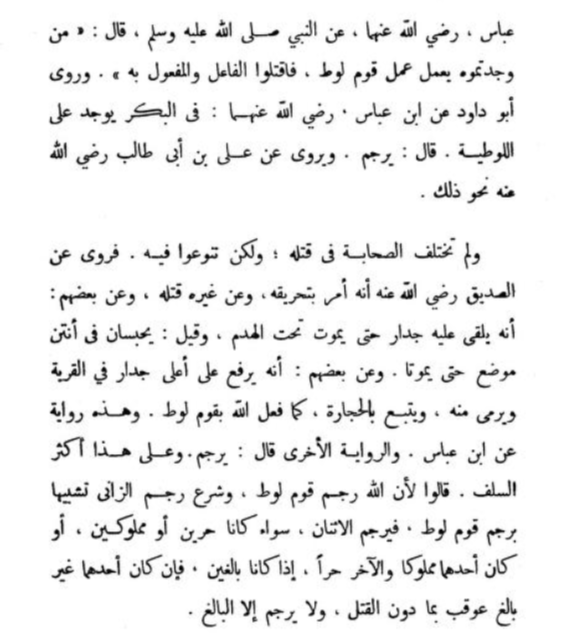
Online link: Majmu al-Fatawa Shaykh al-Islam Ahmad ibn Abd al-Halim ibn Abd al-Salam Ibn Taymiyyah al-Harrani (raḍiya allāhu ʿanhu) : Taqi al-Din Ibn Taymiyyah : Free Download, Borrow, and Streaming : Internet Archive https://archive.org/details/Majmu-al-fatawa/ar_28_Fatawa_Ibn_Taymiyyah/page/n333/mode/2up
Translation:
English Translation
Ibn ʿAbbās (رضي الله عنهما) narrated from the Prophet ﷺ that he said:
“Whoever you find doing the act of the people of Lūṭ, then kill the one who does it and the one to whom it is done.”
And Abū Dāwūd narrated from Ibn ʿAbbās (رضي الله عنهما) regarding a virgin who is found committing sodomy, he said: “He is to be stoned.”
A similar report is also narrated from ʿAlī ibn Abī Ṭālib (رضي الله عنه).
The Companions did not differ regarding killing such a person, but they differed regarding how the punishment should be carried out.
It is reported from Abū Bakr al-Ṣiddīq (رضي الله عنه) that he ordered such a person to be burned. Others reported that he should simply be killed. Some said a wall should be collapsed upon him until he dies under the rubble. It was also said that the two should be imprisoned in the filthiest place until they die.
Some of them said he should be taken to the highest wall or building in the town and thrown from it, then stones should be thrown at him, just as Allah punished the people of Lūṭ. This is one narration from Ibn ʿAbbās.
Another narration says he should be stoned, and this is the view held by most of the early scholars (Salaf).
They said this because Allah stoned the people of Lūṭ, and the stoning of the adulterer was legislated in resemblance to the punishment of the people of Lūṭ.
Therefore both individuals are to be stoned, whether they are free persons or slaves, or one of them is a slave and the other is free, as long as both are adults.
However, if one of them is not an adult, he is punished with something less than execution, because only an adult is stoned.
End of speech
6. Four Sunni Schools based upon Quran & Sunnah
Muslims (almost as a whole) regard homosexuality to be sinful based upon the clear textual proofs of the Qur’an and Sunnah, the consensus (ijmā’) of the first three generations after the Prophet, the agreement of the Four well-known Schools of Islamic Jurisprudence and in accordance with the view of the Sunni scholars spanning more than 1,400 years of Islamic history.
Islam teaches that Muslims must obey Allah by doing what he has commanded and by keeping away from what he has prohibited.
A Muslim who legalises (makes permissible) what is clearly forbidden in the Revealed Texts (Qur’an and Sunnah) such as making lawful fornication, drinking alcohol, gambling or homosexuality, then that person has left the fold of Islam. They are no longer Muslims.
However, Muslims who commit major sins (less than idolatry) such as fornication, robbery or homosexuality whilst affirming their transgression against Allah’s Law and affirming their sin, they remain within the Religion, albeit with weakness in faith (imān). These people are threatened by Allah’s punishment in the Hereafter unless they repent from their sins. And if they enter the Fire, they will not remain in it eternally but acting upon homosexuality through marriage contract is major kufr with Allah and if such person dies will remain in hellfire forever as Al-Allamah Shaykh Ubayad Al-Jabiri rahimahullah stated.
Source: https://abukhadeejah.com/lgbtq-homosexuality-gay-muslims-and-islam/
7. Allamah Imam ibn Kathir mentions in his tafsir of the Quran from Surah Al-Ara’f verse 80 - 85 about Homosexuality Act at the time of propeht Lut alyhisalam.
Part-1: Surah Al-Araf Verse 80 & 81 - What was the sin and how they were doing:
80. And (remember) Lût (Lot), when he said to his people: "Do you commit the worst sin such as none preceding you has committed in the ‘Âlamîn (mankind and jinn)?
— Al-Hilali & Khan
81. "Verily, you practise your lusts on men instead of women. Nay, but you are a people transgressing beyond bounds (by committing great sins)."
— Al-Hilali & Khan
You are reading a tafsir for the group of verses 7:80 to 7:81
The Story of Prophet Lut, upon Him be Peace, and His People
Allah said, We sent,
وَ
(And)
لُوطاًإِذْ قَالَ لِقَوْمِهِ
(Lut, when he said to his people..) Lut (Lot) is the son of Haran the son of Azar (Terah), and he was the nephew of Ibrahim, peace be upon them both. Lut had believed in Ibrahim and migrated with him to the Sham area. Allah then sent Lut to the people of Sadum (Sodom) and the surrounding villages, to call them to Allah, enjoin righteousness and forbid them from their evil practices, their sin, and wickedness. It this area, they did things that none of the children of Adam or any other creatures ever did before them. They used to have sexual intercourse with males instead of females. This evil practice was not known among the Children of Adam before, nor did it even cross their minds, so they were unfamiliar with it before the people of Sodom invented it, may Allah's curse be on them. `Amr bin Dinar conmented on;
مَا سَبَقَكُمْ بِهَا مِنْ أَحَدٍ مِّن الْعَـلَمِينَ
("...as none preceding you has committed in all of the nations.") "Never before the people of Lut did a male have sex with another male." This is why Lut said to them,
أَتَأْتُونَ الْفَـحِشَةَ مَا سَبَقَكُمْ بِهَا مِنْ أَحَدٍ مِّن الْعَـلَمِينَ
إِنَّكُمْ لَتَأْتُونَ الرّجَالَ شَهْوَةً مّن دُونِ النّسَآء
("Do you commit lewdness such as none preceding you has committed in all of the nations Verily, you practice your lusts on men instead of women.") meaning, you left women whom Allah created for you and instead had sex with men Indeed, this behavior is evil and ignorant because you have placed things in their improper places. Lut, peace be upon him, said to them:
هَـؤُلآءِ بَنَاتِى إِن كُنْتُمْ فَـعِلِينَ
("these (the girls of the nation) are my daughters (to marry lawfully), if you must act (so).") 15:71 So he reminded them of their women, and they replied that they do not desire women!,
قَالُواْ لَقَدْ عَلِمْتَ مَا لَنَا فِى بَنَاتِكَ مِنْ حَقٍّ وَإِنَّكَ لَتَعْلَمُ مَا نُرِيدُ
(They said: "Surely, you know that we have neither any desire nor need of your daughters, and indeed you know well what we want!" ) 11:79 meaning, you know that we have no desire for women and you know what we desire with your guests.
82. And the answer of his people was only that they said: "Drive them out of your town, these are indeed men who want to be pure (from sins)!"
— Al-Hilali & Khan
("These are indeed men who want to be pure (from sins)!") Qatadah commented, "They shamed them (Lut and the believers) with what is not a shame at all." Mujahid commented, "(Lut's people said about Lut and the believers,) They are a people who want to be pure from men's anuses and women's anuses!" Similar was narrated from Ibn `Abbas.
Part-2: How Allah destroyed nations of Lut and Saved Lut and his two daughter
You are reading a tafsir for the group of verses 7:83 to 7:84
83. Then We saved him and his family, except his wife; she was of those who remained behind (in the torment).
— Al-Hilali & Khan
84. And We rained down on them a rain (of stones). Then see what was the end of the Mujrimûn (criminals, polytheists and sinners).
— Al-Hilali & Khan
Allah says, We saved Lut and his family, for only his household believed in him.
Allah said in another Ayah,
فَأَخْرَجْنَا مَن كَانَ فِيهَا مِنَ الْمُؤْمِنِينَ - فَمَا وَجَدْنَا فِيهَا غَيْرَ بَيْتٍ مِّنَ الْمُسْلِمِينَ
(So We brought out from therein the believers. But We found not there any household of the Muslims except one of Lut and his daughters) 51: 35-36. Only his wife (from his family) did not believe, remaining on the religion of her people. She used to conspire with them against Lut and inform them of who came to visit him, using certain signals that they agreed on. This is why when Lut was commanded to leave by night with his family, he was ordered not to inform his wife or take her with him. Some said that she followed them, and when the torment struck her people, she looked back and suffered the same punishment as them. However, it appears that she did not leave the town and that Lut did not tell her that they would depart. So she remained with her people, as apparent from Allah's statement,
إِلاَّ امْرَأَتَهُ كَانَتْ مِنَ الْغَـبِرِينَ
(except his wife; she was of the Ghabirin) meaning, of those who remained, or they say: of those who were destroyed, and this is the more obvious explanation. Allah's statement,
وَأَمْطَرْنَا عَلَيْهِمْ مَّطَرًا
(And We rained down on them a rain) is explained by His other statement,
وَأَمْطَرْنَا عَلَيْهَا حِجَارَةً مِّن سِجِّيلٍ مَّنْضُودٍ
مُّسَوَّمَةً عِندَ رَبّكَ وَمَا هِى مِنَ الظَّـلِمِينَ بِبَعِيدٍ-
(And rained on them stones of baked clay, in a well-arranged manner one after another. Marked from your Lord; and they are not ever far from the wrongdoers.) 11:82-83. Allah said here,
فَانْظُرْ كَيْفَ كَانَ عَـقِبَةُ الْمُجْرِمِينَ
(Then see what was the end of the criminals. ) This Ayah means: `See, O Muhammad, the end of those who dared to disobey Allah and reject His Messengers.' Imam Ahmad, Abu Dawud, At-Tirmidhi, Ibn Majah, all recorded a Hadith from Ibn `Abbas who said that Allah's Messenger ﷺ said;
«مَنْ وَجَدْتُمُوهُ يَعْمَلُ عَمَلَ قَوْمِ لُوطٍ فَاقْتُلُوا الْفَاعِلَ وَالْمَفْعُول بِه»
(Whoever is found doing the act of the people of Lut, then kill them; the doer and the one it is done to.)
End
“Verily, by your life (O Muhammad), in their wild intoxication, they were wandering blindly. So As-Saihah (torment — awful cry) overtook them at the time of sunrise. And We turned (the towns of Sodom in Palestine) upside down and rained down on them stones of baked clay. Surely, in this are signs for those who see (or understand or learn the lessons from the Signs of Allah). And verily, they (the cities) were right on the highroad (from Makkah to Syria, i.e. the place where the Dead Sea is now).” [al-Hijr 15:72-76]
For more in detail about the story in more clear and structure way read shaykh abuKhadeeja article: Islam and Homosexuality: What happened in Sodom and Gomorrah? The Prophet Lot (Lūt) and his Daughters: In the Bible and the Qur’an.
#33. Clear Prohibition of Homosexual Act in Quran and Sunnah and Shahabah
Narrated Ibn 'Abbas: That the Messenger of Allah (ﷺ) said: "Whomever you find doing the actions of the people of Lut then kill the one doing it, and the one it is done to."- Jami` at-Tirmidhi 1456 hasan
Narrated Abdullah ibn Abbas:
The Prophet (ﷺ) said: If you find anyone doing as Lot's people did, kill the one who does it, and the one to whom it is done.
Abu Dawud said: A similar tradition has also been transmitted by Sulaiman b. Bilal from 'Amr b. Abi 'Umar. And 'Abbad b. Mansur transmitted it from 'Ikrimah on the authority of Ibn 'Abbas who transmitted it from the Prophet (ﷺ). It has also been transmitted by Ibn Juraij from Ibrahim from Dawud b. Al-Husain from 'Ikrimah on the authority of Ibn 'Abbas who transmitted it from the Prophet (ﷺ). - Sunan Abi Dawud 4462, Hasan Sahih (Al-Albani)
It was narrated from Ibn`Abbas that the Messenger of Allah (ﷺ) said: “Whoever you find doing the action of the people of Lut, kill the one who does it, and the one to whom it is done.” - Sunan Ibn Majah 2561, Hasan (Darussalam)
Punishment
Punishment is death no disagreement among the shahabah and scholars of Islam but how it is done various opinions, all of them are correct, the judge(islamic) judge in muslim country can choose any of it because all the methods leads to death.
Some Companions said that the punishment for homosexuality is to burn the homosexuals with fire, and some of them viewed that they should be thrown down from a high place then have stones thrown at them. Some of them thought that they should be stoned to death.
The Qur’an does not say how homosexuality should be punished, but a saying of the Prophet (may peace and blessings be upon him) makes clear: “Whoever you find engaging in the action of the people of Lūt, execute the one who does it, and the one to whom it is done.” (Ibn Majah 2561, Tirmidhi 1456) This saying must not be used by individuals as an excuse to enact or incite violence against homosexuals.
Prescribed punishments can only be carried out by the legal authority in a country that practices Islamic Law (i.e. in a Muslim country); and there must be clear evidence that actual sex had taken place. The Muslim penal code carries out punishments on the basis of the unlawful act that is committed and not on the basis of a persons’ inclinations where no illegal act has been committed.
This is the view of all of the famous scholars and jurists of Islam in line with the punishment dealt to the people of Lūt (in the Qur’an) and the hadīth of the Prophet. A Muslim, regardless of which country he lives in, is not allowed to physically harm those he regards to be sinners, nor incite others to do so. Vigilantism goes against Islamic teachings because it creates an anarchic, unjust and disorderly society.
Source: Abukhadeeja.com link: The LGBTQ Movement: Homosexuality and Islam: Understanding Muslim Attitudes To Homosexuality (Islam 5.7)
Al-Allmah Imam Ibn Taymiyaah discuss abou the punishment of Homosexual Act, the one who is done and to whom is done source; Majmmo Al-fatwa volume 28 page 34-35. See below
Arabic:
Below is page 335 from volume of 28of majmoo al-fatwaaby Imam ibn Taymiyah
عباس ، رضي الله عنها ، عن النبي صلى الله عليه وسلم ، قال : « من وجدتموه يعمل عمل قوم لوط ، فاقتلوا الفاعل والمفعول به . . وروى أبو داود عن ابن عباس ، رضي الله عنهما : في البكر يوجد على اللوطية . قال : يرجم . ويروى عن على بن أبي طالب رضي الله عنه نحو ذلك ولم تختلف الصحابة في قتله ؛ ولكن تنوعوا فيه . فروى عن الصديق رضي الله عنه أنه أمر بتحريقه، وعن غيره قتله ، وعن بعضهم : أنه يلقى عليه جدار حتى يموت تحت الهدم ، وقيل : يحبسان في أنتن موضع حتى يموتا . وعن بعضهم : أنه يرفع على أعلى جدار في القرية ويرمى منه ، ويتبع بالحجارة، كما فعل الله بقوم لوط . وهذه رواية عن ابن عباس . والرواية الأخرى قال : يرجم . وعلى هذا أكثر السلف . قالوا لأن الله رجم قوم لوط ، وشرع رجم الزاني تشبيها برجم قوم لوط ، فيرجم الاثنان ، سواء كانا حرين أو مملوكين ، أو كان أحدها مملوكا والآخر حراً ، إذا كانا بالغين ، فإن كان أحدهما غير بالغ عوقب بما دون القتل ، ولا يرجم إلا البالغ . .
Online link: Majmu al-Fatawa Shaykh al-Islam Ahmad ibn Abd al-Halim ibn Abd al-Salam Ibn Taymiyyah al-Harrani (raḍiya allāhu ʿanhu) : Taqi al-Din Ibn Taymiyyah : Free Download, Borrow, and Streaming : Internet Archive https://archive.org/details/Majmu-al-fatawa/ar_28_Fatawa_Ibn_Taymiyyah/page/n333/mode/2up
Translation:
English Translation
Ibn ʿAbbās (رضي الله عنهما) narrated from the Prophet ﷺ that he said:
“Whoever you find doing the act of the people of Lūṭ, then kill the one who does it and the one to whom it is done.”
And Abū Dāwūd narrated from Ibn ʿAbbās (رضي الله عنهما) regarding a virgin who is found committing sodomy, he said: “He is to be stoned.”
A similar report is also narrated from ʿAlī ibn Abī Ṭālib (رضي الله عنه).
The Companions did not differ regarding killing such a person, but they differed regarding how the punishment should be carried out.
It is reported from Abū Bakr al-Ṣiddīq (رضي الله عنه) that he ordered such a person to be burned. Others reported that he should simply be killed. Some said a wall should be collapsed upon him until he dies under the rubble. It was also said that the two should be imprisoned in the filthiest place until they die.
Some of them said he should be taken to the highest wall or building in the town and thrown from it, then stones should be thrown at him, just as Allah punished the people of Lūṭ. This is one narration from Ibn ʿAbbās.
Another narration says he should be stoned, and this is the view held by most of the early scholars (Salaf).
They said this because Allah stoned the people of Lūṭ, and the stoning of the adulterer was legislated in resemblance to the punishment of the people of Lūṭ.
Therefore both individuals are to be stoned, whether they are free persons or slaves, or one of them is a slave and the other is free, as long as both are adults.
However, if one of them is not an adult, he is punished with something less than execution, because only an adult is stoned.
End of speech
#34. Homosexual punishment in Islam
Homosexuality: a sexual relationship with someone of the same sex.
Islam’s teaching about homosexuality is referred to in a story found in the Qur’an. This is the story of the Prophet Lūt (may Allah’s peace be upon him), who criticized the men of his town for their homosexual practices. Allah stated:
وَلُوطًا إِذْ قَالَ لِقَوْمِهِ أَتَأْتُونَ الْفَاحِشَةَ مَا سَبَقَكُم بِهَا مِنْ أَحَدٍ مِّنَ الْعَالَمِينَ – 7:80
إِنَّكُمْ لَتَأْتُونَ الرِّجَالَ شَهْوَةً مِّن دُونِ النِّسَاءِ ۚ بَلْ أَنتُمْ قَوْمٌ مُّسْرِفُونَ – 7:81
“And remember Lot (Lūt) when he said to his people: ‘Do you commit the worst sin such as none before you have committed among creation? Indeed, you practise your lusts on men instead of women. Nay, but you are a people transgressing beyond bounds.’” (Quran 7:80-81)
Some people (who engage in, or justify same-sex relationships) have tried to claim that the prohibition (in the verse above) refers to non-consensual sex between homosexuals. Others assert it refers to homosexual relationships outside of marriage. Both of these views clearly contradict this verse because Allah stated: “Indeed, you practise your lusts on men instead of women.” If the verse was referring to homosexual rape (or non-consensual sex), then that is equally forbidden against women. However, Allah (in this verse) allowed sex between heterosexuals (within marriage). Also, if the verse was only forbidding homosexuality outside of marriage, then sex between a man and woman before marriage is forbidden so why would Allah say: “instead of women”? Therefore, the only conclusion that can be drawn from this verse is that sexual relationships between people of the same sex are prohibited.
Furthermore, arbitrarily changing one’s gender from male to female (or vice-versa) does not alter the reality of the prohibition because there is a principle in Islam that states: “Changing the name of something does not change its reality.” So changing the name of alcohol to milk does not alter its reality nor the ruling of prohibition.
Allah (the Most High) also said:
أَتَأْتُونَ الذُّكْرَانَ مِنَ الْعَالَمِينَ – 26:165
وَتَذَرُونَ مَا خَلَقَ لَكُمْ رَبُّكُم مِّنْ أَزْوَاجِكُم ۚ بَلْ أَنتُمْ قَوْمٌ عَادُونَ – 26:166
“You come to the men of creation and you leave those wives whom Allah has created for you? Nay! You are a transgressing people.” (Qur’an 26: 165-166)
Ibn ‘Abbās narrated that Allah’s Messenger (peace and blessings be upon him) stated:
لعن اللهُ من عمِل عملَ قومِ لوطٍ، لعن اللهُ من عمِل عملَ قومَ لوطٍ، لعن اللهُ مَن عملَ عملَ قومِ لُوطٍ
“The curse of Allah is upon the one who engages in the act of the People of Lūt. The curse of Allah is upon the one who engages in the act of the People of Lūt.”
Reported in Musnad Imām Ahmad ibn Hanbal 4/292 and graded saheeh by Ahmad Shākir; see As-Silsilatus-Sahīhah of Al-Albāni, no. 6432, who graded it saheeh (authentic)
Jābir narrated that the Prophet (peace and blessings be upon him) said:
إِنَّ أَخْوَفَ مَا أَخَافُ عَلَى أُمَّتِي عَمَلُ قَوْمِ لُوطٍ
“What I fear most for my followers is the act of the People of Lūt.” (i.e., sodomy)
(Collected by At-Tirmidhi, 1457 and Ibn Mājah, 2563, and graded as hasan by Al-Albāni)
When the people ignored the Prophet Lūt’s message, Allah destroyed the town and every transgressor in it, and He saved Lūt (peace be upon him) and his daughters. This event is a sign for the people who reflect. This story is also mentioned in the scriptures of the Jews and Christians.
Source: https://abukhadeejah.com/lgbtq-homosexuality-gay-muslims-and-islam/
Al-Tirmidhi (1456), Abu Dawud (4462) and Ibn Majah (2561) narrated that Ibn `Abbas (may Allah be pleased with him) said: The Messenger of Allah (peace and blessings of Allah be upon him) said: “Whoever you find doing the action of the people of Lut, execute the one who does it and the one to whom it is done.” (Classed as sahih by al-Albani in Sahih al-Tirmidhi)
Ahmad (2915) narrated from Ibn `Abbas (may Allah be pleased with him) that the Prophet of Allah (peace and blessings of Allah be upon him) said: “May Allah curse the one who does the action of the people of Lut, may Allah curse the one who does the action of the people of Lut,” three times. This was classed as hasan by Shu’ayb al-Arnaut in Tahqiq al-Musnad.
#35.Punishment for Homosexual Act in this world and in hereafter
1. Punishment in This World
In Muslim Countries Where Islamic Law Is Implemented
According to Islamic jurisprudence based on the Qur’an and Sunnah, homosexual acts are considered a grave sin. Classical scholars discussed legal punishments for such acts when the crime is proven under strict Islamic judicial procedures.
A well-known narration reports that Ibn Abbas said that the Prophet Muhammad ﷺ said:
“Whoever you find doing the deed of the people of Lut, kill the one who does it and the one to whom it is done.”
Because of narrations like this, many classical jurists considered severe punishments for this crime when proven in an Islamic court.
However, Islamic law strictly requires that punishments be carried out only by legitimate Muslim authorities and judges. Individual people are never allowed to take the law into their own hands. Islam forbids vigilantism and unlawful violence. Only a lawful Islamic government, after proper investigation, evidence, and judicial process, may decide legal punishments.
Therefore:
- Individuals cannot punish others.
- Individuals cannot incite violence.
- The matter must go through a court and Islamic judge under lawful authority.
In Non-Muslim Countries
If Muslims live in countries where Islamic law is not implemented, they must follow the laws of the land so long as those laws do not force them to commit sin.
In such situations:
- Muslims do not enforce Islamic punishments themselves.
- They are not allowed to harm or attack people.
- They are encouraged to maintain good character, advise with wisdom, and avoid sinful behavior themselves.
In Majority-Muslim Countries Without Islamic Law
In some countries the population may be mostly Muslim but Islamic criminal law is not implemented by the state.
Even in these situations:
- Individuals still cannot take the law into their own hands.
- Violence or vigilantism is not allowed.
- Only legitimate authorities have the right to implement legal punishments if such laws exist.
Islam emphasizes justice, due process, and lawful authority rather than chaos or personal revenge.
2. Punishment in the Hereafter
First, it must be understood that homosexual acts are strongly condemned in Islam and regarded as a serious sin. If a person dies without repenting from major sins, Muslims fear punishment for such a person.
However, Muslims also believe strongly in the vast mercy of Allah. Because of this, believers do not despair of Allah’s mercy and they may still make du‘ā (supplication) for forgiveness for sinful Muslims.
If the Person Did Not Consider It Halal
If a Muslim commits homosexual acts but does not believe that the act is lawful, and does not claim that same-gender marriage is permissible in Islam, then such a person is still considered a Muslim sinner, not a disbeliever.
In this case, their matter is under the will of Allah (Mashī’ah):
- If Allah wills, He may forgive the person.
- If Allah wills, He may punish the person for their sins.
But because the person died as a Muslim and did not deny Islamic teachings, they will not remain in Hellfire forever.
Key Principle in Islamic Belief
A Muslim who commits major sins but does not declare them lawful:
- Remains within Islam.
- Is under Allah’s will.
- May be forgiven or punished.
- Will not remain eternally in Hellfire, unlike disbelief and polytheism.
✅ Summary
- Homosexual acts are considered a serious sin in Islam.
- Worldly punishments, where they exist in Islamic law, can only be implemented by legitimate authorities and judges, never by individuals.
- Muslims living in non-Islamic systems must not take the law into their own hands or incite violence.
- In the hereafter, a Muslim who commits this sin but does not declare it lawful remains under Allah’s will and mercy.
#36. Refutation of Those Who Say: “Let Allah Judge Homosexual person, Not People”
This statement is bāṭil (false) and does not make sense from either a worldly perspective or an Islamic perspective.
The reality is that people judge others all the time according to their ability and the information they have. Human society itself cannot function without such judgments.
Yes, we agree that the ultimate judgement belongs to Allah alone. Only Allah truly knows who will be among the people of Paradise and who will be among the people of Hellfire—whether for eternity or for a temporary punishment. In this sense, it is correct to say that Allah is the final and ultimate Judge.
However, misusing the statement “Allah will judge” to justify evil actions or to silence people from speaking against wrongdoing is incorrect. Sometimes this phrase is used because of personal grudges, jealousy, or hidden agendas to allow evil to continue without criticism.
In reality, when crimes occur in society, people naturally judge them. If someone commits rape, murder, theft, or other crimes, society does not say, “Let Allah judge.” Instead:
- Communities judge the act.
- Courts judge the act.
- Police investigate and judge the act according to the law.
This is something everyone understands. When someone commits wrongdoing, people say “this person is a rapist,” “this person drinks alcohol,” “this person disobeys his parents,” or “this person commits fornication or adultery.” Such judgments in this worldly life are normal and necessary for maintaining moral order in society.
For example, imagine someone in your society who is known for chasing many women, drinking alcohol, stealing, fighting, and committing fraud. Naturally, people say that this person is an evil person or a corrupt person. This type of moral judgement is common in every society.
Therefore, the statement “only Allah judges” must be understood correctly. Otherwise, a person may fall into serious error. In Islamic history, a deviant group known as the Khawarij misused the statement “judgement belongs only to Allah” to justify rebellion and violence. They even went so far as to fight and kill the Companion Ali ibn Abi Talib, who was among the ten companions promised Paradise (Ashara Mubashara).
Because of this, scholars explained that the phrase must not be misused.
When it comes to sinful actions such as homosexual acts, Muslims judge the action as evil and corrupt according to Islamic teachings. However, this does not mean individuals are allowed to incite physical violence or take the law into their own hands.
Islam clearly teaches that:
- People may recognize and condemn sinful acts.
- But punishment and legal enforcement belong only to legitimate authorities and courts, not to individuals.
Therefore, the correct approach is to condemn wrongdoing according to Islamic teachings while maintaining justice, restraint, and lawful conduct.
#37. Homosexual Act Is Not Genetic or not scientifically proven
Some people claim that homosexuality is something people are born with in their genes, just like skin color, eye color, or hair color. However, scientific research does not prove that homosexuality is genetically determined in the same way as these physical traits.
Genes certainly influence many physical characteristics such as eye colour, skin colour, diseases, or disabilities, but scientists have never discovered a gene that directly determines homosexuality. At most, some researchers say that certain genetic or hormonal factors might influence behaviour in general, but this is very different from proving that someone is “born gay.” Even if genes influence some emotions or tendencies, that does not mean they force a person to live a homosexual lifestyle.
Evidence from Identical Twins
One of the clearest pieces of evidence comes from identical twin studies.
Identical twins have exactly the same DNA. If homosexuality were purely genetic, then the following should always happen:
- If one identical twin is homosexual,
- the other twin must also be homosexual.
In other words, the rate should be 100% the same.
However, scientific studies show the opposite. Research on identical twins found that when one twin experiences same-sex attraction, the other twin usually does not. In many studies the agreement rate is only around 10% to 14%.
This means that about nine times out of ten, one twin may be homosexual while the other twin is heterosexual. Because identical twins share the same genes, this clearly shows that homosexuality cannot be genetically determined.
Scientists therefore conclude that the main causes must come from post-birth influences, such as:
- personal experiences
- social environment
- cultural influences
- psychological factors
- individual life events
These factors can affect one twin but not the other, which explains why they may develop different sexual behaviours despite having identical genetics.
Orientation vs. Conduct
Another important distinction is between feelings (orientation) and actions (conduct).
In public discussions, sexual orientation is often limited to categories such as:
- heterosexual
- homosexual
- bisexual
- transgender
However, many other sexual behaviours could also be described as “orientations,” such as:
- incest
- pedophilia
- bestiality
- necrophilia
If someone argues that a behaviour should be accepted simply because a person says “I was born this way,” then the same argument could be used to justify any harmful behaviour. Therefore, laws and moral judgments must be based on the effects of actions, not merely on claims about feelings or orientation.
Sexual Orientation Is Changeable
Research also shows that sexual feelings and identity can change over time for some people. Studies have found that some individuals move:
- from homosexual to heterosexual
- from bisexual to heterosexual
- or from homosexual to bisexual
This phenomenon is called sexual fluidity. If sexual orientation can change during a person’s life, this again shows that it is not fixed in the same way as genetic traits like eye colour or blood type.
No “Gay Gene” Has Ever Been Proven
Over the years, some scientists attempted to find a so-called “gay gene.” One well-known study in the 1990s claimed to find a genetic link on a part of the X chromosome. However, later research failed to reproduce these results, and other scientists could not confirm the claim.
In scientific research, if a discovery cannot be repeated by other researchers, it is not considered reliable evidence. Because of this, many scientists concluded that the idea of a single “gay gene” is unsupported.
Modern genetic research also shows that no single gene can directly cause complex human behaviour. Human behaviour is influenced by a combination of many factors including environment, upbringing, culture, and personal choices.
Cultural and Social Influence
Anthropologists who study human societies have found that sexual behaviours vary greatly between cultures and across different periods of history. Some societies historically had very little or no concept of homosexuality, while others developed particular cultural practices involving it.
If homosexuality were purely genetic and natural in the same way everywhere, then we would expect it to appear uniformly in all cultures and societies. Instead, the patterns differ widely, suggesting that social and cultural influences play a large role.
Conclusion
Based on scientific research and studies:
- There is no proven “gay gene.”
- Identical twin studies show homosexuality is not genetically determined.
- Sexual behaviour is influenced by environment, experiences, and social factors.
- Sexual feelings can change over time, showing they are not biologically fixed.
Therefore, the claim that people are “born gay” in the same way they are born with eye colour or skin colour is not supported by scientific evidence. Instead, evidence suggests that sexual behaviours and lifestyles are influenced largely by environmental and personal factors rather than genetics alone.
#38. Refutation of the Claim That Animal Behavior Justifies Homosexual Acts
Some people attempt to justify homosexual acts by arguing that certain animals sometimes engage in same-sex behavior. They claim that since such behavior can be observed in animals, it must therefore be natural and acceptable for human beings as well.
However, this argument does not stand up to careful reasoning.
Animals often behave according to instinct and uncontrolled impulses, especially when they experience strong sexual urges. For example, animals sometimes run themselves against objects such as sofas, trees, stones, or other surfaces when they feel sexual excitement. If someone uses animal behavior as a justification, then the question naturally arises: should human beings imitate such behavior as well?
Animals also relieve themselves openly in public places, in streets and fields, without any sense of modesty or privacy. Yet human beings do not accept such behavior as normal for themselves. People use bathrooms, follow hygiene rules, and maintain modesty. The fact that humans do not imitate animals in these matters clearly shows that animal behavior cannot be used as a moral standard for human life.
Human beings are fundamentally different from animals because they possess intellect, moral responsibility, and divine guidance. In Islamic belief, human beings are honored above other creations. Allah states in the Qur’an that He has favored the children of Adam over many of His creations. This honor means that humans are expected to live according to moral principles and divine guidance, not merely according to instinct.
Therefore, lowering human conduct to the level of animal behavior would mean degrading the dignity that Allah has given to mankind.
Simply shifting arguments from one place to another does not justify wrongdoing. Using examples from animals does not prove that same-sex relationships are morally acceptable for human beings. Moral guidance for humans comes from revelation, reason, and ethical principles, not from copying the uncontrolled behavior of animals.
For this reason, the claim that animal behavior justifies homosexual acts fails logically and morally, and it does not provide a valid argument for approving same-sex sexual relationships.
#39. Homosexual Act by Nature Is Unnatural
From the perspective of nature, human society, and basic human functioning, sexual relations between opposite genders play an essential role in the continuation and stability of humanity. The following points explain why homosexual acts are considered unnatural in this framework.
1. Humanity Would Have Disappeared Long Ago
The most obvious natural function of sexual relations is reproduction. Human beings continue generation after generation only through the union of male and female.
If the entire human population practiced only homosexual acts, reproduction would stop completely. Over time, humanity would simply disappear. The fact that human civilization has continued for thousands of years shows that the natural system of reproduction is based on male–female relations. Therefore, sexual relations that cannot produce offspring go against the natural reproductive system.
2. Penetrative Anal Sex Can Damage the Rectum
The rectum is not designed for sexual penetration. Its biological function is to remove waste from the body. Because of this, it lacks the natural protection and structure found in reproductive organs.
Medical discussions often point out that penetrative anal intercourse can increase the risk of injury, tearing of tissues, infections, and transmission of certain diseases. This indicates that such activity goes against the natural design of the human body.
3. Human Beings Depend on Each Other and Need Families
Human society is built upon families, where men and women cooperate to raise children and support one another. A stable family structure allows children to grow with care, guidance, and emotional support from both parents.
Opposite-gender relationships within marriage help build families, communities, and societies where people care for one another. This cooperation between men and women has been the foundation of human civilization for centuries.
4. Population Strength and Defense of Society
Throughout history, societies needed strong populations in order to defend themselves, build communities, and maintain stability. A growing population provides the human resources necessary for agriculture, construction, education, and even national defense.
If reproduction stops, societies eventually weaken and collapse because there are not enough people to maintain essential functions such as military protection, workforce development, and social support systems.
5. Natural Complementarity Between Male and Female
Men and women are naturally created with complementary biological and psychological roles. Their bodies are designed in a way that fits together for reproduction, emotional bonding, and family life.
This natural complementarity is visible not only in human beings but throughout the living world, where male and female roles exist for reproduction and continuation of species. Because of this natural pairing, opposite-gender relationships form the biological and social foundation for human life.
Together, these points show that from the perspective of reproduction, human health, social structure, population survival, and biological design, the natural system of human life is built upon the relationship between male and female.
#40. Claiming Homosexuality Is “Normal” Is False
The assertion that homosexuality is “normal” is not supported by nature, biology, or social realities. Here’s why this claim is false:
1. Homosexuality Does Not Fulfill the Primary Purpose of Human Sexuality
The natural function of human sexuality is reproduction, ensuring the continuation of the species. Homosexual acts, by definition, cannot lead to reproduction. Therefore, labeling such acts as “normal” contradicts the biological and natural purpose of sexual relations.
2. Health and Physical Concerns
Certain homosexual practices, such as anal intercourse, pose a higher risk of injury, infections, and diseases. These health risks highlight that such practices are not aligned with the natural design of the human body. Activities that cause harm or go against the body’s natural structure cannot be considered normal.
3. Social and Familial Implications
Human society depends on families and reproduction to thrive. Opposite-gender relationships produce children and maintain social structures. Homosexual relationships cannot fulfill this role naturally, and promoting them as “normal” ignores the social necessity of male–female unions for community stability.
4. Contradiction with Human Nature and Complementarity
Humans are created with biological and psychological complementarity: males and females are naturally designed to pair for reproduction, emotional bonding, and nurturing families. Homosexual acts bypass this natural complementarity, which is essential for human survival. Claiming these acts as “normal” is therefore a denial of the fundamental order and design of human nature.
5. Cultural and Historical Evidence
Throughout history and across societies, heterosexual relationships have been the standard for human continuity and societal development. Homosexuality has always been the exception rather than the rule. Labeling it as “normal” ignores thousands of years of natural and social patterns.
In conclusion, calling homosexuality “normal” is factually and logically incorrect, as it contradicts biology, harms human health, undermines social structures, and goes against the natural complementarity designed for male and female. The claim is therefore a social or ideological assertion, not a reality based on human nature.
#41. No One Asked the Prophet ﷺ About Homosexual Acts
During the lifetime of the last Prophet Muhammad ﷺ (sallallāhu ʿalayhi wa sallam), no one ever approached him seeking permission to engage in same-sex sexual activity. This contrasts with the well-known report of a man who came to the Prophet ﷺ asking about fornication (zina), showing that even sinful sexual questions were sometimes raised.
The fact that homosexual acts were never brought up highlights that such behavior was not socially accepted or considered normal, and it underscores its clear prohibition in Islam. This absence of inquiry demonstrates that same-sex sexual activity was outside the bounds of acceptable human conduct, reinforcing that it is unnatural and forbidden, both from the perspective of Islamic law and human fitra (natural disposition).
Homosexuality was never legitimized or tolerated, which aligns with the broader understanding in Islam that sexual relations are intended only between men and women for the purposes of reproduction, social cohesion, and the preservation of humanity.
#42. Just Like They Learn to Be Homosexual, They Can Learn Not to Be
Muslim scholars explain that homosexuality arises from a corruption of the natural state (fitra), which can be triggered by various environmental and social factors, such as:
- Being raised with the idea that there is no difference between the two sexes, blurring the natural distinctions established by Allah.
- Constant exposure to homosexual behavior, which can normalize it in the minds of children and youth.
- Being taught ideas that contradict science, nature, and intellect, for example, ignoring that two people of the same sex are physiologically incapable of sexual reproduction.
- Childhood sexual abuse, which can distort understanding of sexuality and create confusion regarding sexual preferences.
- Early school indoctrination that promotes behaviors contrary to natural health, morality, and well-being.
- Encouragement from a young age to explore same-sex relationships and “gay” role-play, especially in Western educational and social settings.
- Suppression of dissent, where opposition to LGBTQ ideology is ostracized or criminalized, increasing pressure to conform.
Scholars emphasize that just as individuals can ‘learn’ to engage in homosexual behavior, they can also learn not to. With guidance, support, and personal effort, a person can return to their natural state of being, or at least desist from homosexual activity even if full heterosexuality is not achieved. This reinforces the Islamic principle that humans are naturally oriented toward opposite-sex relationships, and deviations can be corrected through awareness, moral guidance, and environmental influence.
# 43. How Homosexuality Feeling is Developed?
Homosexual feelings and attractions do not usually appear randomly—they develop over time due to a mix of personal experiences, environment, and social influences. Several factors can contribute to these same-sex feelings:
- Childhood experiences and bonding
- Poor attachment to the same-sex parent or difficulties connecting with peers can affect a child’s sense of gender identity.
- If a boy struggles to bond with his father or feels rejected, he may turn emotionally toward female figures, which can influence how he experiences attraction later.
- Similarly, girls may develop incomplete bonding with their mothers or female figures, influencing their attractions.
- Trauma and emotional issues
- Experiences like child sexual abuse, neglect, or emotional trauma can shape sexual feelings and impulses.
- Unresolved issues such as fear, envy, or lack of acceptance may manifest as same-sex attraction.
- Social and environmental factors
- Exposure to certain behaviors, peer interactions, or social conditioning can play a role.
- Chemical exposure, such as hormone-disrupting pollutants, may influence gender development, as studies on animals suggest.
- Developmental models of sexual attraction
- Normally, a boy learns masculinity through attachment to his father and bonding with male peers. This helps him naturally develop interest in the opposite sex at puberty.
- When these attachments are missing or disrupted, a boy may fail to develop a strong male identity and instead find emotional connection and comfort with females. Over time, this unmet need may be expressed as same-sex attraction.
- For girls, similar disruptions in maternal bonding or emotional development can lead to lesbian feelings, often as an unconscious way to meet unmet emotional needs.
- Psychological factors
- Homosexual feelings are often a symptom of deeper emotional or relational challenges, not the core problem itself.
- People may develop these feelings as a way to cope with unmet needs for acceptance, affirmation, and healthy social connection.
- Cultural and external influences
- Modern media, education, and social movements can normalize or encourage exploration of homosexual identity.
- Exposure to messages that glorify same-sex relationships may influence self-identification, especially in youth.
Key Points from an Islamic Perspective
- Having homosexual feelings alone is not sinful; Islam evaluates conduct, not private thoughts.
- Feelings are considered a trial, similar to illness or hardship, and can be resisted with patience, restraint, and guidance.
- The natural order of human sexuality in Islam emphasizes opposite-sex attraction and the family structure. Homosexual behavior is prohibited because it harms the individual and society.
- A person can manage and control these feelings, just as other
- ##instincts and emotions (hunger, anger, jealousy) can be regulated.
In summary, homosexual feelings develop due to a combination of psychological, social, environmental, and developmental factors. While these feelings may feel compelling, they are not immutable, and Islam encourages resisting actions that go against the natural and moral order.
Continue…wait for article 8. See all the articles of this series here: SunniSalafi.com | direct link series: https://sunnisalafi.com/series/reality-of-lgbtq
Read footnotes: