Impotence (Erectile Dysfunction) in Islam & IVF Rulings – Conditions, Marriage & Islamic Guidance
Go to Homepage
بِسۡمِ اللهِ الرَّحۡمٰنِ الرَّحِيۡمِ
In the Name of Allâh, the Most Gracious, the Most Merciful.ⓘ
All praise belongs to Allah alone, and may He exalt our Last Prophet Muhammad ﷺ, bless him and his family, Companions, and all who follow him rightly until the Last Hour.
Learn the Islamic perspective on impotence (erectile dysfunction), marriage rights, infertility, and IVF (test-tube baby). Discover strict scholarly conditions, rulings by major scholars, and guidance on permissible solutions in Islam.
Published: April 7, 2026
Last Update: April 7, 2026
Category: muhammadur-rasulullah
You are reading link-54 online.
You are reading article 23 of this series. See here, the LGBTQ+ series in order=>Series-on-LGBTQ-SunniSalafi.com direct link=>https://sunnisalafi.com/series/reality-of-lgbtq
Category-5: Impotent(Erectile dysfunction) Person & regarding IVF(test tube baby).
# Who is an impotent(Erectile dysfunction) in Islam?
A sexually impotent man is someone who has male genitalia working and is fully functional man but, due to reasons such as illness, psychological issues, physical conditions, or other factors, is unable to engage in sexual intercourse. As a result, he is not able to experience sexual relations or pleasure, and unable to produce children.
Thus it is clear that not everyone who is impotent is intersex. He may be impotent because of sickness that has nothing to do with effeminacy. Or a person may be intersex but is able to have sex and so on.
According to medicalnewstoday.com article: Impotence is the inability for a male to get and maintain an penis erection. It is also known as erectile dysfunction(ED). Impotence can occur due to a variety of physical and psychological reasons.
Impotence is a very common condition that can impact a person’s ability to have satisfactory sexual intercourse. It can occur at any age. However, it is most common among older men.
According to the University of Wisconsin, around 5 percent of men in the United States that are over 40 years old have complete erectile dysfunction (ED). Around 15 percent of men over the age of 70 have complete ED.
Source: Why am I impotent? Common causes and treatments direct link: https://www.medicalnewstoday.com/articles/316064
According to healthline.com article: Impotence occurs when you’re unable to achieve an erection, maintain an erection, or ejaculate on a consistent basis. It’s used interchangeably with ED. Several factors can contribute to the condition, including both emotional and physical disorders.
According to the Urology Care Foundation, an estimated 30 million Americans experience ED.
A 2007 study published in the American Journal of Medicine noted the risk of impotence increases with age. Research suggests it’s even higher in men who have also been diagnosed with one or more cardiovascular risk factors.
Impotence can often have a negative effect on your sex life, and it can also cause depression, additional stress, and low self-esteem.
Source: 5 Common Causes of Impotence: Diseases, Medications & More direct link: https://www.healthline.com/health/erectile-dysfunction/common-causes-impotence#what-is-impotence
# How Long will a Wife Ordered to be Patient with a Husband suffering ED(Erectile Dysfunction) problem -Shaykh Abu Khadeejah
There is a question from a sister. She asks: how much should a wife endure when her husband is going through certain physical defects, such as erectile dysfunction? No treatments have worked, and a few years have already passed. How long does she have to remain patient?
Answer by Shaykh AbuKhadeejah(well grounded student of knowledge): The question is regarding a man who is not able to have intimate relations with his wife. There are two types of men in this category. First, those who refuse to have sexual intimacy with their wives even though they are able. Second, those who are unable due to illness, such as erectile dysfunction.
It is the right of the woman that her husband has marital relations with her. If he is not able to do so, then she has the right to seek separation. Likewise, if a man is not able to provide his wife with children—either because he refuses or because he is unable, for example if he is infertile—then it is permissible for her to seek separation, either through divorce or khula. The scholars have mentioned this because it is the right of the woman.
If she chooses to remain with him and be patient, that is also allowed for her. It is known from the Prophet ﷺ with his wife Sawdah (رضي الله عنها) that as she grew older, she sensed that the Prophet ﷺ might divorce her. So she approached the Prophet ﷺ and said, “O Messenger of Allah, do not divorce me. Instead, give my night to Aisha (رضي الله عنها).” The Prophet ﷺ kept Sawdah as his wife, and she gave her night to Aisha (رضي الله عنها). This shows that it is permissible for a woman to remain patient if she chooses. She wished to remain the wife of the Prophet ﷺ in this life and in Jannah, so she had a strong desire to remain with him.
With respect to this sister’s situation, every person is different. There is no fixed time limit that can be placed, such as saying she must be patient for two weeks, two years, or six months. Every person knows their own condition best.
What she should do is reflect on her situation. She should consider that this man is not able to give her children and is not able to be intimate with her. She should think about whether she can live with that or not, and whether it becomes a trial (fitnah) for her. Just as men have desires, women also have desires; Allah has placed this in both.
She should seek consultation (istisharah), but not with everyone. She should not go around informing the whole world about her husband’s condition. Instead, she should consult someone trustworthy, such as her sister, her mother, or someone who will keep the matter private. The goal is not to dishonor him, especially if this illness is something Allah has tested him with.
After seeking advice, she should come to a decision. Of course, it is a difficult decision. Once she has made her decision—whether to ask for divorce or khula—she should then pray istikhara. Istikhara comes after deciding on a course of action. She asks Allah to guide her to what is best and to turn it away from her if it is bad for her in her worldly life or her religion.
This is the advice regarding this matter.
# Can an impotent man marry?
Summary:
- There is no Shar‘i prohibition against an impotent man getting married.
- However, he must disclose his condition truthfully to the woman before marriage. Hiding it is sinful, and the wife has the right to annul the marriage if she was not informed.
- Impotence may give the wife the right to request separation. Most scholars say the husband may be given up to one year to see if the condition improves; some scholars allow immediate annulment.
- If the woman knew about his impotence and accepted it, she loses the right to annul the marriage later.
- Marriage may still be suitable in cases where the woman does not have strong sexual desire, such as due to illness or old age, and the marriage can still fulfill other purposes like companionship, care, maintenance, and protection.
- For intersex individuals, marriage is not allowed if their gender is unclear; if it is confirmed that the person is male or female, then scholars and doctors may recommend to get marry but this is very critical situation so one must not hide intersex identity while proposing opposite gender for marriage and in general there is no default ruling regarding marriage of intersex individual because each intersex individual is different and must goes through medical examination and trusted scholars fatwa before engaging in marriage with normal person or with other intersex individual person because each intersex individual disability lies in sexual reproductive system.
- Scholars generally do not advise young women who desire normal marital relations and children to marry an impotent man, because it may lead to hardship later.
Conclusion:
An impotent man can marry in Islam if he
honestly discloses his condition, but the woman has the
right to refuse or seek annulment, and such marriages
should be considered carefully.
# Female Infertility and Pregnancy Loss
Sometimes a natural marriage between a healthy male and female (heterosexual couple) takes place, but the couple is unable to conceive a child. One possible reason on the male side is Erectile Dysfunction, where the man is unable to maintain an erection for sexual intercourse.
However, there are also situations where the difficulty is related to the woman. In medical terms, this is usually referred to as Female Infertility.
Female infertility means a woman is unable to become pregnant after a significant period of trying (usually about one year of regular unprotected intercourse). This may happen due to several medical reasons such as hormonal imbalance, problems with ovulation, issues with the uterus or fallopian tubes, or other health conditions.
Another situation is when a woman becomes pregnant but the pregnancy ends before the baby can survive outside the womb. In medical terminology, this is called a Miscarriage (also known as spontaneous pregnancy loss). This occurs when the pregnancy ends naturally, often during the early months.
Summary:
- Male cause: Erectile Dysfunction – difficulty with erection preventing intercourse.
- Female cause (unable to conceive): Female Infertility.
- Pregnancy ending in the middle: Miscarriage.
These conditions are medical issues and can sometimes be treated depending on the underlying cause.
Personally, I know from my relatives and family circle that when a couple—whether the male or the female, or both—cannot conceive a child within four years or even less, people in society often start looking at them as if something is strange. In extreme cases, some even begin to suspect intersex traits, which is an even worse and incorrect assumption.
In reality, every situation is different and can be a difficult test for the couple when it comes to marital life. Such matters require understanding, patience, and compassion rather than judgment.
May Allah have mercy on all of us. Ameen.
# What is IVF (Test-Tube Baby) Technology and What It Solves
Modern medicine has developed technologies to help couples who face difficulty conceiving. One of the most well-known methods is In Vitro Fertilization, commonly called a test-tube baby.
IVF is a medical procedure in which the egg from the woman and the sperm from the man are fertilized outside the body in a laboratory. After fertilization, the resulting embryo is placed back into the woman’s uterus so that pregnancy can develop normally.
What Problems IVF Helps Solve
IVF can help in several situations, such as:
- Female infertility – when a woman cannot conceive due to problems with ovulation, blocked fallopian tubes, or other reproductive issues.
- Male infertility – when sperm count or sperm quality is low.
- Unexplained infertility – when doctors cannot find a clear reason why pregnancy is not happening.
- Repeated pregnancy loss – in some cases where pregnancies repeatedly end early.
- Delayed pregnancy due to age – when couples marry later and natural fertility decreases.
What IVF Does Not Mean
A test-tube baby does not mean the child grows in a test tube. The fertilization only happens in the lab; afterward, the embryo grows normally in the mother’s womb like any other pregnancy.
Purpose
The main goal of IVF is to help couples who cannot conceive naturally to have children, giving hope to many families facing infertility.
According to nhs.co.uk: IVF is one of
the Assisted Reproduction Techniques (ART) and is commonly known as
the “test tube baby”
procedure.
Under normal circumstances a pregnancy results when an egg which is released
from
an ovary unites with a sperm within the fallopian tube. This process is called
fertilisation.
There are circumstances however when this process cannot occur naturally.
The most
common are:
- Fallopian tubal blockage or damage
- Lack of, or problems with quality and motility of sperm
- Endometriosis
- Cervical problems
- Failed intrauterine insemination
Occasionally no cause can be found for the infertility (Unexplained
infertility) and under
these circumstances IVF is also an option for treatment.
Source: In Vitro Fertilisation (IVF) and Embryo transfer - Worcestershire Acute Hospitals NHS Trust
According to healtline.com : IVF helps people with infertility who want to have a baby. Because it’s expensive and invasive, couples often try other fertility treatments first. These may include taking fertility drugs or having intrauterine insemination.
In vitro fertilization (IVF) is a type of assistive reproductive technology (ART). It involves retrieving eggs from a woman’s ovaries and fertilizing them with sperm. This fertilized egg is known as an embryo. The embryo can then be frozen for storage or transferred to a woman’s uterus.
Depending on your situation, IVF can use:
- your eggs and your partner’s sperm
- your eggs and donor sperm
- donor eggs and your partner’s sperm
- donor eggs and donor sperm
- donated embryos
Your doctor can also implant embryos in a surrogate, or gestational carrier. This is a woman who carries your baby for you.
The success rate of IVF varies. According to the American Pregnancy Association, the live birth rate for women under age 35 undergoing IVF is 41 to 43 percent. This rate falls to 13 to 18 percent for women over the age of 40.(menaing: The success rate of IVF is not the same for everyone. It depends mainly on age. Women under 35 have a higher chance of giving birth through IVF, around 41% to 43%. But for women over 40, the chances are much lower, around 13% to 18%.)
Source: In-Vitro Fertilization (IVF): Procedure, Preparation & Risks
How Is In Vitro Fertilization Performed?
There are five steps involved in IVF:
- stimulation
- egg retrieval
- insemination
- embryo culture
- transfer
Stimulation
A woman normally produces one egg during each menstrual cycle. However, IVF requires multiple eggs. Using multiple eggs increases the chances of developing a viable embryo. You’ll receive fertility drugs to increase the number of eggs your body produces. During this time, your doctor will perform regular blood tests and ultrasounds to monitor the production of eggs and to let your doctor know when to retrieve them.
Egg Retrieval
Egg retrieval is known as follicular aspiration. It’s a surgical procedure performed with anesthesia. Your doctor will use an ultrasound wand to guide a needle through your vagina, into your ovary, and into an egg-containing follicle. The needle will suction eggs and fluid out of each follicle.
Insemination
The male partner will now need to give a semen sample. A technician will mix the sperm with the eggs in a petri dish. If that doesn’t produce embryos, your doctor may decide to use ICSI.
Embryo Culture
Your doctor will monitor the fertilized eggs to ensure that they’re dividing and developing. The embryos may undergo testing for genetic conditions at this time.
Transfer
When the embryos are big enough, they can be implanted. This normally occurs three to five days after fertilization. Implantation involves inserting a thin tube called a catheter inserted into your vagina, past your cervix, and into your uterus. Your doctor then releases the embryo into your uterus.
Pregnancy occurs when the embryo implants itself in the uterine wall. This can take 6 to 10 days. A blood test will determine if you’re pregnant.
Source: healthline.com link: In-Vitro Fertilization (IVF): Procedure, Preparation & Risks
# Muslim Attitudes To Artificial Insemination (AI) & IVF(test tube baby)
There seems to be some differing amongst Muslims regarding the permissibility of AI. Some Muslims believe that since children are a gift and a blessing from Allah, then couples who cannot have children should accept that fate, and not become disheartened, since it was Allah’s will. Not all couples receive the gift of children.
Other Muslims believe that though it is true that to have children through the natural process of sexual relations between couples is indeed a gift and blessing from Allah, BUT this does not exclude the use of science or fertility technology that is itself God-given. It is Allah who gave humans the ability to develop these technologies. So long as these technologies do not contradict the Qur’an and Sunnah, they are permitted. Allah said:“It is He Who has created you from a single person (Adam), and then He has created from him his wife (Eve), in order that he might enjoy the pleasure of living with her. When he had sexual relation with her, she became pregnant and she carried the foetus about lightly. Then when it became heavy, they both invoked Allah, their Lord (saying): “If You give us a good and pious child, we shall indeed be among the grateful.”” (Qur’an 7:189)
Source: Artificial Insemination (AI) from the husband or by a sperm donor (Ethics 1.7)
# Islamic Ruling on In-Vitro Fertilization-IVF(Test Tube Baby)
IVF (In-Vitro Fertilization) should be disallowed, in order to be on the safe side or it may be allowed when the guidelines illustrated in the detailed answer are applied.
Children are truly a blessing and one of the greatest joys of life, and one of the main purposes of marriage is to have offspring.A righteous child is a great gift for his parents in this life and in the Hereafter, because his good deeds also benefit his parents[1].
Sometimes a husband or wife may face difficulty in having children or may experience delays in conceiving. In such cases, they should be patient, seek Allah’s reward, make plenty of du‘a, and ask for forgiveness. They should remember that Allah decrees everything with wisdom and for a reason.
If Islamically permissible methods are available to help them have children, it is acceptable to use them. However, Muslims should avoid false methods involving sihr (witchcraft) or myths, and be cautious of doctors who do not fear Allah and focus only on making money. Hence some of doctors switch eggs or sperm, which is why many scholars have forbidden these methods or allowed them only under very strict conditions.
Shaykh Abu Khadija Abdul Wahid rahimahullah from Maktabah Salafiyah has written two or three articles on this topic on his website[2], about IVF and about artificial injection, which is given to a woman to make her pregnant. We will discuss that."
We need to make sure that this IVF and artificial injection, or any other method, is used by the couple only in extreme necessity to have a child. It is absolutely not to be used just because you’ve been married for a couple of months, or a year, or four or five years, and you say, "Well, we’re not having children, so let’s try this." Do not say that at all; it should be done only in extreme necessity. That is why the scholars have placed a very strict condition on this.
Now let’s look at the direct answers of our major scholar, Saleh Ibn al-Uthaymeen (may Allah have mercy on him), from his Majmu‘ al-Fatawa, volume 17, pages 27–28, regarding IVF and artificial injections.
I will first quote the original Arabic, then give a simple translation. After that, we will move on to the details about the conditions, because the conditions are very strict.This is because of all the modern methods we have today, such as IVF, artificial methods, and even newer technologies that scientists are researching, like Cloning—where it may become possible to choose characteristics like gender, height, or skin color. So a person must be very careful.
Majmmo al fatwa by Allmah Imam Muhammad ibn Salih Al-Utahymeen rahimahulla volume 17 page 27-28: you can download the original arabic all collection from here: download book the collection of fatwas and messages of his eminence sheikh muhammad bin saleh al uthaymeen pdf - Noor Library
Original Arabic:
page-27
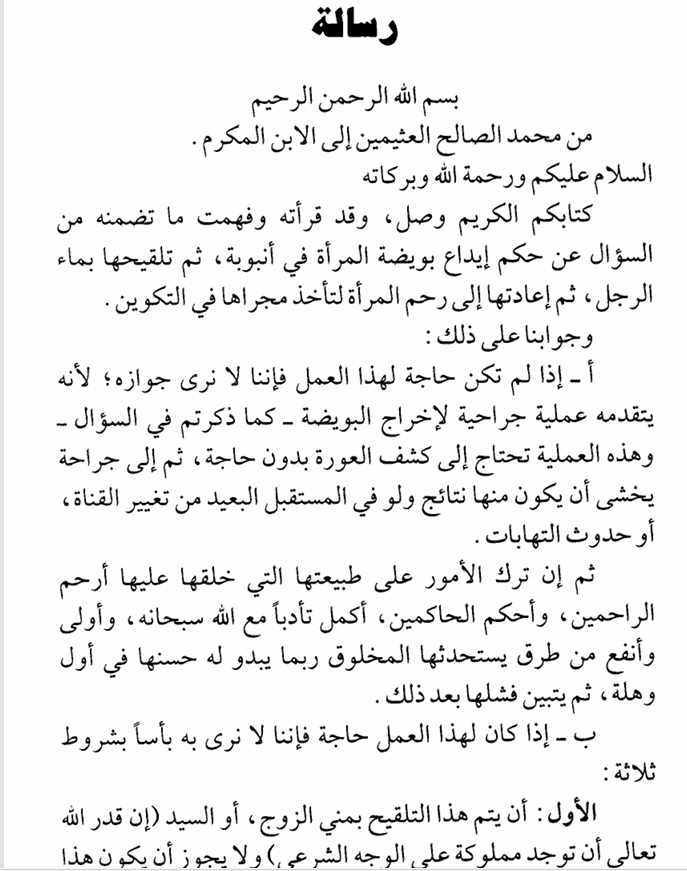
رسالة
بسم الله الرحمن الرحيم
من محمد الصالح العثيمين إلى الابن المكرم .
السلام عليكم ورحمة الله وبركاته
كتابكم الكريم وصل، وقد قرأته وفهمت ما تضمنه من السؤال عن حكم إيداع بويضة المرأة في أنبوبة، ثم تلقيحها بماء الرجل، ثم إعادتها إلى رحم المرأة لتأخذ مجراها في التكوين .
وجوابنا على ذلك :
أ ـ إذا لم تكن حاجة لهذا العمل فإننا لا نرى جوازه؛ لأنه يتقدمه عملية جراحية لإخراج البويضة - كما ذكرتم في السؤال - وهذه العملية تحتاج إلى كشف العورة بدون حاجة، ثم إلى جراحة يخشى أن يكون منها نتائج ولو في المستقبل البعيد من تغيير القناة،
أو حدوث التهابات .
ثم إن ترك الأمور على طبيعتها التي خلقها عليها أرحم الراحمين، وأحكم الحاكمين أكمل تأدباً مع الله سبحانه، وأولى وأنفع من طرق يستحدثها المخلوق ربما يبدو له حسنها في أول
وهلة، ثم يتبين فشلها بعد ذلك . ب ـ إذا كان لهذا العمل حاجة فإننا لا نرى به بأساً بشروط
ثلاثة :
الأول : أن يتم هذا التلقيح بمني الزوج، أو السيد (إن قدر الله تعالى أن توجد مملوكة على الوجه الشرعى ) ولا يجوز أن يكون هذا
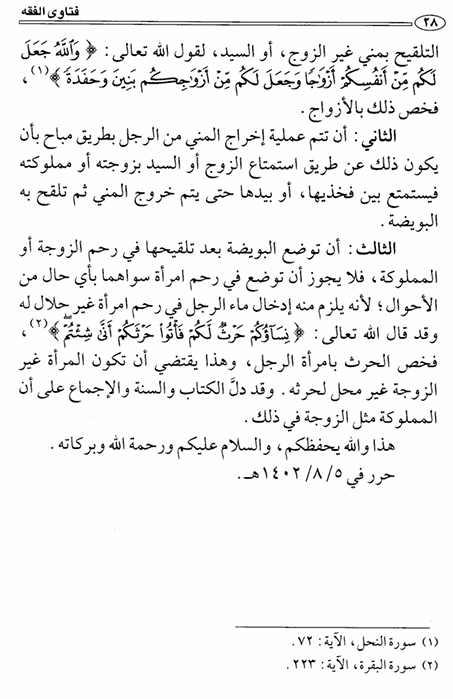
۲۸ page-28
فتاوى الفقه
التلقيح بمني غير الزوج أو السيد، لقول الله تعالى: ﴿ وَاللَّهُ جَعَلَ لكُم مِّنْ أَنفُسِكُمْ أَزْوَاجًا وَجَعَلَ لَكُم مِّنْ أَزْوَاجِكُم بَنِينَ وَحَفَدَةً (۱) ، فخص ذلك بالأزواج .
الثاني : أن تتم عملية إخراج المني من الرجل بطريق مباح بأن يكون ذلك عن طريق استمتاع الزوج أو السيد بزوجته أو مملوكته فيستمتع بين فخذيها، أو بيدها حتى يتم خروج المني ثم تلقح به
البويضة . الثالث : أن توضع البويضة بعد تلقيحها في رحم الزوجة أو المملوكة، فلا يجوز أن توضع في رحم امرأة سواهما بأي حال من الأحوال ؛ لأنه يلزم منه إدخال ماء الرجل في رحم امرأة غير حلال له وقد قال الله تعالى: ﴿ نِسَاؤُكُمْ حَرْثٌ لَكُمْ فَأْتُوا حَرْثَكُمْ أَنَّى شِئْتُمْ ) (۲) ، فخص الحرث بامرأة الرجل وهذا يقتضي أن تكون المرأة غير الزوجة غير محل لحرثه . وقد دلّ الكتاب والسنة والإجماع على أن
المملوكة مثل الزوجة في ذلك . هذا والله يحفظكم، والسلام عليكم ورحمة الله وبركاته .
حرر في ١٤٠٢/٨/٥هـ.
(۱) سورة النحل، الآية: ۷۲ .
(۲) سورة البقرة الآية : ۲۲۳
Screenshot:
Simple English Translation:
Page 27
A Letter
In the name of Allah, the Most Gracious, the Most Merciful.
From Muhammad al-Ṣāliḥ al-ʿUthaymīn to the respected son.
Peace, mercy, and blessings of Allah be upon you.
Your noble letter has been received. I have read it and understood what it contains regarding the question about the ruling on placing a woman’s egg in a test tube, then fertilizing it with a man’s sperm, and then returning it to the woman’s womb so that it may proceed in its natural course of development.
Our answer to that is as follows:
(A)
If there is no need for this procedure, then we do not consider it permissible. This is because it involves a surgical procedure to extract the egg—as you mentioned in the question—and this requires exposing the private parts without necessity. It also involves surgery that may result in consequences, even in the long term, such as damage to the reproductive tube or the occurrence of infections.
Furthermore, leaving matters in their natural state, as created by the Most Merciful and the Most Wise, is more complete in showing proper conduct toward Allah (Glorified be He), and is more appropriate and beneficial than methods introduced by humans, which may initially appear good but later prove to fail.
(B)
However, if there is a need for this procedure, then we do not see any harm in it, provided three conditions are met:
First condition:
That the fertilization is done
using the sperm of the husband, or the master (if—by Allah’s decree—a bondwoman exists in a lawful manner).
It is not permissible for this fertilization to be done with the sperm of anyone other than the husband or
the master, due to the statement of Allah تعالى:
“And Allah has made for you spouses from among yourselves, and from your spouses He has given you children and grandchildren.”
Thus, He specifically restricted this to spouses.
Second condition:
That the sperm is obtained from
the man through a permissible method, such as the husband (or master) enjoying his wife (or bondwoman), for
example between her thighs or by her hand, until ejaculation occurs, and then the egg is fertilized with
it.
Third condition:
That the fertilized egg is placed
back into the womb of the wife or the bondwoman. It is not permissible, under any circumstances, to place it
into the womb of another woman, because this would involve introducing the man’s sperm into the womb of a
woman who is not lawful for him.
Allah تعالى said:
“Your wives are a place of cultivation for you, so come to your place of cultivation however you wish.”
Thus, cultivation is restricted to one’s wife, which indicates that a woman other than the wife is not a lawful place for that.
The Qur’an, Sunnah, and scholarly consensus all indicate that a bondwoman has the same ruling as a wife in this matter.
May Allah preserve you.
Peace, mercy, and blessings of Allah be upon
you.
Written on: 5/8/1402 AH
References:
- Surah An-Naḥl (16:72)
- Surah Al-Baqarah (2:223)
End of translation:
In the same volume 17 question number 9, Allamah Imam Muhammad ibn Salih Al-Uthaymeen rahimahullah also said:
“Artificial fertilization is when the husband’s sperm is taken and placed in the uterus of the wife by means of a syringe. This is a very serious issue. Who can be certain that the doctor will not put the sperm of one man in the uterus of someone else’s wife?! Hence we think that precautions must be taken and we should not issue fatwas except in specific cases where we know the man, the woman and the doctor. As for opening the door to this, there is the fear of evil consequences.
The matter is not to be taken lightly, because if any deceit takes place, it means that lineages will be mixed, and there will be chaos, which is something that shari’ah has forbidden. Hence the Prophet (peace and blessings of Allah be upon him) said: “One should not have intercourse with a pregnant woman until she gives birth[3].” I will not issue fatwas to this effect, unless a specific case is referred to me and I know the man, the woman and the doctor.” (Majmu’ Fatawa al-Shaykh Ibn ‘Uthaymin, 17/question no. 9)
In the above fatwa of Allamah Imam Muhammad ibn Salih Al-Uthaymeen said in question number 9, volume 17 about artificial fetilization which is called Artificial insemination in medical terms and this is also one of the way to make women pregnanet however it is different from IVF(test-tube baby).Read the difference below:
# Artificial insemination and IVF are not the same.
- Artificial insemination involves directly inserting sperm into a woman's uterus to facilitate fertilization, often used for cases of low sperm count or unexplained infertility.
- In vitro fertilization (IVF), on the other hand, involves retrieving eggs from a woman's ovaries and fertilizing them with sperm in a laboratory setting before transferring the resulting embryo back into the uterus.
The two procedures differ in their processes, costs, and success rates, with IVF generally being more complex and expensive than artificial insemination.
# Conditions for allowing IVF
However, IVF (In-Vitro Fertilization) may be permissible subject to certain conditions, including the following:
1 – That there is a real need for that. A delay of one or two years in having children is not an excuse for the couple to pursue this or similar methods. Rather they should be patient, for Allah may grant them a way out soon without them doing anything that is haram.
2- Personal desire is not allowed under the claim of “extreme necessity.” For example, if a man is living in another country and decides not to have a physical relationship with his wife, but instead chooses to store his sperm and send it so that his wife can use it for IVF or artificial insemination to become pregnant—this is not considered a valid necessity. Such actions are not permissible. It is haram no doubt
3- A person should trust Allah and make a lot of duʿā. First, both husband and wife should get proper medical checkups and try medicine treatment if needed. They should try to have children naturally before considering anything else.
There is no need to panic—remember Allah’s decree (Qadr). Your responsibility is only to take the permissible (halal) means (asbāb), and then leave the results to Allah.
Do not worry too much about what people around you think or say.
4- The woman should not uncover her ‘awrah before men when there is female staff available.
5- The sperm must come from the husband and the egg from the wife, and be implanted in the wife’s uterus . Anything else is not permissible at all.
6- It is not permissible for the husband to masturbate, rather he may be intimate with his wife without penetration, and produce semen in this manner or use condom to store sperm.
7- The woman’s eggs and man’s sperm should not be kept in a freezer for later use , or another appointment, and there should not be any delay in placing them in the woman’s uterus. Rather that should be done immediately without any delay, lest they be mixed with others or be used for other people.
8- There should be complete trust in the doctors who are doing this procedure.
9- Surrogacy is strictly forbidden in Islam.Surrogacy is a procedure in which a woman agrees to carry a child conceived artificially for another woman who is unable to do so herself. So fertility treatment can also be used to ‘impregnate’ a surrogate mother (i.e. a woman who has a baby for another woman). A surrogate mother gives birth to a child and hands it over to a couple to raise it.
It is usual for the surrogate mother merely to have the sperm of the intended father implanted onto her own egg via artificial insemination. However, if the intended mother has working ovaries then through IVF, the fertilised egg can be implanted into the surrogate mother’s womb (gestational surrogacy). Once the baby is born, it is handed over to the couple for whom she carried it. Under British law, she can be paid expenses but not a fee.
After the child is born, the intended father will put his name down as the father on the birth certificate. This automatically gives him equal rights with the surrogate mother. After six weeks the couple who intend to raise the child can apply for a Parental Order. This gives them full parental rights over the child and the surrogate mother loses all the rights she had in the first six weeks.
This process of surrogacy is strictly forbidden in Islam. Ibn Uthaimīn (in vol. 17) and many other scholars state that the egg must be placed into the uterus of the wife and it is absolutely forbidden to place it into another woman because that involves placing the sperm of a man into a woman that he is not married to, which is clearly not permissible. The Qur’an states:
“Your wives are a tilth for you, so go to your tilth, when or how you will.” (2:223)
So the “tilth” is mentioned with regard to one’s wife – so the only place for a man’s sperm is his own wife.
Additionally:
- The process involves a second woman who is not the wife of the man. This may be seen as a form of adultery.
- Family life and lineage is very important and it is not allowed to mix the identity of the offspring by placing a confusion over who the parents are.
- It is Allah’s choice whether a couple should have children and one is not allowed to use impermissible means to attain something that they want. After making permissible attempts to have children – the acceptance of a couple that they cannot have children is a sign of true faith.
Source: In Vitro Fertilisation (IVF treatment) and Surrogacy in Islam (Ethics 1.8)
10- Both partner must be married and alive in this worldly life. If a husband is dead and women(wife) use other man sperm then it is called Zina(adultery) similarly if a wife(women) is dead and husbnad use other women egg then it called Zina(adultery) but if a semen is released from husband and he dies immediately then women can use semen to fetilized and vice versa it’s like women is pregnant by men and men dies.
Sadly what we found, a lot of deception and lies goes into this process. And we know healthy men sell their semen just for money. Just watch this video of “Singh in USA” where he talk about sperm donor. Link: Software Engineer became Sperm Donor! But Why? $1400 / Month?
# Conclusion:
The conclusion is this: you can see how strict a condition has been set by the scholars, because in this process there is a lot of deceit, and doctors and scientists often only want money. People who just want worldly results, meaning they only want a child by any method, do these things. But what does our Islam teach us? It teaches us to take the right path—use good, permissible means—and leave the results to Allah. Even if there are prophets on the Day of Judgment who had no followers, does that mean their claim was false? Absolutely not. Allah says that you must only take good means, lawful methods, and trust in Him. That is why scholars have imposed such a strict condition, and I don’t think anyone will be able to fully meet it. If you want to be completely sure, if you have a doctor in your family, especially a brother, then you can contact him to get absolute certainty. Otherwise, you will remain in confusion.
Thus, when Imam Muhammad Ibn Salih Al-Uthaymeen was asked, he said, in question 9, in volume 17 of his book Majmu‘ al-Fatawa, that until he knows the doctor and the couple, he will not give permission. So, this is the conclusion. It is better for you to adopt a child. That child may not be a biological son, but he will fulfill you—he will support you in old age, give you food, take care of you, just as we expect from our own biological children. So, this is the best option.
And in this entire process, if you rely on IVF or artificial methods, then it is very risky and it is better to stay on the safe side by not using this method. Because of these strict conditions, the general fatwas you read online—like the one you read of mine or others—don’t apply by themselves. You must ask your own scholars, those you trust, those you trust for their knowledge and piety. Approach them this way. It is better to leave all this and rely on Allah alone, and try naturally. Many people get anxious—five, six, eight years—but I have seen some who, even after twelve years, still have children naturally. First, use medicine; take medicine first, and use all your duʿā and sincerity, ask Allah for help.Ameen
Here is a clear summary with key highlights:
Summary (Article 23 – Impotence & IVF in Islam)
1. What is Impotence (ED)?
- Impotence (Erectile Dysfunction) means a man cannot maintain an erection for intercourse.
- It can be caused by physical or psychological issues.
- Important:
- Not all impotent men are intersex.
- Impotence ≠ intersex condition.
2. Wife’s Rights & Patience
- A wife has the right to intimacy and children.
- If the husband cannot fulfill this:
- She may seek divorce or khula.
- However:
- She may choose patience if she wishes.
- No fixed time limit—each case is personal.
- She should:
- Reflect on her situation
- Seek private consultation
- Pray istikhārah before deciding
3. Can an Impotent Man Marry?
- ✅ Marriage is allowed
- ⚠️ But:
- He must disclose his condition honestly
- Hiding it is sinful
- The wife:
- Can refuse or annul the marriage
- Scholars advise:
- Young women wanting children should be cautious
4. Infertility & Miscarriage
- Causes of not having children:
- Male: Erectile Dysfunction
- Female: Infertility
- Pregnancy loss: Miscarriage
- These are medical conditions, not something to judge.
- Society often wrongly assumes things—this is incorrect.
5. What is IVF (Test-Tube Baby)?
- In Vitro Fertilization (IVF):
- Egg + sperm fertilized outside the body
- Then placed in the woman’s womb
- Helps with:
- Male/female infertility
- Unexplained infertility
- Repeated miscarriage
- Important: Baby still grows normally in the womb.
6. Artificial Insemination vs IVF
- Artificial insemination: sperm placed directly in uterus
- IVF: fertilization happens in lab, then embryo transferred
- IVF is more complex and costly
7. Islamic View on IVF
- Scholars differ:
- Some say avoid completely
- Others allow with strict conditions
- Children are a blessing from Allah, but using halal means is allowed.
8. Key Ruling by Saleh Ibn al-Uthaymeen
- IVF is:
- ❌ Not allowed without need
- ⚠️ Allowed only with strict conditions
Three Core Conditions
- Sperm must be from husband only
- Semen must be obtained in a permissible way
- Embryo must be placed in wife’s womb only
- ❌ No donor sperm/eggs
- ❌ No surrogacy
- ❌ No mixing of lineage
9. Additional Strict Conditions
- Must be real necessity (not just desire)
- Try natural methods + medicine first
- Avoid exposing ‘awrah unnecessarily
- No storing sperm/eggs long-term (risk of mixing)
- Must trust doctors fully
- Both spouses must be alive and married
10. Major Concerns
- Risk of deception (mixing sperm/eggs)
- Doctors may prioritize money over ethics
- Leads to lineage confusion (haram)
11. Better Approach
- ✔ Trust Allah (Qadr)
- ✔ Make duʿā
- ✔ Use halal means only
- ✔ Be patient—many conceive naturally later
- ✔ Do not panic due to society
12. Alternative Option
- Adoption is encouraged as a safer option:
- Provides emotional fulfillment
- Avoids doubtful methods
13. Final Conclusion (Core Message)
- Islam teaches:
- Use halal means
- Avoid doubtful/haram methods
- Leave results to Allah
- Because of strict conditions:
- IVF is very limited and risky
- Must consult trusted scholars personally
- General online fatwas are not enough
14. Additional Reminder (After Death Benefits)
- Deeds that continue after death:
- Charity (ṣadaqah jāriyah)
- Beneficial knowledge
- Righteous child making duʿā
Overall Highlight
👉 The article emphasizes patience, honesty, strict Islamic limits, and reliance on Allah, while warning against blindly using modern reproductive technologies without proper necessity and guidance.
Continue…wait for the article 24. See all the articles of this series here: SunniSalafi.com - direct link series: https://sunnisalafi.com/series/reality-of-lgbtq
[1] Everlasting Rewards: Deeds That Benefit the Deceased (Summary)
Introduction:
In Islam, some good deeds
continue to benefit a person even after death. These are based on authentic Hadith and are a source of
ongoing reward in the Hereafter.
What Remains After Death
The Prophet ﷺ said:
"Three things follow the
deceased: his family, his wealth, and his deeds. Two return and one remains. His family and wealth
return, but his deeds remain with him."
— [Ṣaḥīḥ Muslim 7424]
✔ Only a person’s deeds stay with them after death.
Three Continuous Rewards
The Prophet ﷺ said:
"When a person dies, all
his deeds come to an end except for three:
① Ongoing charity (ṣadaqah jāriyah),
② Beneficial
knowledge,
③ A righteous child who prays for him."
— [Ṣaḥīḥ Muslim
4223]
How Children Benefit Parents
Children can help deceased parents by:
- Making duʿāʾ and seeking forgiveness
- Fulfilling promises
- Honoring their relations
"A person’s rank in Paradise may be elevated… Through your child’s
supplication."
— [Sunan Ibn Mājah 3660]
Charity for the Deceased
Giving charity on behalf of the deceased benefits them:
- "Yes, and the best form of charity is providing water." — [Sunan al-Nasā’ī 3694]
- Charity on behalf of parents is allowed — [Ṣaḥīḥ al-Bukhārī 1388]
- Donating property also benefits — [Jāmiʿ al-Tirmidhī 669]
Fulfilling Missed Obligations
Heirs can perform acts the deceased missed:
- Hajj — [al-Nasā’ī 2635]
- Fasting — [Ṣaḥīḥ al-Bukhārī 1952]
- Vows — [Ṣaḥīḥ al-Bukhārī 2761]
Special Continuous Rewards
- Guarding Muslim frontiers continues reward after
death:
— [Abū Dāwūd 2500] - Narrated Fadalah ibn Ubayd:
The Last Prophet (ﷺ) said: Everyone who dies will have fully complete his action, except one who is on the frontier (in Allah's path), for his deeds will be made to go on increasing till the Day of Resurrection, and he will be safe from the trial in the grave.-Sunan Abi Dawud 2500, Sahih (Al-Albani)
Power of Duʿāʾ
- Qur’an: “Our Lord! Forgive us and our brethren…” — [Sūrat al-Ḥashr 59:10]
- "Be sincere in supplication for him." — [Abū Dāwūd 3199]
- The Prophet’s duʿāʾ for the dead — [Ṣaḥīḥ Muslim 2232]
Other Ways the Deceased Benefit
- جماعة praying over the deceased:
— [Sunan al-Nasā’ī 1993] - Duʿāʾ after burial:
— [Abū Dāwūd 3221] - Praising the deceased leads to forgiveness:
— [Silsilah al-Aḥādīth al-Ṣaḥīḥah 517] - Believers are witnesses:
— [Ṣaḥīḥ al-Bukhārī 2642]
Ongoing Good Deeds
- Starting a good practice:
— [Jāmiʿ al-Tirmidhī 2675] - Planting trees or crops:
— [Jāmiʿ al-Tirmidhī 1382]
Conclusion:
Deceased people continue to benefit through duʿāʾ, charity, righteous children, and ongoing good deeds. Sincerity and following the Sunnah are essential.
[2] Sources:
IVF | Abu Khadeejah أبو خديجة,
In Vitro Fertilisation (IVF treatment) and Surrogacy in Islam (Ethics 1.8)
Artificial Insemination (AI) from the husband or by a sperm donor (Ethics 1.7)
Fertility issues and contraception in Islam: The choice to have children (Ethics 1.6)
[3] This is in relation to women who is already pregnent by other man as per your women pregnancy then you can have sex with your women during pregnancy. Shaykh Muhammad ibn sali al utahymeen is using below hadiths as proof:
Abu Sa’id Al Khudri traced to Prophet (ﷺ) the following statement regarding the captives taken at Atwas. There must be no intercourse with pregnant woman till she gives birth to her child or with the one who is not pregnant till she has had one menstrual period. Sunan Abi Dawud 2157, Sahih (Al-Albani)
Narrated Abu Sa'id (RA)" The Prophet (ﷺ) said in regard to the captives taken at Autas, "There must be no intercourse with a pregnant woman till she gives birth, or with one who is not pregnant till she has had one menstrual period."
[Abu Dawud reported it, and al-Hakim graded it Sahih (authentic)].- Bulugh al-Maram
Abu Sa'id al-Khurdi traced to the Prophet the following statement regarding the captives taken at Autas, “There must be no intercourse with a pregnant woman till she gives birth to her child, or with one who is not pregnant till she has had one menstrual period.”
Ahmad, Abu Dawud and Darimi transmitted it.
Mishkat al-Masabih 3338
لم تتمّ دراسته (الألباني)
It was narrated from Abu Hurairah that the Messenger of Allah(ﷺ) said: "Wouldn't anyone of you like to find three great, fat pregnant she-camels when he returns to his family?" We said: "Yes." He said: "Three verses that one of you recites during the praer are better for him than three great, fat pregnant she-camels."
Sunan Ibn Majah 3782, Sahih (Darussalam)